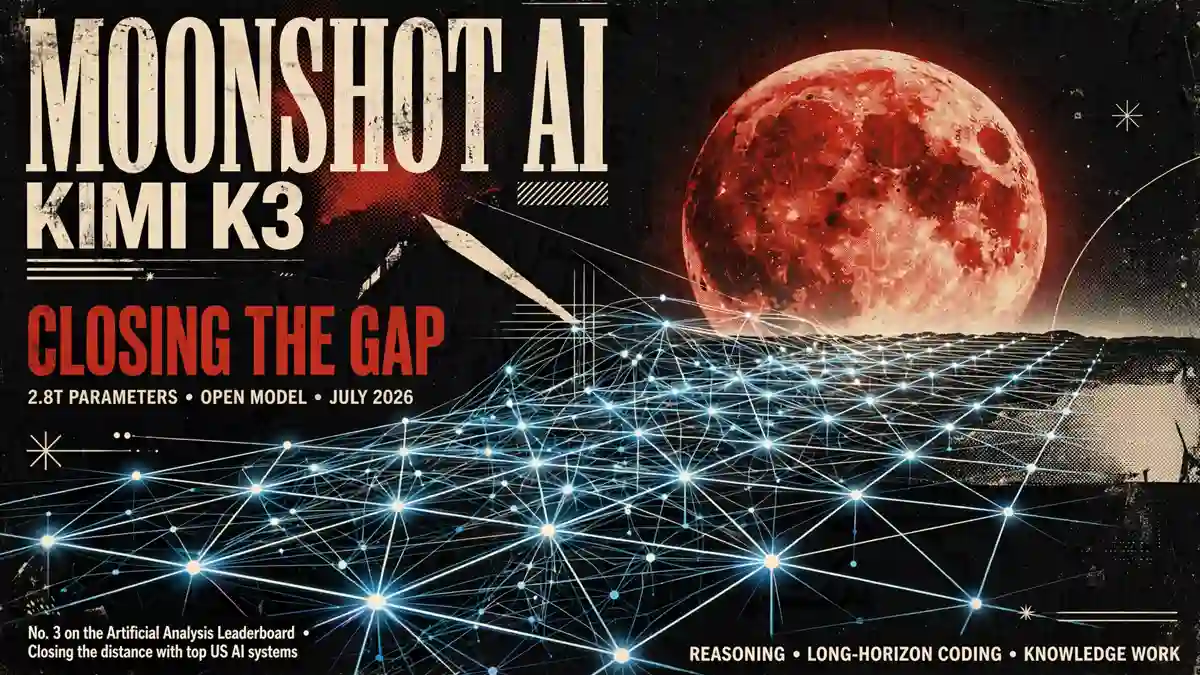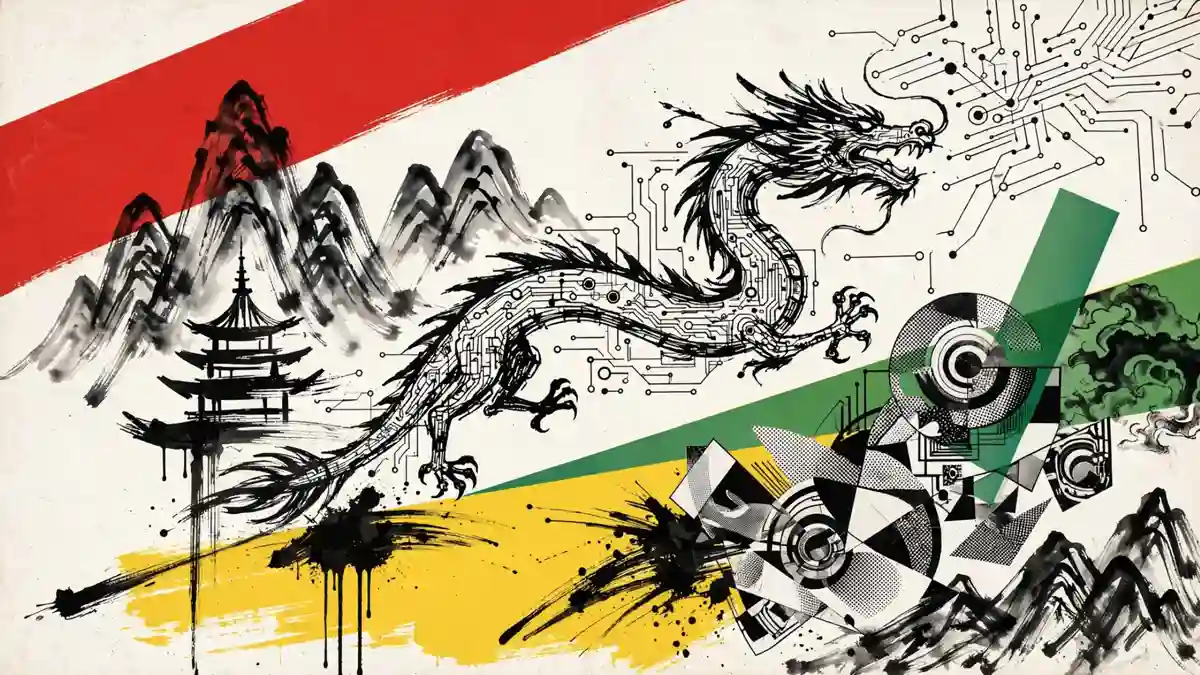
China's AI ecosystem combines big tech incumbents, lean unicorn startups, domestic chipmakers, and state-directed infrastructure into a single unified drive, one with no direct equivalent anywhere in the world.
China's AI is not one story. It is an ecosystem, the national infrastructure of artificial intelligence research, development, deployment, and governance in the People's Republic of China, built over four decades and accelerating into 2026 faster than most Western observers anticipated.
AI Made in China
China's artificial intelligence sector is one of the fastest-growing and most strategically coordinated in the world.
Backed by state policy, massive corporate investment, and a data pool of 1.4 billion users, the country is developing large language models, domestic AI chips, and national compute infrastructure simultaneously, a breadth of coverage no single private company could attempt alone.
From Alibaba's Qwen3 to Baidu's ERNIE, ByteDance's Doubao, and Huawei's Ascend chip stack, Chinese companies are competing directly with American firms like OpenAI, Google, and Anthropic across every layer of the AI stack.
Some Western analysts describe unease over China's AI as a form of AI Angst, reflecting both technological admiration and deep concern about its societal and geopolitical impact. It is a productive unease. Because China's AI is not just about building smarter machines.
China's AI is about redefining power, through data, chips, algorithms, and a state, society integration that the West isstructurally unlikely to replicate.
12 Key Facts About China's AI in 2026
National Strategy: The 2017 Next Generation AI Development Plan set the goal of global AI leadership by 2030. The 2024 AI+ Initiative operationalises this for manufacturing, agriculture, and urban governance.
Government Support: AI is the top state priority in the 14th Five-Year Plan (2021–2025). Support mechanisms include subsidies, computing power vouchers for startups, and state-backed funding for semiconductor development.
Large Language Models: Alibaba (Qwen3-Max, trillion-parameter), Baidu (ERNIE 4.0 Turbo), Tencent (Hunyuan), ByteDance (Doubao), and Zhipu AI (GLM-4/5) now field competitive frontier models.
The Efficiency Revolution: DeepSeek's 2025 training cost breakthrough, producing frontier-level results at a fraction of Western costs, proved algorithmic efficiency can substitute for raw compute. Read the full analysis →
Domestic AI Chips: China is building an alternative GPU ecosystem: Huawei Ascend 910B/C, Cambricon MLU370, Enflame T20, MetaX C500, Iluvatar CoreX, and Horizon Robotics Journey 6.
National Compute Grid: A $295 billion state plan funds 250+ interconnected AI data centres, operated by China Mobile and China Telecom, forming a "sovereign compute" backbone insulated from foreign hardware.
AI in Daily Life: Applications span e-commerce (Taobao, Douyin), healthcare (medical imaging, rural triage), education (real-time AI tutors), finance (instant credit scoring), and smart city management.
Open Source as Strategy: China has surpassed the US in the release of publicly available open-weight AI models, using openness as a tool of global influence, the inverse of US closed-model dominance.
Regulation and Ideology: All models must uphold "Core Socialist Values," pass CAC security reviews, and filter 31 categories of politically sensitive content. Users require real-name registration.
Export Controls: US restrictions on Nvidia A100/H100/H800 chips have pushed China toward domestic alternatives and algorithmic workarounds, inadvertently catalysing domestic innovation.
Global South Expansion: China exports AI infrastructure, surveillance, smart city, and cloud systems, to developing nations in Africa, Southeast Asia, and Latin America, mirroring the Huawei 5G playbook.
Performance Parity: The Stanford 2026 AI Index confirms the performance gap between US and Chinese frontier models has "effectively closed," with the two nations trading benchmark leadership multiple times per year.
A 2025 policy requires 50% of chips in state data centres to come from domestic vendors, rising to 80% under the 2026 sovereign compute mandate. This guaranteed domestic market is the lifeline that allows Chinese chip firms to survive before achieving world-class yields.
China's AI: The Corporate Landscape
The Chinese AI market is structured in two distinct tiers: the state-designated "National AI Champions" and a newer generation of agile unicorn startups.
The National AI Team
The Ministry of Science and Technology designated specific companies to lead specialised AI sectors, ensuring concentrated resources rather than fragmented competition:
| Company | Designated Sector | Key Product (2026) |
|---|---|---|
| Baidu | Autonomous Vehicles | Apollo platform; ERNIE 4.0 Turbo LLM |
| Alibaba | Smart City / Cloud | Qwen3-Max (trillion-parameter); City Brain |
| Tencent | Medical Intelligence | Hunyuan multimodal model; AI diagnostics |
| iFlytek | Voice Recognition | SparkDesk LLM; multilingual voice systems |
| SenseTime | Intelligent Vision | SenseNova 5.0; large-scale facial recognition |
| Huawei | Software & Hardware | Ascend 910B/C chips; PanGu 4.0 model |
| ByteDance | Content & Consumer AI | Doubao LLM; Seedream image generation |
The Emerging Unicorn Layer
A second tier of younger companies, the "Six AI Tigers", emerged from the "War of a Hundred Models" between 2021 and 2024, all reaching unicorn status before 2026. For the deep analysis of their strategic role and what they mean for global AI competition, see our companion piece: The USA–China AI Coin Flip →
China's AI: Timeline (1956–2026)
The history of Chinese AI spans seven decades, from early government-funded research programs to the trillion-parameter LLMs competing head-to-head with OpenAI.
| Year | Milestone |
|---|---|
| 1956 | Chinese scientists at the national "Science and Technology Conference" reference automation and machine learning concepts, inspired by parallel developments in the USSR and West. |
| 1979 | China holds its first national AI conference; the Chinese Association for Artificial Intelligence (CAAI) is founded two years later. |
| 1980s | Universities develop expert systems and machine translation. Early AI research led primarily by scientists educated abroad, translated Western textbooks are the primary knowledge source. |
| 1999 | The 863 Program expands to fund speech recognition, natural language processing, and robotics research at a national scale. |
| 2006 | AI is formally listed as a strategic emerging technology in China's 2006–2020 National Science and Technology Plan. |
| 2012 | SenseTime and Megvii are founded, pioneering computer vision and facial recognition. China's consumer data advantage begins to compound. |
| 2015 | "Made in China 2025" plan identifies AI as a priority industry for technological self-reliance and global competitiveness. |
| 2016 | AlphaGo defeats Lee Sedol. The CCP cites the match as proof that AI is the defining "dual-use" frontier for economic and military power. Urgency accelerates. |
| 2017 | China releases the landmark Next Generation AI Development Plan, the strategic blueprint for global AI leadership by 2030. Military-Civil Fusion Development Commission established. |
| 2018 | Baidu introduces ERNIE, its large-scale NLP pretraining model. The LLM era in China begins. |
| 2019 | Beijing publishes "AI Governance Principles" emphasising safety, fairness, and "AI for good", the first iteration of the regulatory framework. |
| 2020 | AI deployed at scale for COVID-19 contact tracing, fever detection, and medical diagnostics, the largest real-world AI public health deployment in history. |
| 2021 | China passes the Data Security Law (DSL) and Personal Information Protection Law (PIPL). Zhipu AI and Baichuan AI emerge as LLM-focused startups. |
| 2022 | Mandatory algorithm disclosure to the CAC takes effect. Over 30 Chinese cities announce plans for intelligent computing centres. |
| 2023 | CAC Interim Measures for Generative AI services require alignment with "Core Socialist Values" and security review before public release. DeepSeek is founded as a High-Flyer hedge fund spinoff. |
| 2024 | AI+ Initiative launched by Premier Li Qiang. General AI Education Guide mandates AI literacy from Grade 1 to Grade 12. Qwen3-Max and Hunyuan multimodal models released. |
| 2025 Q1 | DeepSeek releases R1, a frontier reasoning model trained for a fraction of US costs. The release triggers a $600 billion single-day drop in Nvidia's market value and is declared China's "Sputnik Moment." |
| 2025 Q3 | China connects regional computing hubs into a national AI grid. Beijing mandates minimum 8 AI class hours per year in primary and middle schools, effective September 2025. |
| 2026 Q1 | Stanford AI Index confirms US-China performance gap "effectively closed." Leading US model holds only a 2.7% benchmark lead. Zhipu AI becomes the first LLM firm to go public globally, HKSE listing. |
| 2026 Q2 | China announces $295 billion (2 trillion yuan) five-year compute buildout. 80% domestic chip mandate for state data centres takes effect. CAC opens the Algorithm Registration Centre in Beijing. |
| 2026 Q3 | Zhipu AI Launches GLM-5.2: Merely months after unveiling the baseline GLM-5 architecture in February and a speed-optimized GLM-5.1 in April, Beijing-based Zhipu AI shocks the international dev community by shipping GLM-5.2 under an unrestricted, MIT open-weight license. |
China's push into AI reflects a century of strategic anxiety turned into industrial policy, the drive to never again miss a foundational technology revolution.
Why Zhipu AI’s Newest Model Is a Massive Leap for Open-Source Intelligence
A striking example of China's rapidly advancing AI ecosystem is GLM-5.2, an open-weight large language model launched by Beijing-based startup Zhipu AI.
Positioned as a direct challenge to premium, closed-source Western frontier models like OpenAI's GPT-5.5 and Anthropic's Claude Opus 4.8, GLM-5.2 represents a massive leap forward in long-context reasoning and autonomous agentic workflows.
Its breakthrough "IndexShare" architecture radically slashes per-token computational costs by sharing structural shortcuts across its sparse attention layers, proving that Chinese AI labs are not just matching Silicon Valley's raw intelligence benchmarks, but are actively out-engineering them when it comes to open-source access and hardware efficiency.
A Generation of Models
The clearest sign of Chinese AI progress is the maturity of its large language model generation. This is no longer a catching-up exercise. By 2026, Chinese models are competitive across every benchmark that matters.
Alibaba's Qwen3-Max, unveiled in late 2025, is the flagship. With over one trillion parameters and a hybrid "thinking/non-thinking" architecture that allows users to trade reasoning depth for speed, it is designed for enterprise deployment across translation, financial analysis, and code generation. Qwen runs on Alibaba Cloud's tiered subscription infrastructure, giving it immediate monetisation that pure-play AI labs lack.
Baidu's ERNIE 4.0 Turbo integrates multimodal capabilities, text, image, and voice, and powers the Ernie Bot consumer product that competes directly with ChatGPT in the Chinese market. Baidu's Apollo autonomous vehicle platform uses ERNIE-derived reasoning for real-world decision-making, closing the loop between foundation model research and physical deployment.
ByteDance's Doubao has quietly become the most-used AI assistant in China by monthly active users, a function of ByteDance's unmatched distribution through Douyin and its content recommendation infrastructure. Doubao is also the source of Seedream, ByteDance's image generation model competing with Midjourney and DALL·E.
The open-source dimension matters strategically. China now releases more publicly available AI models than the United States. By distributing high-quality open-weight models globally, Chinese labs establish technical standards, build developer ecosystems, and accrue geopolitical influence, at zero marginal cost per download.
The Domestic Chip Ecosystem
Chips remain China's most structurally significant bottleneck, and its most consequential innovation challenge.
Despite billions in subsidies, domestic processors still trail Nvidia's top line in raw efficiency. Advanced-node fabrication continues to depend on Dutch ASML lithography machines, Japanese chemical suppliers, and US design software, all subject to expanding export restrictions.
But the picture is shifting faster than Western analysts expected.
Huawei's Ascend 910B and 910C are no longer merely symbolic. They are increasingly viable for specific training tasks and are now the mandatory choice for state-directed compute projects. Smaller domestic firms are developing domain-specific inference chips, cheaper, more efficient for deployment than training, that fill gaps where Nvidia's products were never the right fit anyway.
The strategic logic is clear: by mandating that state data centres purchase local chips, Beijing has guaranteed a domestic market that allows Chinese semiconductor companies to survive, iterate, and improve, even before achieving world-class performance. Forced demand creates forced learning.
| Chip | Maker | Primary Use | 2026 Status |
|---|---|---|---|
| Ascend 910B/C | Huawei | LLM training & inference | Mandatory in state data centres |
| MLU370 | Cambricon | Cloud AI inference | Deployed by China Telecom |
| T20 | Enflame | LLM training on clusters | Used in "intelligent computing centres" |
| C500 | MetaX | Data centre AI workloads | Growing deployment in Tier-2 cities |
| CoreX | Iluvatar | Inference-optimised | Competitive on cost-per-token |
| Journey 6 | Horizon Robotics | Autonomous vehicle edge AI | Deployed in Baidu Apollo vehicles |
Everyday Applications: AI Embedded in Chinese Society
AI in China is not confined to research labs or government press releases. It is woven into the texture of daily life at a scale and integration depth that has no equivalent in the West.
E-commerce: Taobao and Tmall now use generative AI to draft product descriptions, power customer service chatbots, and generate live-stream scripts for merchants. ByteDance's Douyin integrates AI into recommendation loops that adapt to user behaviour in near-real time, the most sophisticated content delivery system ever built.
Healthcare: Urban hospitals deploy AI imaging tools for diagnostic radiology, flagging tumours, measuring bone density, screening for diabetic retinopathy, often faster than senior clinicians. Rural clinics use AI triage systems to prioritise patients and provide basic medical guidance where trained staff are scarce.
Education: Adaptive AI tutoring platforms adjust lesson difficulty in real time, creating personalised learning maps for each student. Under the 2025 General AI Education Guide, Beijing requires a minimum of eight AI class hours per year at primary and middle school level, building AI literacy from the ground up as a national security priority.
Finance: AI-powered credit scoring underpins Ant Group's digital lending infrastructure. Real-time fraud detection processes billions of Alipay and WeChat Pay transactions daily. Quantitative AI funds, including High-Flyer, the hedge fund that spawned DeepSeek, use ML for market prediction at a scale Western quant firms are only beginning to match.
Smart Cities: Over 500 Chinese cities have deployed some form of AI-managed infrastructure. Traffic-signal AI reduces congestion in Beijing and Shenzhen. Energy grid optimisation cuts industrial power waste. Sanitation AI schedules collection routes dynamically by neighbourhood density.
Surveillance: SenseTime and Megvii supply facial recognition infrastructure to public security agencies across China. In Xinjiang, AI-powered surveillance systems, capable of ethnic profiling, have drawn sustained international condemnation and triggered US sanctions on both companies.
The Politics of Control
No account of Chinese AI can ignore the political context. In China, technology and governance do not exist in separate domains. They are designed to reinforce each other.
All major AI platforms are required to filter outputs for ideological compliance. Large language models must align with "Core Socialist Values" and refuse to generate content on topics deemed politically sensitive, Tiananmen Square, Taiwan independence, Xinjiang detention camps, at a 95% success rate mandated by CAC regulations.
For international critics, these restrictions compromise scientific openness and limit the global credibility of Chinese AI research. For officials and the CCP, they are non-negotiable prerequisites for any model interacting with the Chinese public.
As one Beijing-based researcher described it: "We cannot separate technology from governance. They grow together." That sentence captures the entire Chinese AI philosophy. It is not a bug. It is the architecture.
This balance, rapid innovation within hard ideological constraints, defines China's AI trajectory. It ensures that AI serves state priorities. It also creates an inbuilt ceiling on certain forms of open-ended research and international scientific collaboration.
The Global Ripple: Exporting the AI Ecosystem
China is not only building AI for domestic use. It is exporting its AI architecture to the world.
In Washington, analysts warn that cost-efficient open-weight models from DeepSeek undermine the strategic logic of semiconductor export controls, if efficiency compensates for hardware restrictions, the controls achieve less than intended.
In Brussels, regulators debate whether European firms should integrate Chinese AI platforms at all, given persistent concerns about data sovereignty and the reach of China's National Security Law.
Meanwhile, China is exporting AI infrastructure, not chips, but systems, to developing nations across Africa, Southeast Asia, and Latin America. Smart city platforms, cloud services, and surveillance infrastructure are flowing through the same channels that Huawei used to spread 5G networks. Countries that adopt these systems enter Chinese-led technological ecosystems, with the data residency, standards compliance, and dependency that entails.
This is how AI becomes geopolitics. Not through grand confrontations, but through infrastructure contracts, data agreements, and the quiet lock-in of technical standards.
Conclusion: The World Cannot Imagine AI Without China
China's AI drive is both a technical contest and a political initiative, and the two dimensions are inseparable.
It demonstrates how a state can direct resources, regulate content, mobilise private capital, and embed technology into education and society toward a singular strategic aim. It also reveals the risks inherent in that model: hardware bottlenecks that export controls keep alive, ideological constraints that cap certain forms of reasoning, and international mistrust that limits the global adoption of Chinese AI platforms.
Whether China's approach yields global dominance by 2030 or produces a self-contained parallel ecosystem, formidable and sovereign, but separate, remains the defining question of the next decade of AI development.
But one thing is no longer in question: the world cannot understand artificial intelligence, its economics, its politics, its applications, its risks, without placing China at the centre of the story.
After the AI Hype
What happens when the bubble meets reality? The data centers, the electricity bills, and the question no one in Silicon Valley wants to answer.
x402: Internet-Native Payments
The open standard reshaping how AI agents and humans transact. Why it matters for the sovereign compute era.
Demystify AI
From LLMs to MoE, from sovereign compute to Constitutional AI, your essential guide to the vocabulary of the AI era.
China's AI: Frequently Asked Questions
China's AI strategy is anchored in the 2017 Next Generation AI Development Plan, which set the goal of global AI leadership by 2030. The 2024 AI+ Initiative operationalises this across manufacturing, agriculture, healthcare, and urban governance. By 2026, Beijing has committed $295 billion (2 trillion yuan) in state-directed infrastructure over five years, with an 80% domestic chip mandate ensuring technological sovereignty. The strategy operates across five layers simultaneously: policy direction, corporate designation, infrastructure buildout, education pipeline, and regulatory control.
The National AI Team, Alibaba (Qwen3-Max, trillion-parameter LLM), Baidu (ERNIE 4.0 Turbo, Apollo autonomous vehicles), Tencent (Hunyuan multimodal), ByteDance (Doubao, Seedream), and Huawei (Ascend chips, PanGu 4.0), forms the institutional backbone. A newer tier of unicorn startups, known as the Six AI Tigers (Zhipu AI, Moonshot AI, MiniMax, Baichuan AI, 01.AI, StepFun), compete at the frontier model level. DeepSeek, a hedge-fund spinoff, disrupted cost assumptions for the entire industry in January 2025.
China's most advanced models include: Qwen3-Max by Alibaba (trillion-parameter, hybrid thinking architecture, enterprise-grade); DeepSeek-V3 and R1 (efficiency-first, frontier reasoning at minimal training cost); ERNIE 4.0 Turbo by Baidu (multimodal, integrated with Apollo AV platform); Hunyuan by Tencent (multimodal, optimised for Chinese-language tasks); Doubao by ByteDance (highest Chinese MAU of any AI assistant); and the GLM-4/5 series by Zhipu AI (the first LLM firm to go public globally, HKSE 2026).
Domestic chips are the linchpin of China's AI sovereignty strategy. Following US export controls on Nvidia A100 and H100 GPUs, China accelerated development of alternatives: Huawei Ascend 910B/C, Cambricon MLU370, Enflame T20, MetaX C500, Iluvatar CoreX, and Horizon Robotics Journey 6. A 2025 policy mandates 50% domestic chip sourcing in state data centres, rising to 80% under the 2026 buildout plan. By guaranteeing a domestic market, Beijing ensures chip firms can iterate toward world-class performance even while lagging Nvidia's current top line in raw efficiency.
China is executing a $295 billion (2 trillion yuan) five-year National Integrated Computing Network — over 250 interconnected AI data centres managed by state telecoms China Mobile and China Telecom. Regional intelligent computing centres offer subsidised "computing power vouchers" to startups and universities. The network runs primarily on domestically produced chips, with facilities now established in over 30 cities. The design prioritises high-speed interconnects between regional clusters, enabling the seamless transfer of compute between civil governance and military-civil fusion applications.
AI is embedded across Chinese society at a depth unmatched elsewhere. E-commerce: Taobao, Tmall, and Douyin use generative AI for product descriptions, customer service, and hyper-personalised content feeds. Healthcare: AI imaging diagnoses radiology cases in urban hospitals; rural triage AI operates where trained staff are scarce. Education: Adaptive AI tutors adjust lesson difficulty in real time; the state mandates AI literacy from Grade 1. Finance: AI credit scoring and fraud detection process billions of digital payment transactions daily. Smart cities: Traffic, energy grids, and sanitation scheduling are AI-managed in over 500 Chinese cities.
China's AI regulation is administered primarily by the Cyberspace Administration of China (CAC), with additional oversight from the State Administration for Market Regulation (SAMR). Models must uphold "Core Socialist Values," pass a security review before public release, and comply with the Personal Information Protection Law (PIPL) and Data Security Law (DSL). Since 2023, generative AI must filter 31 categories of unsafe content and refuse politically sensitive prompts — including those about the 1989 Tiananmen Square protests — at a 95% success rate. Users require real-name registration. Algorithm disclosure to the CAC has been mandatory since 2022.
China's AI advances have reshaped global competition on multiple fronts. Efficient open-weight models from DeepSeek undermine the strategic rationale of US chip export controls — if algorithmic efficiency compensates for hardware restrictions, the controls achieve less than intended. China exports AI infrastructure — smart city platforms, surveillance systems, cloud services — to developing nations across Africa, Southeast Asia, and Latin America, mirroring the Huawei 5G playbook. The Stanford 2026 AI Index confirms the performance gap between US and Chinese frontier models has "effectively closed," with the two nations trading benchmark leadership multiple times per year.
Four structural challenges constrain China's AI trajectory. Hardware bottlenecks: domestic chips still trail Nvidia's top line in raw efficiency; advanced-node fabrication depends on foreign equipment subject to expanding export controls. Ideological constraints: mandatory content filtering and "thought token forcing" in models like Qwen create capability ceilings in sensitive domains, limiting open-ended scientific inquiry. International mistrust: data sovereignty concerns and National Security Law reach limit adoption of Chinese AI platforms in Europe and the US. Talent restrictions: international travel restrictions on key AI researchers at firms like DeepSeek risk slowing the cross-pollination of ideas that drives breakthrough research.
China's State Council aims for global AI preeminence by 2030, with a "mature new-generation AI theory and technology system" that makes China the world's primary AI innovation centre. Three-stage milestones: parity with global leaders by 2020 (achieved); AI as the "main driving force" of industrial transformation by 2025 (on track per 2026 assessments); complete global preeminence in theory, technology, and application by 2030. The CCP frames this goal as the definitive answer to the "Century of Humiliation", China's historical experience of missing the first two industrial revolutions. Missing a third is not an option the Party is willing to contemplate.
Jans Bock-Schroeder
Publisher & Founder — AI Angst
Coming from the world of art, photography, and the luxury market, Jans launched AI Angst in 2025 to explore the cultural, ethical, and psychological impacts of artificial intelligence. His work bridges creative vision with critical technology analysis, offering clarity in an era of rapid technological change.
Sources and Citations
This article draws on the following primary sources, updated for the June 2026 revision:
-
Stanford HAI — "Artificial Intelligence Index Report 2026"
Primary source for US-China performance gap, benchmark leadership data, and talent pipeline statistics.
https://aiindex.stanford.edu/report/ -
China State Council: "New Generation AI Development Plan" (2017, Document No. 35)
Foundational policy establishing China's 2030 preeminence goal and three-stage roadmap.
https://www.gov.cn/zhengce/content/2017-07/20/content_5211996.htm -
Cyberspace Administration of China (CAC): "Interim Measures for Generative AI Services" (2023)
Primary regulatory source for Core Socialist Values mandate, 31-category censorship framework, and real-name registration requirements.
http://www.cac.gov.cn/2023-07/13/c_1690898327029107.htm -
DeepSeek: "DeepSeek-V3 Technical Report" (2025)
Primary source for training cost, MoE/MLA architecture, and 3FS file system details.
https://arxiv.org/abs/2412.19437 -
Wikipedia: "Artificial Intelligence in China"
Secondary verification for corporate timeline, 863 Program history, and regulatory chronology.
https://en.wikipedia.org/wiki/Artificial_intelligence_in_China -
China-AI: Multi-chapter intelligence briefing (2025/2026)
AI Angst editorial research archive. Covers the Six AI Tigers, sovereign compute strategy, military-civil fusion doctrine, and regulatory regime in depth.
Internal research briefing, AI Angst editorial archives.
Originally published September 26, 2025. Last verified and updated: June 29, 2026. All external links open in a new tab.