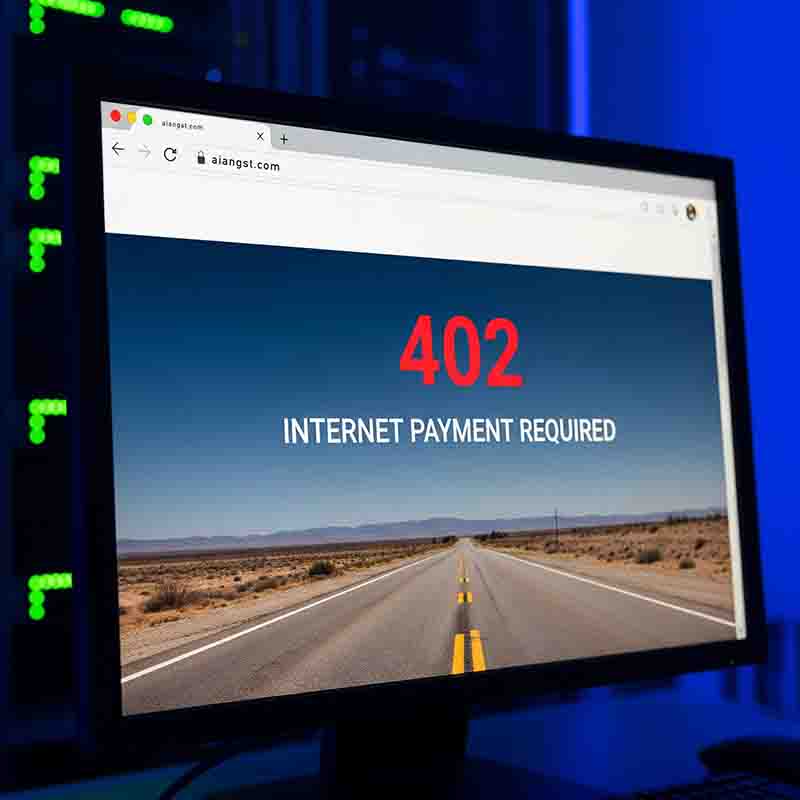
The Open Standard That Turns HTTP 402 Into Real Payments
x402 is an open HTTP-based payment protocol that repurposes the HTTP 402 (Payment Required) status to enable in-protocol, blockchain-based, pay-per-use transactions (commonly stablecoin payments). Clients receive payment instructions in a 402 response and submit cryptographically signed payment authorizations for on-chain or facilitator-verified settlement before resource access.
x402 Internet Payments
A Long-Dormant Web Code, HTTP 402, Finds New Life as a Standard for Online Payments.
It allows websites, APIs, and AI agents to request payments directly through standard web infrastructure.
Instead of requiring accounts, subscriptions, or manual billing, a client can send a cryptographically signed payment to access services instantly.
x402 makes payments work like information on the web: fast, direct, and universal.
Coinbase leads protocol development and provides facilitators that simplify settlement.
Google has extended its Agentic Payments Protocol with x402, allowing AI agents to pay each other directly with stablecoins.
Vercel supports x402 via its AI SDK, making it easy for front-end developers to embed payments into AI-powered applications.
x402 represents a shift from platform-first payments (Stripe, Visa, PayPal) to a protocol-first standard baked into the web.
As adoption grows, x402 could transform the internet from a network of information into a network of value.
Just as HTTPS became the default for secure browsing, x402 could become the default for internet payments.
x402 is an open payment protocol that uses the long-reserved HTTP 402 status code, “Payment Required.” It lets websites, APIs, and AI agents request payments directly through standard web infrastructure.
12 important facts to know about x402
x402 Revives the HTTP 402 Status Code: The protocol activates the long-unused HTTP 402 “Payment Required” status code, originally reserved in the 1990s but never implemented.
It Is an Open Standard, Not a Proprietary Product: Unlike Stripe or PayPal, x402 is protocol-first, designed to function as part of the web’s infrastructure rather than a closed platform.
Payments Double as Authentication: With x402, payment itself grants access. Users, AI agents, or IoT devices don’t need accounts, API keys, or passwords—settlement is proof of authorization.
Stablecoins Power the System: x402 uses stablecoins like USDC for predictable, dollar-pegged pricing, avoiding volatility common in other cryptocurrencies.
Built for Micropayments: Transaction fees are fractions of a cent, making per-article content, per-query APIs, and per-second video streaming** economically viable.
Optimized for Machine-to-Machine Payments: AI agents and IoT devices can transact **autonomously, buying compute, storage, or data without human involvement.
ERC-3009 Enables Gasless Transactions: The protocol supports ERC-3009, which allows clients to sign off-chain payment approvals without holding gas tokens, simplifying integration.
Settlement Is Fast and Final: Payments confirm in as little as 200 milliseconds on networks like Base, with no chargebacks because settlement happens on-chain.
Coinbase Is a Leading Facilitator: The Coinbase Developer Platform provides developer tools and fee-free settlement on Base, helping drive early adoption of x402.
Google and Vercel Are Early Adopters: Google’s Agentic Payments Protocol (AP2) integrates x402 for AI agents, while Vercel’s AI SDK supports it with one-line middleware integration.
It Supports Pay-Per-Use Business Models: x402 unlocks **new revenue models: pay-per-article, pay-per-inference, pay-per-minute cloud compute, or autonomous IoT payments.
Security and Centralization Remain Open Questions: While x402 is open, reliance on facilitators like Coinbase raises centralization debates. AI financial autonomy also creates risks if wallets are compromised.
As AI and IoT systems demand more autonomy, the absence of a native payment layer becomes harder to ignore.
x402 Timeline
Year
Milestone
1991
Early drafts of the HTTP protocol reserved 402 “Payment Required”, but it was never formally implemented.
1999
The 402 code remained in official documentation as “reserved for future use,” leaving the door open for a native payment system.
2010s
Researchers and developers explored web micropayments, but high transaction fees on credit cards and PayPal made them impractical.
2018
A new Ethereum token (ERC-3009) standard enabled gasless, signed payments, laying the foundation for protocols like x402.
2020
Stablecoins like USDC became widely used for fast, low-cost payments, creating a viable currency layer for internet-native transactions.
2022
Developers began experimenting with using HTTP 402 as a trigger for blockchain-based payments, reviving its original purpose.
2023
Coinbase introduced developer tools and facilitators for x402, making it easy to integrate stablecoin payments into apps and APIs.
2023
Vercel embedded x402 into its AI SDK, allowing developers to monetize AI services with one line of code.
2024
Google integrated x402 into AP2, enabling AI agents to transact with stablecoins programmatically. Early use cases emerged: pay-per-article news, per-query AI model inference, and IoT payments.
2025
x402 is increasingly viewed as the native payment layer of the internet, comparable to how HTTPS standardized online security.
x402: Micropayments Made Simple
x402 might have remained a niche experiment if not for major backers. Coinbase launched its Developer Platform, providing facilitators that verify and settle x402 transactions on the Base blockchain.
Reviving HTTP 402 for Modern Payments
For decades, web browsers have carried a hidden instruction that never quite worked as intended: the HTTP 402 status code, labeled “Payment Required.”
Now, with the rise of artificial intelligence and blockchain technology, that forgotten marker is being revived as the foundation of a new protocol called x402, an attempt to make payments as native to the internet as hyperlinks.
How x402 Simplifies Internet-Native Transactions
The idea is deceptively simple.
Instead of asking users to create accounts, store credit cards, or juggle subscriptions, websites can return a 402 message when payment is needed.
A client, whether a person with a digital wallet or an autonomous AI agent, responds by sending a blockchain-based transfer, in stablecoins like USDC.
If verified, access is granted instantly.
For developers, the implementation is strikingly light: a single line of middleware code can convert an API or service into a pay-per-use business.
Major Players Driving x402 Adoption
Backers of x402 describe it not as another app but as an internet standard, akin to HTTPS, designed to run beneath the surface of everyday interactions.
Coinbase has led development, and Google has integrated the protocol into its Agentic Payments Protocol, a framework for allowing AI agents to transact.
Vercel, a major provider of developer tools, has embedded x402 into its software kit for artificial intelligence applications.
Together, these alliances have lent the project early legitimacy in a crowded payments field.
Solving the Micropayments Problem
The motivations are practical.
Legacy systems impose high fixed fees that make small transactions uneconomical.
Micropayments, fractions of a cent for a data request, a few pennies for an article, or modest sums for cloud computing, have long been proposed as a way to unlock new business models but remained out of reach.
By using low-cost blockchain networks, x402 makes such exchanges possible at scale.
For merchants, settlement arrives in seconds, without the risk of chargebacks.
For users, payment itself doubles as authentication: if the transfer clears, access is granted.
Security and Centralization Concerns Around x402
Critics, however, see risks in giving autonomous software financial autonomy.
If an AI agent can authorize payments, what happens if it malfunctions or is compromised?
Supporters have suggested safeguards such as limited-scope wallets or multi-signature approvals to reduce exposure.
Another tension lies in reliance on facilitators like Coinbase’s developer platform, which simplifies integration but reintroduces elements of centralization to an otherwise open standard.
Unlocking New Business Models Through Internet-Native Payments
Beyond the technical debates, the economic implications are broad.
News outlets could charge per article rather than forcing annual subscriptions.
Developers of niche AI models might monetize every inference.
IoT devices—from smart meters to self-driving cars—could transact without human intervention, paying for electricity, bandwidth, or repairs automatically.
Advocates describe it as a shift from a web of information to a web of value.
The Future of x402 and Internet-Native Payments
The path forward is uncertain. Widespread adoption requires not only technical readiness but also trust, regulatory clarity, and a critical mass of participants.
Yet if x402 succeeds, it would fulfill an ambition planted in the earliest days of the web: to make paying for digital goods as seamless as reading them.
From Dormant Code to Web of Value
By resurrecting an unused line of internet code, x402 points to a future in which machines and humans alike can exchange money as easily as data, quietly, instantly, and perhaps, one day, universally.
402 Redefines Pay-Per-Use Pricing
x402 turns the internet into a network of value, not just information.
By reviving the HTTP 402 status code, it enables instant, low-cost, and machine-native payments that legacy systems cannot match.
From micropayments for journalism to AI-driven commerce and IoT transactions, x402 offers a blueprint for how money can move as freely as data.
The timing could not be more relevant. The rise of artificial intelligence and Internet of Things (IoT) devices creates a new demand: machines paying machines.
The story of x402 is, in a sense, the story of the internet itself: a reminder that sometimes, the seeds of the future are planted long before the world is ready to see them grow.
Next Generation AI
Inside China’s AI Revolution
Shifting the Conversation
AI Angst vs. AI Realism
Demystify AI
Access Your Essential Glossary!
x402: FAQ
x402 is an open standard for internet-native payments. It revives the unused HTTP 402 “Payment Required” status code to enable direct, blockchain-based payments between users, AI agents, and machines.
When a client requests a resource, the server can respond with an HTTP 402 status. This message includes the payment amount and wallet details. The client then sends a stablecoin payment, and once verified, the resource is unlocked instantly.
The HTTP 402 status code was reserved in the 1990s for payments but was never implemented. x402 now gives it practical use as a native payment signal for the web.
Unlike Stripe or PayPal, x402 is a protocol-first solution, not a proprietary platform. It supports micropayments, stablecoins, and machine-to-machine transactions, which traditional systems cannot handle efficiently.
x402 typically uses stablecoins like USDC. These are dollar-pegged tokens that provide price stability, making them suitable for predictable, low-cost payments.
Coinbase, Google, and Vercel are among the early backers. Coinbase offers settlement through its developer platform, Google integrates x402 into its Agentic Payments Protocol, and Vercel includes x402 in its AI SDK.
Micropayments at fractions of a cent, Instant settlement in under 200 ms, Machine-to-machine payments for AI and IoT, Reduced fraud and no chargebacks, Seamless developer integration.
Examples include: Pay-per-article journalism, AI model inference billed per query, IoT devices paying for connectivity, Cloud services priced per GPU-minute or storage unit.
Yes. Risks include AI agents overspending, compromised wallets, and **centralization concerns** if too many developers depend on Coinbase as the main facilitator.
If widely adopted, x402 could become the native payment layer of the internet, just as HTTPS became the default for secure communication. It may redefine online business models, enabling a true network of value.