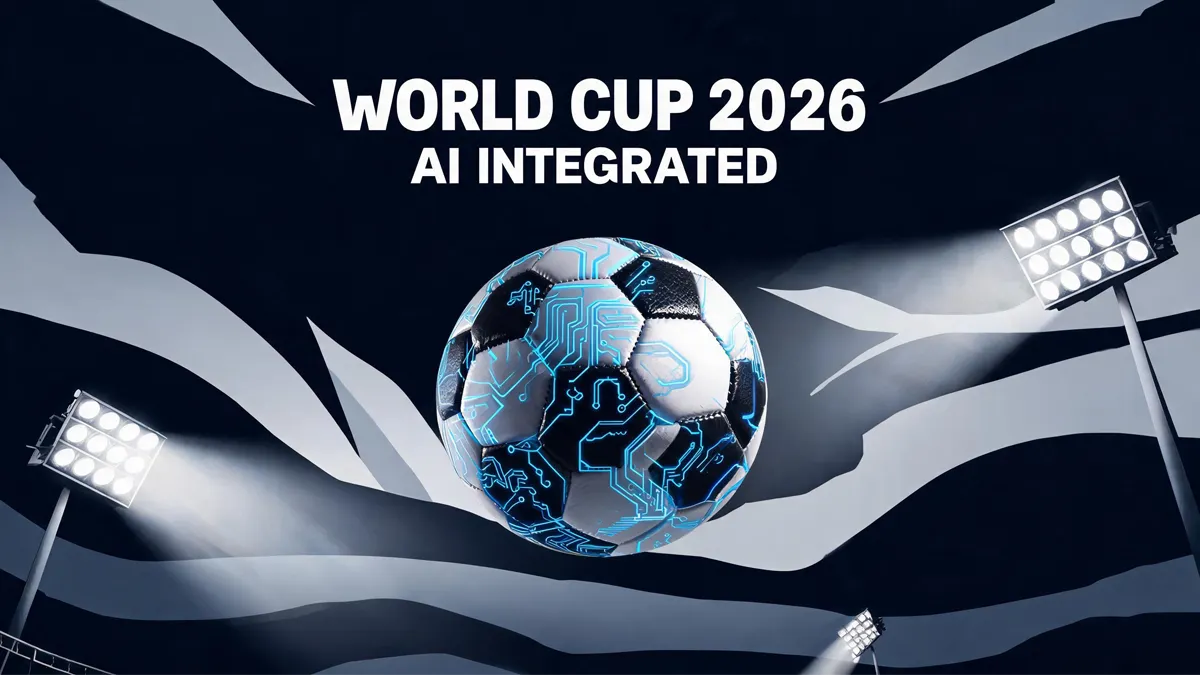
Something happened at the last World Cup that most fans completely missed. Not a goal. Not a red card. Not even a controversial penalty.
It happened inside a server room 500 metres from the pitch. In 0.8 seconds. And by the time the crowd reacted, the decision had already been made, not by a human, but by a machine tracking 29 points on every player's body at 50 frames per second.
The 2026 FIFA World Cup, hosted across the United States, Canada, and Mexico, is the most AI-saturated sporting event in human history. And most fans watching are completely unaware of how deep the machine runs.
The Machine That Already Knows the Goal Is Coming
Let me tell you about xG. Expected Goals. The number your club's analyst has been citing for five years that you've been half-ignoring.
At the 2026 World Cup, xG is no longer a post-match statistic. It is a real-time engine running continuously, processing player positions, body angles, defensive pressure, goalkeeper stance, and 40 additional variables, to calculate the probability of a goal before the shot is even taken.
When your striker receives the ball in the box with his back to goal, two defenders tight, goalkeeper off his line, the AI system already knows: this is a 0.12 xG moment. An 88% chance he doesn't score. Before he turns. Before he shoots.
That same engine feeds the coaching staff on the touchline. Which means the substitution decision your manager makes in the 67th minute is informed by an AI probability model, not just his gut.
Germany used AI tactical data as early as the 2014 World Cup, the SAP Match Insights system tracked 10,000 position data points per player per match. Three months later they beat Brazil 7–1. No one called it cheating. Everyone called it preparation. The only difference now is that every team has access to the same tools.
The Ball Knows Things You Don't
Inside the 2026 World Cup match ball, the Adidas Duetto, sits a sensor you can't see and most commentators won't mention.
An Inertial Measurement Unit. Transmitting position, spin, speed, and trajectory data 500 times per second to a central AI processing system.
This is what powers semi-automated offside technology (SAOT). The moment a player plays the ball, the exact millisecond of contact is logged by the ball sensor. The AI cross-references that timestamp against the 3D skeletal reconstruction of every player on the pitch, and generates the offside line in under one second.
In Qatar 2022, SAOT reduced the average offside review from 70 seconds of human analysis to under 25 seconds of AI-assisted confirmation.
In 2026, the system is faster. More precise. And, for the first time, being trialled for foul detection. Not to replace referees. To flag potential missed incidents to the VAR room before the play continues too far downfield.
29 anatomical points tracked per player, per frame, shoulders, hips, knees, elbows, feet
50 frames per second, faster than the human eye can process continuous movement
500 data transmissions per second from inside the ball itself
12 dedicated tracking cameras installed at every 2026 World Cup venue
Sub-1-second decision time, from kick to confirmed offside line
The human brain, for reference, requires approximately 13 milliseconds to process a visual image. But applying judgment, tracking 22 players simultaneously, and calculating millimetre-level positional relationships? That takes seconds. The AI doesn't need seconds.
Before the Player Feels It: AI Sees the Injury Coming
This is the part that still surprises people when I explain it.
The injury prediction systems used by the top national teams at this World Cup are not reacting to injuries. They are predicting them. Days in advance.
GPS vests worn in training transmit acceleration, deceleration, and sprint distance data to AI models that track subtle changes in movement patterns, the micro-asymmetries that precede a hamstring tear, the slight favoring of one leg that signals a hip flexor under strain.
Combined with heart rate variability from wearables and sleep data from smart mattresses in the team hotel, these systems build a daily injury risk score for every squad member. Studies published in the British Journal of Sports Medicine show AI injury prediction models accurately forecast hamstring injury risk 7 days in advance with greater than 80% accuracy in elite football populations.
France, Germany, and Brazil all use versions of these systems. When a coach makes a "precautionary" substitution in the 55th minute of a tight match, this is often why. The machine flagged it. The coach trusted it.
The Real Reveal: AI Isn't Watching the Match. It's Playing It.
Here is what I want you to take away from this.
The 2026 FIFA World Cup isn't just the biggest football tournament ever staged. It's the tournament where the boundary between human sport and machine intelligence became genuinely blurry for the first time.
Not because AI is making the final decisions. It isn't. Referees still blow the whistle. Managers still make the call. Strikers still decide in a fraction of a second whether to shoot or pass.
But the information environment surrounding every one of those human decisions has been colonised by machine intelligence. The coach knows the xG. The VAR official has the skeleton tracking. The fitness team has the injury score. The scout prepared for this opponent using AI pattern recognition across 300 hours of footage, compressed into a 12-page pre-match report.
Football is still played by humans. But the game around the game, the decisions, the preparations, the officiating infrastructure, the broadcast data, is now AI-first.
| Year | AI Milestone in World Cup Football |
|---|---|
| 2014 | Germany deploys SAP Match Insights: 10,000 tracking data points per player per match. Result: 7–1 vs Brazil. |
| 2018 | VAR (Video Assistant Referee) introduced at the FIFA World Cup Russia. First AI-assisted officiating at a World Cup. |
| 2021 | FIFA announces semi-automated offside technology (SAOT) development programme. Connected Ball sensor unveiled. |
| 2022 | SAOT deployed for the first time at Qatar World Cup. Connected Ball transmits 500 data points/second. Offside review time cut from 70s to 25s. |
| 2023 | England FA announces Google DeepMind partnership for AI coaching research. Second Spectrum acquired by Genius Sports for $200M. |
| 2024 | Euro 2024 becomes first major continental tournament with real-time AI xG broadcast overlays on public feeds. AI injury prediction tools reach 80%+ accuracy in peer-reviewed studies. |
| 2025 | FIFA confirms SAOT upgrade for 2026 including 29-point body tracking. AI foul-detection flagging system trialled in FIFA Club World Cup. |
| 2026 | FIFA World Cup USA/Canada/Mexico. Most AI-integrated World Cup in history. 48 teams, 104 matches, and machine intelligence running beneath every decision. |
The Hype Behind the Headlines
Not all AI is this useful. Understand the full picture — the AI hype cycle, the bubble, and where genuine value actually lives.
The DeepSeek Sputnik Moment
The $6 million model that rewrote the rules. The same efficiency breakthrough reshaping AI in sport.
Demystify AI
xG, IMU, SAOT, MoE — decode every acronym in the AI world with our essential glossary.
World Cup AI: FAQ
At the 2026 FIFA World Cup, AI is deployed across multiple systems simultaneously. FIFA's semi-automated offside technology (SAOT) tracks 29 body points per player at 50 frames per second to call offsides in under 1 second. Real-time player tracking generates xG (expected goals) and xT (expected threat) data mid-match for coaching teams. Sports analytics firms like Second Spectrum and STAT Edge provide AI coaching tools to national teams. FIFA's Connected Ball technology embeds an IMU sensor transmitting positional data 500 times per second. AI injury prediction models monitor player biometrics daily throughout the tournament.
Semi-automated offside technology (SAOT) is FIFA's AI-powered offside detection system, first deployed at the 2022 Qatar World Cup and upgraded for 2026. Twelve dedicated tracking cameras feed data to an AI model that reconstructs the 3D position of up to 29 anatomical landmarks per player, including shoulders, hips, knees, and feet, at 50 frames per second. When a ball is played, the system generates an offside line accurate to millimetres in under one second, delivering a visual 3D animation to VAR officials. In Qatar 2022 it reduced offside review time from an average of 70 seconds to under 25 seconds.
FIFA's Connected Ball, the Adidas Duetto in 2026, contains an Inertial Measurement Unit (IMU) sensor inside the ball's bladder. This sensor transmits precise positional and motion data 500 times per second to a central AI processing system. This gives officials and analysts exact data on the moment of the kick (critical for offside timing), ball speed, ball spin, and trajectory, eliminating the frame-rate estimation errors that plagued earlier VAR decisions.
xG (Expected Goals) is a machine learning metric that calculates the probability of a shot resulting in a goal, based on historical data from hundreds of thousands of similar attempts. Input variables include: distance from goal, angle to goal, shot type (header, weak foot, dominant foot), pressure from defenders, assist type, and goalkeeper positioning. An xG of 0.75 means that situation historically produces a goal 75% of the time. Modern AI xG models at the 2026 World Cup are dynamic, recalculating in real time as players move, rather than waiting for the shot to be taken.
Yes, with meaningful accuracy. AI injury prediction systems used by elite national teams analyse GPS tracking data, accelerometer readings, heart rate variability, sleep data from wearables, and historical injury profiles to calculate each player's daily injury risk score. Studies in the British Journal of Sports Medicine show AI models can predict hamstring injury risk up to 7 days in advance with greater than 80% accuracy in elite football populations. Teams including Germany, France, and Brazil use these systems to inform substitution decisions before physical symptoms are apparent to the player or medical staff.
National teams use AI-powered video analysis platforms, including Hudl Sportscode, Wyscout, and proprietary systems from Second Spectrum, to process hours of opponent footage in minutes. AI identifies pattern frequencies: how often a team presses high in the 70th minute, which full-back has a lower defensive success rate under aerial balls, what passing combinations precede their most dangerous attacks. Tactical AI tools generate pre-match reports with heatmaps, pressing triggers, and set-piece vulnerabilities in detail that would take a human analyst team days to compile.
No, AI is assisting, not replacing. SAOT generates offside calls automatically, but a human VAR official reviews and confirms before the decision is communicated to the on-field referee. Foul, penalty, and card decisions remain entirely human judgments. FIFA's position is that AI handles objective positional data while human officials retain authority over subjective interpretations of intent, foul severity, and sportsmanship. The 2026 World Cup is the first to trial AI-assisted foul detection, flagging potential missed incidents to the VAR team, but final decisions remain with officials.
Germany has been a pioneer since 2014 with SAP Match Insights, the data infrastructure credited with informing their 7–1 victory over Brazil. France uses Second Spectrum's player tracking for live tactical analysis. England partnered with Google DeepMind for an AI coaching research programme announced in 2023. Brazil developed a proprietary AI scouting platform following poor tournament results. The US national team, as co-host, has integrated AI-powered player development tools across its entire youth pathway since 2022.
Multiple AI models attempt World Cup predictions. Goldman Sachs has published Monte Carlo tournament simulations since 2014. Google DeepMind and Opta build probabilistic models based on Elo ratings, squad depth, form, and draw brackets. The honest answer: AI calculates win probabilities from historical patterns, but football's variance, a single red card, an unexpected injury, a 30-yard deflection, is too large for reliable prediction. Brazil, France, England, and the host United States are consistently rated as high-probability winners in 2026 simulation models, but anyone who tells you they know who will lift the trophy is selling something.
Three concerns dominate the debate. First, data privacy: players' biometric data — heart rate, GPS positioning, sleep patterns, injury history, is collected and processed without always-clear consent frameworks. Second, algorithmic bias: AI scouting models trained on historical data may systematically undervalue players from leagues with lower data coverage, particularly African and South American leagues, reinforcing existing structural inequalities in the transfer market. Third, the human game: if AI tactical systems converge on optimal strategies, football risks becoming homogeneous, a solved game where surprise and individual genius are engineered out of existence.

Jans Bock-Schroeder
Publisher & Founder of AI Angst
Coming from the world of art, photography, and the luxury market, Jans launched AI Angst in 2025 to explore the cultural, ethical, and psychological impacts of artificial intelligence. His work bridges creative vision with critical technology analysis, offering clarity in an era of rapid technological change.
Sources and Citations
This article is based on the following primary sources, research papers, and technical documentation:
-
FIFA, "Semi-Automated Offside Technology: Technical Overview" (2022)
Primary technical documentation for SAOT body-tracking specifications, Connected Ball IMU data, and VAR integration at Qatar 2022.
https://www.fifa.com/technical/football-technology -
British Journal of Sports Medicine, "Machine learning for injury prediction in elite football" (2023)
Peer-reviewed study showing AI injury prediction models achieve 80%+ accuracy for hamstring injury 7 days in advance in elite populations.
https://bjsm.bmj.com/ -
Google DeepMind, "Tackling climate change and sport with AI" and England FA Partnership Announcement (2023)
Source for the England FA and Google DeepMind coaching research collaboration.
https://deepmind.google/discover/blog/ -
Second Spectrum, Technical Platform Documentation
Source for real-time player tracking, xG calculation methodology, and AI coaching tools deployed in professional football.
https://www.secondspectrum.com/ -
Goldman Sachs, "Quantifying Football" World Cup AI Simulation Reports (2014–2022)
Source for Monte Carlo simulation methodology in World Cup outcome prediction modelling.
https://www.goldmansachs.com/insights/ -
Wikipedia, "Video assistant referee" / "Expected goals"
Secondary verification for VAR history, xG methodology, and tournament deployment timeline.
https://en.wikipedia.org/wiki/Video_assistant_referee
Last verified: July 17, 2026. All links open in a new tab.