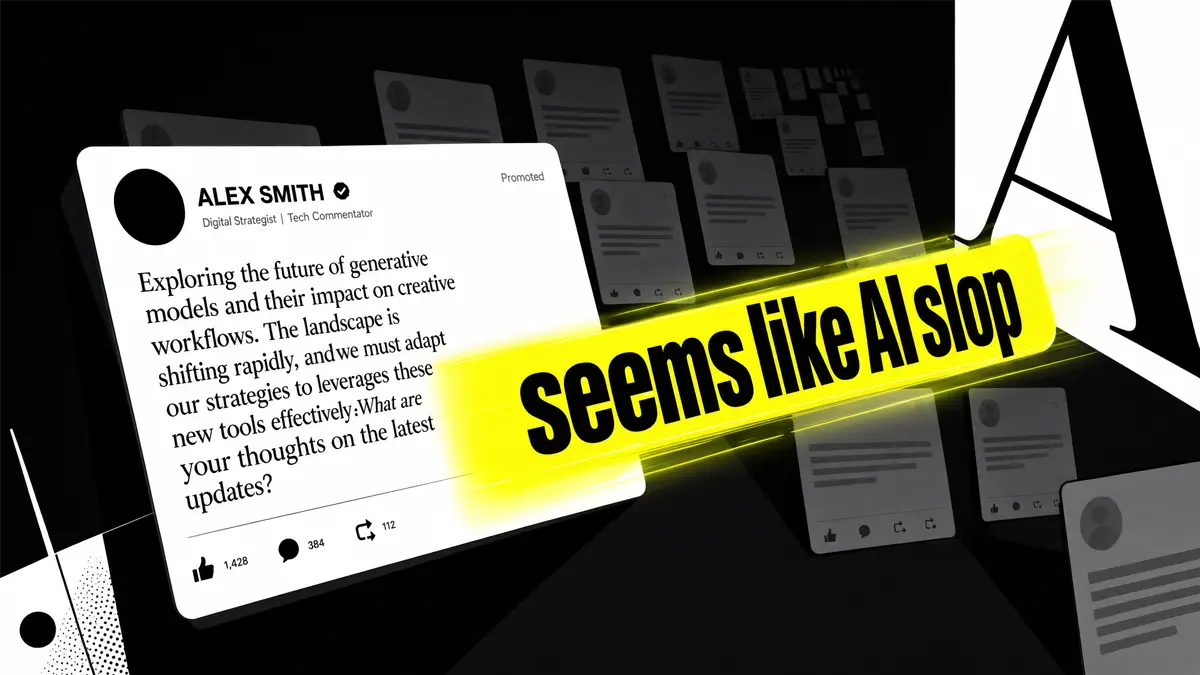
If you've scrolled LinkedIn any time in the last two years, you already know the genre: a "vulnerable" story about a layoff, a rejected candidate, or a chance encounter, followed by an oddly tidy business lesson, followed by a call to "let's connect."
LinkedIn has finally given you a button for that. It just says the quiet part out loud.
What the Button Actually Does
Starting July 30, 2026, LinkedIn rolled out a new reporting option labeled, plainly, "Seems like AI slop." It sits in the three-dot menu on any post.
Clicking it immediately hides the post from that user's own feed
The report also feeds LinkedIn's internal detection models, according to chief product officer Hari Srinivasan
Flagged posts are expected to see reduced algorithmic reach, though LinkedIn hasn't published the exact mechanics of how that's calculated
LinkedIn will also privately flag to some posters, in their own dashboard, when their content is coming across as AI-heavy, intended to nudge people using AI to polish their own writing rather than punish them outright
"AI slop is a top priority for all of us," Srinivasan wrote in a post announcing the change. "We really care about this."
Why LinkedIn Is Doing This Now
The timing lines up with some fairly stark numbers. AI detection firm Pangram estimated that over 40% of long-form posts and roughly 30% of short-form posts on LinkedIn are fully AI-generated, based on scans run through its browser extension. Separate reporting citing Pangram's data suggested LinkedIn accounts for the large majority of all AI-generated content the firm sees scanned across major social platforms.
"Slop is hard to define and the definition changes; this lets us tune our models and make better feeds," Srinivasan said, acknowledging upfront that reliably detecting AI writing at scale is a moving target, not a solved problem.
The company also says its automated systems already block a large volume of coordinated, automated posting and comment attempts every day, framing the new button as a complement to that existing detection work rather than a replacement for it.
| What's Changing | Detail |
|---|---|
| New "Seems like AI slop" button | Hides flagged posts from the reporter's feed; feeds detection models |
| "Enhance your post" AI writing tool | Being retired |
| New proofreading tool | Corrects grammar/clarity without rewriting voice or substance |
| Private "inauthentic" flag | Nudges some posters privately if their content reads as heavily AI-written |
| Other changes announced same day | Expanded profile/page verification; option to block comments from company pages |
The Part That's Making People Raise an Eyebrow
Here's the wrinkle several outlets flagged right away: LinkedIn spent the last couple of years actively encouraging people to use its own built-in AI writing assistant to draft and polish their posts. That's the exact tool critics blame, in part, for training a whole genre of users to sound the same.
The company appears to have noticed the contradiction itself. Alongside the new reporting button, LinkedIn is retiring its "Enhance your post" feature entirely and replacing it with a more conservative proofreading tool, one explicitly designed to correct grammar and clarity rather than rewrite someone's voice or substance.
This isn't happening in isolation, either. A week earlier, newsletter platform Substack rolled out its own AI-content detector, built with Pangram, with CEO Chris Best saying bluntly that Substack was adding it "because we're sick of slop and we don't want Substack to turn into LinkedIn." Elsewhere, link-aggregator Digg shut down its Reddit-competitor product entirely in March, citing an inability to get a handle on bot-driven content, and infrastructure company Cloudflare has reported that bot traffic across the web now outnumbers human traffic.
Reaction on the ground has been a mix of relief and disbelief. "Genuinely thought it was a joke until I clicked on a few posts," one user wrote after spotting the new button, according to a post captured on Bluesky. Whether the flagging system itself can be misused, to suppress posts a reader simply disagrees with rather than ones that are genuinely low-effort AI output, remains an open question LinkedIn hasn't fully addressed.
LinkedIn AI Slop Button: FAQ
It's a reporting option in the three-dot menu on any LinkedIn post. Clicking it immediately hides the post from that user's own feed and sends a signal into LinkedIn's internal systems, which chief product officer Hari Srinivasan says will help train the company's AI-content detection models and reduce a flagged post's algorithmic reach.
AI detection firm Pangram estimated that over 40% of long-form LinkedIn posts and roughly 30% of short-form posts are fully AI-generated, based on scans through its browser extension. Separate reporting citing Pangram data suggested LinkedIn accounts for roughly 62% of all AI-generated content the firm scans across major social networks.
Until this rollout, LinkedIn had its own "Enhance your post" feature that used AI to help rewrite users' posts, the exact kind of tool critics link to the platform's AI-slop reputation. LinkedIn is now retiring that feature in favor of a more conservative proofreading tool that corrects text without changing a person's voice or substantially rewriting it.
It's not fully clear yet. A flagged post is immediately hidden from the reporting user's own feed, and the feedback feeds LinkedIn's detection models, but LinkedIn hasn't detailed whether a human reviews each report or what threshold of reports triggers broader removal or reduced distribution for a post.
No. Newsletter platform Substack added its own AI-content detector about a week earlier, in partnership with Pangram, with CEO Chris Best explicitly saying he didn't want Substack to "turn into LinkedIn." Link aggregator Digg shut down its Reddit-competitor product in March 2026, citing an inability to control bot-driven content, and Cloudflare has reported that bot traffic now exceeds human traffic across the web generally.
Some users and commentators have raised that concern, since a simple, prominent report button labeled with a loaded term like "slop" could be used to suppress posts a reader simply dislikes or disagrees with, not just genuinely low-effort AI content. LinkedIn has acknowledged that reliably defining and detecting "slop" at scale remains a real technical challenge.

Jans Bock-Schroeder
Publisher & Founder of AI Angst
Coming from the world of art, photography, and the luxury market, Jans launched AI Angst in 2025 to explore the cultural, ethical, and psychological impacts of artificial intelligence. His work bridges creative vision with critical technology analysis, offering clarity in an era of rapid technological change.
Sources and Citations
This article is based on the following sources, published July 30-31, 2026:
-
TechCrunch — "LinkedIn adds a button to report AI-generated 'slop'" (July 30, 2026)
Primary source for the feature rollout, the "Enhance your post" retirement, and related product changes.
https://techcrunch.com/2026/07/30/linkedin-adds-a-button-to-report-ai-generated-slop/ -
404 Media — "LinkedIn Introduces a 'Seems Like AI Slop' Button" (July 30, 2026)
Source for the original discovery of the feature and background on LinkedIn's AI-slop reputation.
https://www.404media.co/linkedin-introduces-a-seems-like-ai-slop-button/ -
Forbes — "LinkedIn Adds New Feature To Flag AI Slop" (July 30, 2026)
Source for Hari Srinivasan's direct quotes and automated-detection figures.
https://www.forbes.com/sites/codyluongo/2026/07/30/linkedin-adds-new-feature-to-flag-ai-slop/ -
Futurism — "LinkedIn Adds Button on Every Post to Report 'Seems Like AI Slop'" (July 30, 2026)
Source for the Chris Best/Substack context and the Bluesky user reaction quote.
https://futurism.com/artificial-intelligence/linkedin-adds-button-report-seems-like-ai-slop -
BigGo Finance — "LinkedIn Adds 'Seems Like AI Slop' Button in Bid to Curb Flood of Low-Quality Posts" (July 30, 2026)
Source for the Pangram percentage figures cited in this article.
https://finance.biggo.com/news/4cdcd336-d8ad-466a-8bfd-5b4fe29cae4c
Published: July 31, 2026. Sources verified at time of publication. All external links open in a new tab. Figures attributed to Pangram reflect that company's own detection methodology and have not been independently audited.