Here's a simple question: what color is the team's uniform in Bend It Like Beckham? If you're not sure, that's fine. Nobody expects you to know that off the top of your head.
A group of researchers asked people exactly that kind of question. Some answered alone. Others had an AI chatbot to consult first, one the researchers had specifically chosen because it usually got the answer wrong.
What happened next wasn't really about movie trivia at all.
The Setup
The study comes from Valerio Capraro of the University of Milano-Bicocca, working with Chiara Marcoccia of École Normale Supérieure and Walter Quattrociocchi of Sapienza University of Rome. Its title says exactly what it found: "AI advice suppresses people's willingness to say 'I don't know,' even when the advice is wrong and accuracy is incentivized."
Participants answered questions about obscure visual details in films, deliberately picked because they'd be unlikely to appear in AI training data
The main experiment used Step 3.5 Flash, a model chosen specifically because it was usually wrong on these questions
That design choice mattered: it ruled out the explanation that people were simply making a sensible choice to trust an accurate tool
Researchers also tested GPT-5.5, Claude Sonnet 4.6, and Gemini 3.5 Flash, which missed some of the same questions but got others right
One group of participants had a financial incentive tied directly to giving the correct answer
The Numbers That Matter
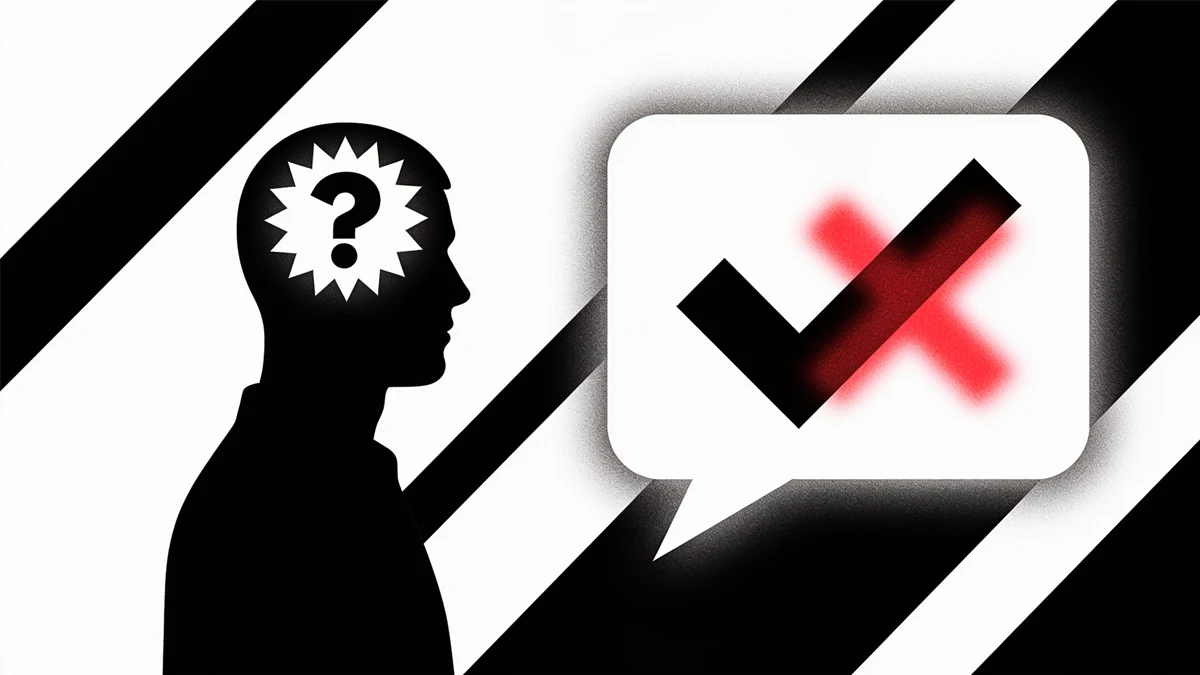
Without AI, 44% of participants correctly said they didn't know the answer. With AI available, that number fell to 3%.
Accuracy moved the same direction. In the no-AI group, 27% of participants got the answer right. With AI in the mix, accuracy fell to 9%, roughly a third of the baseline.
Confidence did the opposite. Participants without AI reported 30% confidence in their answers. Participants with AI reported 76% confidence, more than double, while being far more likely to be wrong.
"People became much worse, the accuracy was only one third, but they were twice as confident," Capraro said.
| Measure | No AI Access | With AI Access | With AI + Pay Incentive |
|---|---|---|---|
| Said "I don't know" (correctly) | 44% | 3% | 8% |
| Gave the correct answer | 27% | 9% | 16% |
| Reported confidence in final answer | 30% | 76% | Not separately reported |
Paying people to get it right helped, but only a little. Willingness to admit ignorance rose from 3% to 8%, and accuracy rose from 9% to 16%. Both numbers stayed well below what people managed entirely on their own.
Why This Isn't Just About Movie Trivia
The researchers were careful to rule out an obvious counterargument: maybe people were just correctly deferring to a smarter tool. That's why they picked a model that was usually wrong, and why some participants who would have answered correctly on their own changed their answer to a wrong one after asking the AI.
"For humans, the capacity to say, 'I don't know,' is very important because it represents the recognition of the limits of our own knowledge," Capraro said. "But now with AI, we can get an easy answer to virtually every question, so we wondered whether this would interfere with human capacity to say, 'I don't know,' to suspend judgment."
The finding echoes a term Wharton researchers coined earlier this year: "cognitive surrender," describing how people accept incorrect AI answers roughly 80% of the time while reporting higher confidence than those working without AI at all. Capraro's study adds a sharper point to that picture. It isn't only that people trust wrong answers once they see them. The mere availability of AI seems to suppress the habit of recognizing what you don't know in the first place.
The "I Don't Know" Study: FAQ
Access to AI advice collapsed participants' willingness to say "I don't know" from 44% to 3%. Accuracy dropped from 27% to 9%. Confidence rose from 30% to 76%, even though people were, on average, three times less accurate.
Valerio Capraro of the University of Milano-Bicocca, Chiara Marcoccia of École Normale Supérieure, and Walter Quattrociocchi of Sapienza University of Rome. Their paper is titled "AI advice suppresses people's willingness to say I don't know, even when the advice is wrong and accuracy is incentivized."
Deliberately obscure visual details from films that AI models typically get wrong, such as the color of the team's uniform in Bend It Like Beckham or the vehicle a character drives in Like a Cat on a Highway. Researchers chose these because they were unlikely to appear in AI training data.
The main experiment used Step 3.5 Flash, chosen specifically because it was usually wrong on these questions, ruling out the possibility that reduced "I don't know" answers simply reflected people sensibly trusting an accurate tool. The researchers also tested GPT-5.5, Claude Sonnet 4.6, and Gemini 3.5 Flash, which missed some of the same questions but got others right.
Only partly. With a monetary incentive for correct answers, willingness to say "I don't know" rose from 3% to 8%, and accuracy rose from 9% to 16%. Both figures remained far below the no-AI baseline of 44% and 27%.
Yes. Wharton researchers coined "cognitive surrender" earlier in 2026 to describe people accepting incorrect AI answers roughly 80% of the time while reporting higher confidence than those working without AI. This study adds a related finding: the mere availability of AI suppresses the habit of recognizing what you don't know, not just the willingness to double-check a wrong answer.
Jans Bock-Schroeder
Publisher & Founder of AI Angst
Coming from the world of art, photography, and the luxury market, Jans launched AI Angst in 2025 to explore the cultural, ethical, and psychological impacts of artificial intelligence. His work bridges creative vision with critical technology analysis, offering clarity in an era of rapid technological change.
Sources and Citations
This article is based on the following sources, published July 19-20, 2026:
-
Capraro, Marcoccia & Quattrociocchi — "AI advice suppresses people's willingness to say I don't know, even when the advice is wrong and accuracy is incentivized" (PsyArXiv preprint, 2026)
The original research paper underlying this article.
https://osf.io/preprints/psyarxiv/5y6m4_v1 -
The Register — "Using AI makes people less likely to admit they don't know something" (July 19, 2026)
Source for study design details and direct quotes from Valerio Capraro.
https://www.theregister.com/ai-and-ml/2026/07/19/using-ai-makes-people-less-likely-to-admit-they-dont-know-something/5274567 -
The Next Web — "AI advice made people three times less accurate but twice as confident, researchers found" (July 19, 2026)
Source for the full statistical breakdown, incentive-condition results, and the "cognitive surrender" comparison.
https://thenextweb.com/news/ai-advice-suppresses-critical-thinking-wrong-answers-study -
Archyde — "AI Advice Suppresses Critical Thinking and Increases Confidence in Wrong Answers" (July 19, 2026)
Additional source corroborating the study's confidence and accuracy figures.
https://www.archyde.com/ai-advice-suppresses-critical-thinking-and-increases-confidence-in-wrong-answers/
Published: July 20, 2026. Sources verified at time of publication. All external links open in a new tab. This study is a preprint and has not yet completed formal peer review.