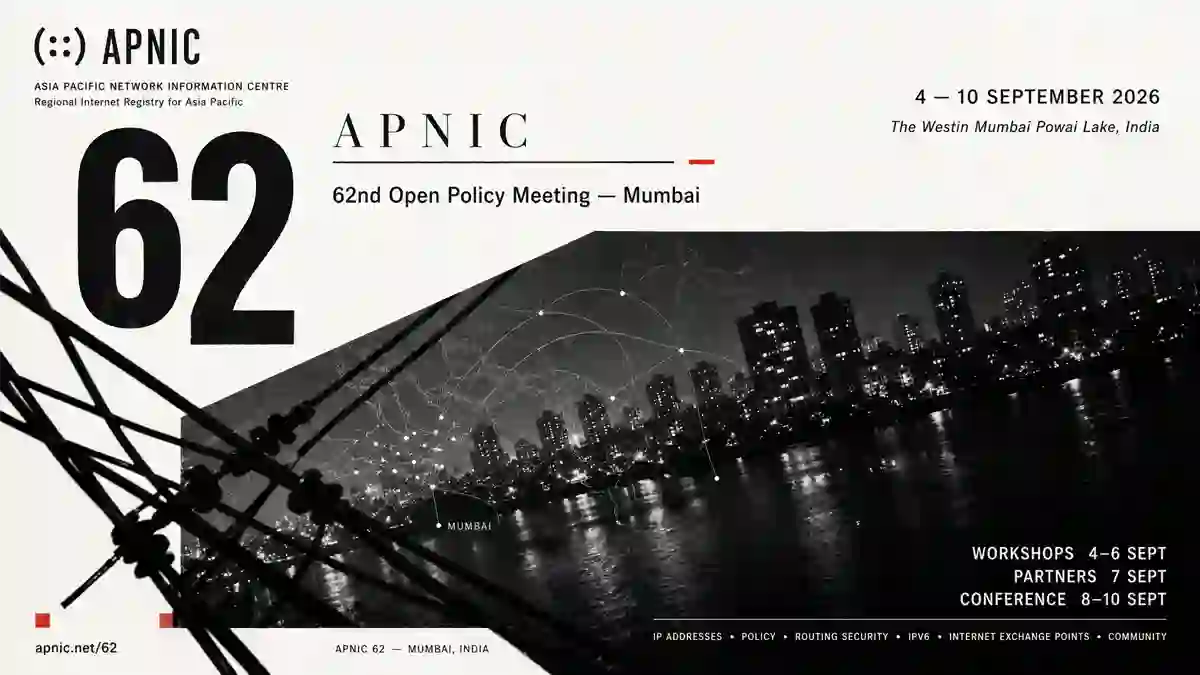

Nobody outside the networking world has heard of APNIC, and that's exactly why it matters. It's one of five regional registries on Earth that hand out the IP addresses every device on the internet needs to exist online, the plumbing beneath every app, stream, and chatbot query you've ever sent.
This week, more than 600 of the people who maintain that plumbing are in Mumbai for APNIC 62, and the conversation dominating the room isn't routing tables or address exhaustion. It's AI, and whether the pipes can actually handle what's about to be poured through them.
What APNIC 62 Actually Is
| Detail | What's Happening |
|---|---|
| Dates | September 4-10, 2026; workshops through September 7, conference sessions September 8-10 |
| Location | The Westin Mumbai Powai Lake, Mumbai, India, the first APNIC conference held in India since 2012 |
| Hosts | National Internet Exchange of India (NIXI) and the Internet Service Providers Association of India (ISPAI), backed by India's Ministry of Electronics and Information Technology |
| Attendance | More than 600 network operators, engineers, policymakers, and industry leaders |
| Opening keynotes | Lightstorm Group's Amajit Gupta on AI-driven network automation; JPCERT/CC's Yukako Uchida on cybersecurity trust and cooperation |
APNIC itself, the Asia Pacific Network Information Centre, is the non-profit registry responsible for allocating IP addresses across the region, one of the quiet technical bodies that has to function correctly for the rest of the internet to work at all.
Why AI Is On The Agenda At An Internet-Plumbing Conference
Organizers have been direct about the reason: AI-powered services, cybersecurity threats, and rapidly growing demand for digital services are putting real pressure on the infrastructure that has to carry all of it. That's not a marketing line, it's the literal framing APNIC and its co-hosts used to describe this year's conference.
AI-driven traffic patterns look different from traditional web traffic, and network operators are having to adapt automation and capacity planning around it
AI is also being pitched as part of the solution, with the opening keynote focused specifically on using AI to automate network operations
Cybersecurity remains tightly linked to the AI conversation, given how much AI-related traffic and AI-enabled attack tooling now moves across the same networks APNIC's members operate
The Rest Of The Agenda Hasn't Gone Anywhere
AI is the headline framing, but APNIC conferences run on a steady diet of infrastructure work that doesn't change just because a new technology shows up:
Technical workshops on routing, switching, and next-generation service provider networking, including a three-day session covering segment routing and streaming telemetry
The Open Policy Meeting of the APNIC Policy SIG, considering seven active proposals on internet number resource policy
A memorandum of understanding between NIXI and APNIC, signed September 8, to accelerate IPv6 adoption and routing security across India's internet infrastructure
That IPv6 push matters on its own terms. The internet has been slowly running out of the older IPv4 addresses for years, and IPv6 adoption is the long-term fix, work that continues regardless of whichever technology trend is dominating the opening keynote in any given year.
Why This Is Worth Paying Attention To
Conferences like APNIC 62 rarely make headlines outside trade press, and that's part of the point. Decisions made in rooms like this one, about address allocation, routing security, and how networks handle a new category of automated traffic, quietly shape whether the internet keeps working reliably as AI use scales up. Nobody's going to see a press release about it when it goes well. They'll notice if it doesn't.
APNIC 62: FAQ
APNIC, the Asia Pacific Network Information Centre, is the not-for-profit organization that allocates IP addresses and related internet number resources across the Asia Pacific region, one of the technical bodies that keeps the internet's addressing system functioning. APNIC 62 is its 62nd conference, running September 4 to 10, 2026 in Mumbai, India, bringing together network operators, engineers, policymakers, and industry leaders for workshops and policy discussions.
Organizers say AI-powered services, alongside cybersecurity threats and growing demand for digital services, are placing new pressure on the underlying internet infrastructure that has to carry and secure that traffic. The opening keynote addressed AI-driven network automation directly, and the conference is examining both how AI can improve network operations and the new technical and policy challenges it creates.
APNIC 62 is hosted by India's National Internet Exchange of India (NIXI) and the Internet Service Providers Association of India (ISPAI), with support from the Ministry of Electronics and Information Technology (MeitY) and the Government of Maharashtra. It's organized by APNIC itself. It's the first time an APNIC conference has been held in India since 2012.
APNIC 62 includes technical workshops on routing and network operations, policy meetings including the Open Policy Meeting of the APNIC Policy SIG considering seven active proposals, and a keynote on cybersecurity trust and cooperation from JPCERT/CC. On September 8, NIXI and APNIC are also signing a memorandum of understanding to accelerate IPv6 adoption and routing security in India.
Indirectly, yes. The policies and technical standards developed at APNIC conferences shape how IP addresses are allocated and how routing security is implemented across the Asia Pacific region, which affects the reliability and security of internet connections for everyone in that region, including the growing share of that traffic that's AI-generated or AI-directed.

Jans Bock-Schroeder
Publisher & Founder of AI Angst
Coming from the world of art, photography, and the luxury market, Jans launched AI Angst in 2025 to explore the cultural, ethical, and psychological impacts of artificial intelligence. His work bridges creative vision with critical technology analysis, offering clarity in an era of rapid technological change.
Sources and Citations
This article is based on the following sources:
-
APNIC 62 Official Conference Site: Home, Program, and Register pages
Primary source for dates, venue, and workshop and conference schedule.
https://conference.apnic.net/62/ -
Odisha Diary: "APNIC 62 Hosted by MeitY's NIXI Brings Global Internet Community Together in Mumbai"
Source for host organizations, keynote speaker details, and the NIXI-APNIC memorandum of understanding.
https://orissadiary.com/apnic-62-hosted-by-meitys-nixi-brings-global-internet-community-together-in-mumbai/ -
IBG News: "APNIC 62: Mumbai Conference Puts AI, Cybersecurity and Internet Resilience in Focus"
Source for attendance figures and comments from MeitY and NIXI officials.
https://ibgnews.com/2026/09/07/apnic-62-mumbai-conference-puts-ai-cybersecurity-and-internet-resilience-in-focus/ -
APNIC Blog: "Register now for APNIC 62 in Mumbai"
Source for workshop details and the technical program submission process.
https://blog.apnic.net/2026/05/27/register-now-for-apnic-62-in-mumbai/ -
ISOC Live: "HYBRID 8 SEP 04:00 UTC – APNIC 62"
Source for the Open Policy Meeting schedule and the seven active policy proposals.
https://isoc.live/21971/
Published: September 7, 2026. Sources verified at time of publication. All external links open in a new tab.