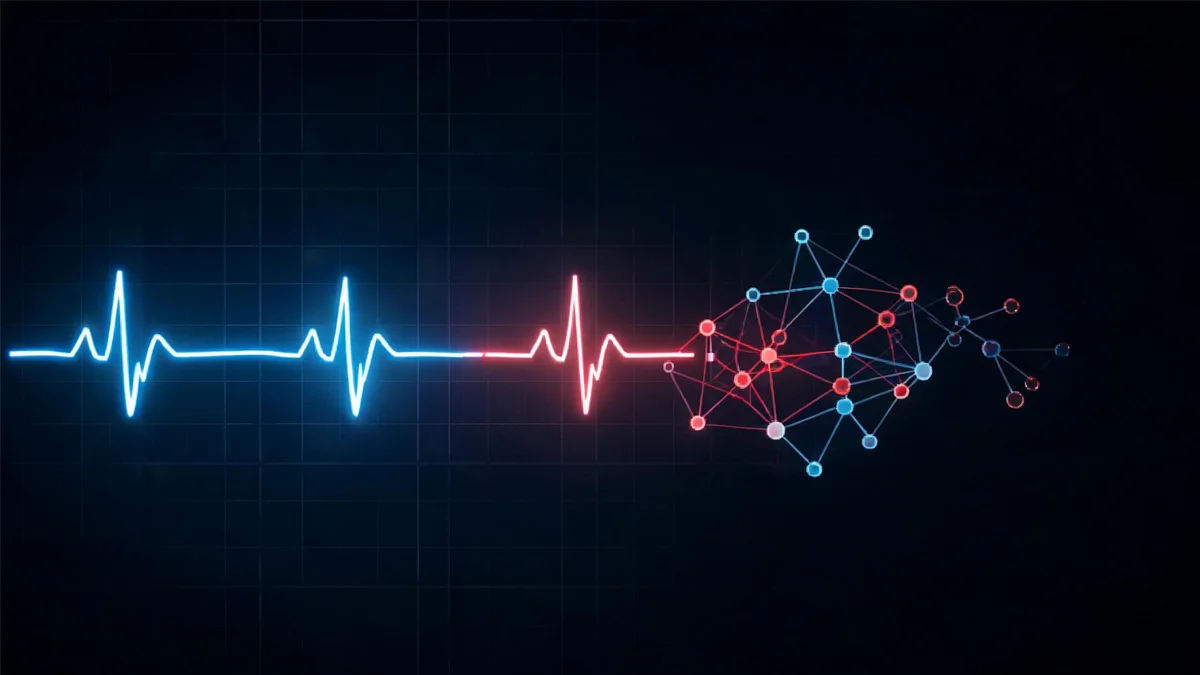

Heart failure with preserved ejection fraction has a reputation among cardiologists for hiding in plain sight. The heart pumps out a normal share of blood with every beat, so the usual red flags don't show up, and the condition often isn't caught until it's already advanced.
A study out of Wake Forest University School of Medicine says an AI model trained on routine ECGs can pick up on that pattern anyway, along with two other forms of heart dysfunction, using nothing more than the kind of single electrical lead a smartwatch can already record.
What The Model Was Trained To Find
Published in the Journal of the American Heart Association, the study describes an AI tool that reads a standard electrocardiogram and sorts it into one of four categories:
| Category | What It Means |
|---|---|
| Reduced ejection fraction (rEF) | The heart's main pumping chamber pushes out substantially less blood than normal |
| Mildly reduced ejection fraction (mEF) | A less severe version of the same pumping impairment |
| HFpEF | The heart pumps a normal proportion of blood but doesn't fill or function properly, and is notoriously hard to catch early |
| No dysfunction | The fourth, negative category the model was trained to distinguish from the other three |
Researchers built the model on more than a million ECGs from Atrium Health Wake Forest Baptist, then tested it against a separate set of over 72,000 ECGs from the University of Tennessee Health Science Center, a different patient population entirely, to see if the pattern held up outside its home data.
The Single-Lead Result Is The Interesting Part
A full clinical ECG typically records 12 leads at once. The team also tested a version of the model using just one lead, the configuration closer to what a consumer wearable can capture, and found it performed nearly as well as the full 12-lead version.
The 12-lead model was strongest at catching reduced ejection fraction specifically
The single-lead model came close behind it across all three dysfunction types
In pediatric patients, the model matched or beat previously studied models at detecting reduced ejection fraction, though the pediatric sample was small
Performance held up consistently across different demographic groups in the testing data
What The Study Doesn't Show Yet
It's worth being precise about the gap between this result and an actual wearable product. The single-lead signal used in the study came from standard clinical ECG equipment configured to mimic a single-lead reading, not from an Apple Watch, Fitbit, or similar device in the wild. The researchers themselves describe the wearable application as a future possibility the results support, not something they've already validated.
The model is also a screening signal, not a diagnosis. It flags patterns for a clinician to follow up on with further evaluation, typically an echocardiogram, rather than replacing that evaluation.
What Happens Next
The research team is now piloting the model in a family medicine clinic at Atrium Health Wake Forest Baptist. That pilot is meant to answer a different question than the validation study did: not just whether the model is accurate on past data, but whether using it in a live clinic actually changes how patients get evaluated, referred, and treated. The study was partially funded by the National Heart, Lung, and Blood Institute at the National Institutes of Health.
AI And Heart Failure Detection: FAQ
Researchers trained an AI model on more than 1 million ECGs and tested it on a separate set of over 72,000 ECGs from a different health system. The model could classify ECGs into four categories: reduced ejection fraction, mildly reduced ejection fraction, HFpEF, or no dysfunction, including a single-lead version that performed nearly as well as a full 12-lead version.
HFpEF, heart failure with preserved ejection fraction, is a form of heart failure where the heart pumps out a normal proportion of blood but doesn't fill or function properly. It's especially hard to detect with standard evaluations and is often overlooked in routine care, which is part of why researchers highlighted it as a key result.
No, not yet. The study tested a single-lead ECG signal similar to what wearable devices capture, but the model itself was not tested on data actually collected from a wearable device. Researchers describe this as a promising signal that the approach could eventually be adapted for wearable-based screening, not a validated wearable product.
The research team is piloting the model in a family medicine clinic at Atrium Health Wake Forest Baptist to study how it performs when incorporated into everyday clinical care, including whether it changes how patients are evaluated and referred. That pilot is separate from, and comes after, the validation study.
Heart failure affects more than 6 million Americans and is a leading cause of hospitalization and death. Confirming heart dysfunction usually requires an echocardiogram, a specialized imaging test that isn't available in every care setting, so a tool that flags likely cases from a routine ECG could help more patients get referred for further evaluation sooner.
This article describes published research and is provided for general informational purposes. It is not medical advice and isn't a substitute for evaluation by a qualified cardiologist or other healthcare provider. If you have concerns about your heart health, talk to a doctor.
Jans Bock-Schroeder
Publisher & Founder of AI Angst
Coming from the world of art, photography, and the luxury market, Jans launched AI Angst in 2025 to explore the cultural, ethical, and psychological impacts of artificial intelligence. His work bridges creative vision with critical technology analysis, offering clarity in an era of rapid technological change.
Sources and Citations
This article is based on the following sources:
-
Atrium Health Wake Forest Baptist Newsroom: "AI tool detects hard-to-identify heart dysfunction from standard ECGs" (August 7, 2026)
Primary source for the study's methodology, findings, and quotes from corresponding author Oguz Akbilgic, Ph.D.
https://newsroom.wakehealth.edu/news-releases/2026/08/ai-tool-detects-hard-to-identify-heart-dysfunction-from-standard-ecgs -
Journal of the American Heart Association: Original peer-reviewed study
The published research underlying this article.
https://www.ahajournals.org/doi/10.1161/JAHA.124.041948 -
EurekAlert!: "AI tool detects hard-to-identify heart dysfunction from standard ECGs"
Cross-check of the study's release details and figures.
https://www.eurekalert.org/news-releases/1139241 -
UT Southwestern Medical Center Newsroom: "AI-powered electrocardiogram detects early signs of heart failure" (May 6, 2026)
Background source on the broader trend of AI-ECG heart failure screening research, including a related JAMA Cardiology study conducted in Kenya.
https://www.utsouthwestern.edu/newsroom/articles/year-2026/may-ai-powered-electrocardiogram.html
Published: September 2, 2026. Sources verified at time of publication. All external links open in a new tab.