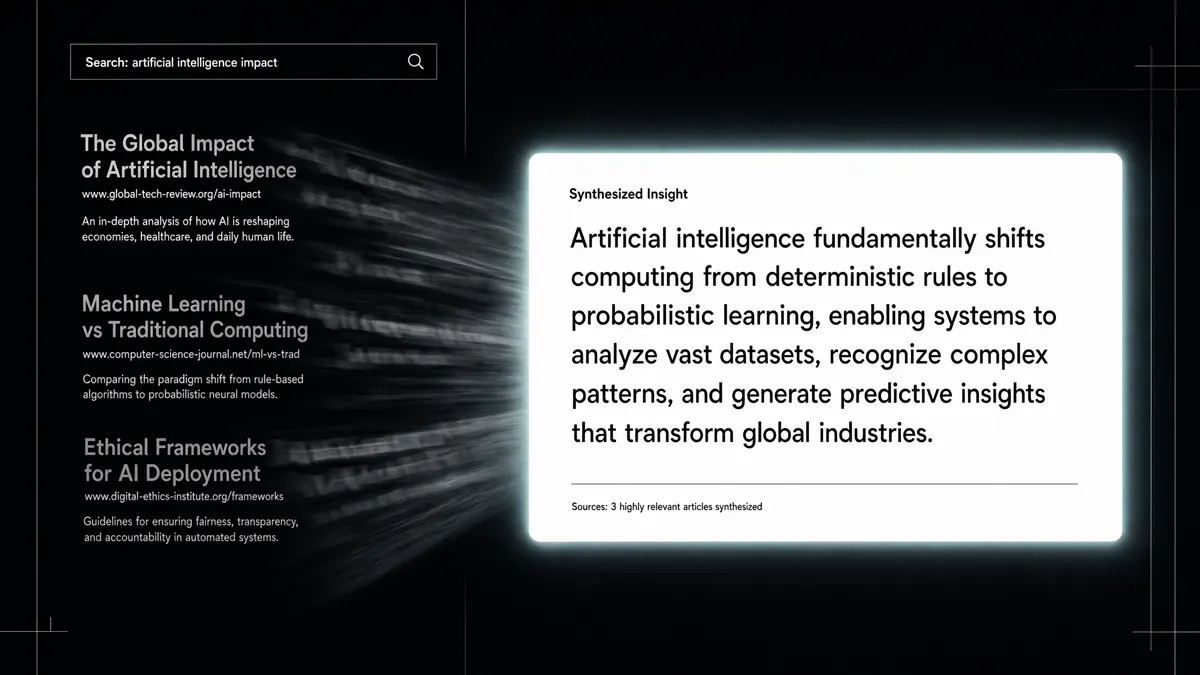

Type a question into Google today, and there's a good chance the answer arrives before you ever have to leave the page. That's not an accident, and it's not a small shift, either.
It's the biggest structural change to how information moves online since search itself replaced the phone book.
The Number That Sums It Up
Search research firm SparkToro, run by longtime search analyst Rand Fishkin, published a 2026 analysis with a blunt headline: "less than one third of Google searches still send a click."
AI Overviews now appear on more than 20% of Google searches, and click-through rates drop by nearly 60% when they show up
Separately, Pew Research tracked almost 69,000 real Google searches from a representative sample of US adults and found people clicked a link inside an AI Overview in only about 1% of cases where one appeared
Google's newer, more conversational AI Mode pushes this further still: in the large majority of AI Mode sessions, users never leave Google's own interface at all
Analyst firm Gartner has projected traditional search engine query volume could fall by roughly 25% by 2026, driven largely by AI chatbots and assistants absorbing queries that used to go to a search box
None of this is theoretical anymore. It's what SparkToro's Amanda Natividad has called the "Zero-Click Web": an emerging norm across search engines, social platforms, and AI tools alike, where the destination increasingly discourages you from leaving it.
Not Every Search Is Losing Clicks Equally
The pain isn't spread evenly, and the dividing line is fairly predictable once you see it: what the searcher was actually trying to do.
Informational queries, "what is," "how does," "best way to," now get resolved directly on the results page at a very high rate, since these are exactly the queries a well-written AI summary can fully answer
Transactional queries, buying something specific, signing up for a service, booking a reservation, still reliably drive people to click through, since an AI summary can't complete the purchase itself
Publishers whose traffic depended heavily on explainer content, how-to guides, and reference material have generally seen the steepest declines, in some cases losing a large share of their organic search traffic within a single year
Stuart Forrest, global director of SEO digital publishing at Bauer Media, put the shift plainly to the BBC: "We're definitely moving into the era of lower clicks and lower referral traffic for publishers."
| Metric | Figure | Source |
|---|---|---|
| Google searches resulting in a click, 2026 | Under 1 in 3 | SparkToro |
| Searches where an AI Overview appears | 20%+ | SparkToro |
| Click-through-rate drop when an AI Overview appears | ~60% | SparkToro |
| Users clicking a link inside an AI Overview | ~1% | Pew Research (tracked real searches) |
| Projected drop in traditional search volume by 2026 | ~25% | Gartner |
| Google AI Mode monthly users | 1 billion+ | Google, I/O 2026 |
Google Is Still the Elephant in the Room
It's worth being precise about scale here, because the "AI is replacing Google" narrative can outrun the data. Independent web-traffic trackers still put Google at somewhere around 90% of global search-engine market share; standalone AI answer engines like ChatGPT Search and Perplexity, while growing fast in absolute terms, remain a much smaller slice of overall query volume by comparison.
What's actually happening is less a changing of the guard and more Google racing to become the AI answer engine itself, folding Gemini-powered summaries directly into the product people already use billions of times a day, rather than ceding that behavior shift to a separate competitor.
The New Metric Nobody Used to Track
If clicks are drying up, what are publishers and brands supposed to optimize for instead? A new discipline has emerged to answer exactly that question: Generative Engine Optimization, or GEO, the practice of structuring content so an AI system is more likely to cite or reference it inside a generated answer, rather than simply ranking it higher in a list of links.
The emerging logic goes something like this: even if a visitor never clicks through, being the source an AI Overview credits by name is still a form of visibility and brand exposure, arguably a more trusted one, since it arrives wrapped in the credibility of the AI's own summary. Whether that exposure can actually replace lost traffic revenue for content businesses that depended on clicks is a separate, unresolved question, and one a lot of publishers are still actively working out in real time.
AI Search: FAQ
It refers to search experiences where an AI system reads multiple sources and generates a direct, synthesized answer, rather than just returning a ranked list of links for the user to click through themselves. This includes Google's AI Overviews and AI Mode, and standalone AI answer engines like ChatGPT Search and Perplexity.
Search research firm SparkToro's 2026 analysis found less than one-third of Google searches now send a visitor to an external website, down from a substantially higher share in prior years, as more queries get resolved directly on the results page itself.
Rarely. Pew Research tracked nearly 69,000 real Google searches from a representative sample of US adults and found users clicked a link within an AI Overview in only about 1% of cases where one appeared, even though the Overview itself often cited outside sources.
No. Informational queries, the "what is," "how does," and "best way to" searches, are resolved on the search page itself far more often than transactional queries like buying a specific product or signing up for a service, which still reliably drive clicks. Publishers whose traffic depended heavily on informational, how-to, or explainer content have generally seen the steepest declines.
Google said at its 2026 I/O developer conference that AI Mode had surpassed 1 billion monthly users, with query volume more than doubling each quarter. Independent research from SparkToro found AI Mode's share of total search transitions was still relatively small as of early 2026, suggesting rapid growth from a modest starting base.
Often shortened to GEO, it's the practice of structuring content so AI systems are more likely to cite or reference it in a generated answer, as opposed to traditional SEO, which optimizes for ranking position in a list of links. It's emerged as publishers and marketers shift some effort toward earning a mention inside an AI answer rather than a click beneath one.

Jans Bock-Schroeder
Publisher & Founder of AI Angst
Coming from the world of art, photography, and the luxury market, Jans launched AI Angst in 2025 to explore the cultural, ethical, and psychological impacts of artificial intelligence. His work bridges creative vision with critical technology analysis, offering clarity in an era of rapid technological change.
Sources and Citations
This article draws on the following sources:
-
SparkToro — "In 2026, Less than One Third of Google Searches Still Send a Click" (June 18, 2026)
Primary source for the core click-through data and the "Zero-Click Web" framing.
https://sparktoro.com/blog/in-2026-less-than-one-third-of-google-searches-still-send-a-click/ -
Search Engine Land — "Google zero-click searches reach 68% in early 2026: Study" (June 9, 2026)
Source for AI Overview appearance rate, CTR decline, and AI Mode transition data.
https://searchengineland.com/google-zero-click-searches-2026-study-479717 -
Search Engine Journal — "Google AI Overviews Impact On Publishers & How To Adapt Into 2026" (October 28, 2025)
Source for the Stuart Forrest/Bauer Media quote and publisher-impact context.
https://www.searchenginejournal.com/impact-of-ai-overviews-how-publishers-need-to-adapt/556843/ -
Pew Research Center — "Google Users Are Less Likely to Click on Links When an AI Summary Appears" (July 22, 2025)
Source for the tracked-search 1% AI Overview click-through figure, based on nearly 69,000 real, monitored Google searches.
https://www.pewresearch.org/
Published: August 3, 2026. Sources verified at time of publication. All external links open in a new tab. AI chatbot "market share" figures vary enormously across industry sources depending on methodology, so this piece relies on more conservative, independently tracked data (SparkToro, Pew, StatCounter) rather than the widest-ranging estimates.