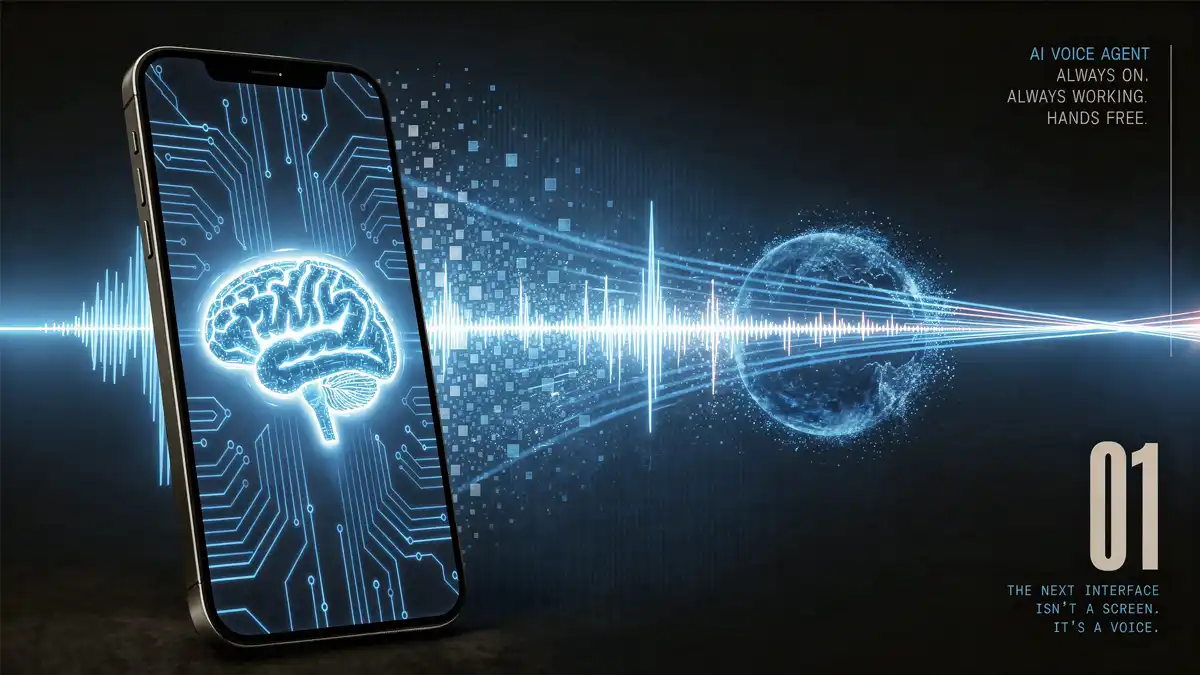
Pick up most phones and you get the same thing: a grid of icons, waiting for you to tap the right one.
Pick up one of three new phones shown in Shanghai this week, and there's no grid at all. Just a button, or a voice, and something that's supposed to already know what you meant.
This isn't the first time someone's tried to build a phone without apps. It's the first time three serious manufacturers have tried it at once.
Three Phones, One Idea
At WAIC 2026 in Shanghai this week, three Chinese companies each showed a phone built around a single AI agent rather than an app grid:
ZTE's Nubia brand showed the NaviX Ultra, running ByteDance's Doubao agent, calling it the world's first agentic AI smartphone. No conventional home screen, no traditional app store; a dedicated orange side button or a voice command calls up the agent, which maps a request to a sequence of actions and carries it out.
StepFun showed the STEPX Neo, running its own operating system built around an in-house agent called Amoo.
Honor, spun off from Huawei, showed the RobotPhone, built on an agent co-developed with Alibaba using its Qwen model, paired with a mechanical gimbal camera that extends and rotates from the body.
Nubia executives demoed real-time photo editing, map creation, and travel planning at the conference, activated with nothing more than a spoken instruction.
"Many so-called AI phones on the market simply stack AI functions on top of an existing system," said Nubia chief Ni Fei. "That actually makes it more cumbersome for users."
Why This Time Might Be Different
Phones and gadgets built entirely around an AI agent aren't new. They just haven't worked yet.
The Humane AI Pin, a $699 clip-on wearable, launched promising to replace the smartphone screen with natural-language interaction. It shut down, selling its assets to HP for $116 million. The Rabbit R1, a $199 device built on what its maker called a "large action model" designed to navigate apps on a user's behalf, has faced its own well-documented struggles, including reported back-pay disputes with staff.
Both of those products tried to replace the phone entirely. The new Chinese devices take a narrower bet: keep the phone, keep a version of the app layer underneath, but put an agent in front of it as the primary way of getting things done. Nubia's earlier prototype under the same concept, released in December, sold out its initial 30,000-unit batch quickly and doubled in price on the resale market, a small but real signal of demand.
One useful caveat, echoed by industry newsletter AI Weekly: "world's first" is doing a lot of work in this framing, and none of the three companies has disclosed chipset, on-device model size, or how much of the agent runs locally versus in the cloud. The devices have been shown, not independently benchmarked.
| Device | Maker | AI Partner | Notable Feature |
|---|---|---|---|
| NaviX Ultra | ZTE (Nubia) | ByteDance's Doubao | No home screen; dedicated agent button, four color options |
| STEPX Neo | StepFun | In-house Amoo agent | Proprietary agent-native operating system |
| RobotPhone | Honor | Alibaba's Qwen | Extending, rotating gimbal camera; embodied-intelligence framing |
The Bigger Reason This Is Happening Now
This isn't happening in a vacuum. China's smartphone shipments have fallen for five consecutive quarters, as a global memory-chip shortage pushed component costs up and consumer demand down. IDC expects the global smartphone market to post its steepest annual decline on record in 2026.
Against that backdrop, IDC expects AI smartphones to account for more than half of China's market this year. For manufacturers competing on thin margins, an agent that can genuinely save someone time is a more durable selling point than another camera bump or screen-refresh-rate bump.
Apple and Samsung are approaching the same moment differently, at least for now. Samsung's Galaxy AI and Apple's Apple Intelligence add features, like proactive suggestions, live translation, or writing tools, on top of the existing app-based interface, rather than replacing it with a single agent layer. Apple has also recently secured regulatory approval to bring Apple Intelligence to China through partnerships with Alibaba and Baidu, putting it in more direct competition with the same ecosystem powering these new agentic devices.
AI Phones: FAQ
Rather than adding AI features on top of a traditional app-grid interface, an agentic phone is built around a single AI agent that can understand a request and carry it out across multiple apps on its own, such as booking a trip, editing photos, or messaging contacts, with minimal manual navigation.
ZTE's Nubia brand showed the NaviX Ultra, running ByteDance's Doubao agent, calling it the world's first agentic AI smartphone. StepFun showed the STEPX Neo with its own operating system and an agent called Amoo. Honor showed the RobotPhone, built on Alibaba's Qwen model, with a mechanical gimbal camera.
Not yet. The Humane AI Pin, a $699 wearable, shut down and sold its assets to HP for $116 million. The Rabbit R1, a $199 AI-first device based on a "large action model," has faced its own struggles, including reported back-pay disputes with staff. Both were built as phone replacements rather than phones with an agent layer added.
China's smartphone shipments have fallen for five consecutive quarters as memory-chip costs rose and consumer demand weakened, with IDC projecting the steepest annual decline in the global smartphone market's history in 2026. Manufacturers are turning to agentic AI as a new differentiator to reignite demand.
IDC expects AI smartphones to account for more than half of China's smartphone market in 2026, as the category becomes the industry's primary growth story amid an otherwise historic decline in overall phone sales.
Not in the same way, so far. Samsung's Galaxy AI and Apple Intelligence add AI features on top of the existing app-based interface rather than replacing it with a single agent. Apple has also recently secured regulatory approval to bring Apple Intelligence to China through partnerships with Alibaba and Baidu.
Jans Bock-Schroeder
Publisher & Founder of AI Angst
Coming from the world of art, photography, and the luxury market, Jans launched AI Angst in 2025 to explore the cultural, ethical, and psychological impacts of artificial intelligence. His work bridges creative vision with critical technology analysis, offering clarity in an era of rapid technological change.
Sources and Citations
This article is based on the following sources, published July 18-20, 2026:
-
The Next Web — "China is rebuilding the smartphone around AI agents. ZTE's NaviX sold out in hours." (July 18, 2026)
Primary source for the NaviX Ultra, StepFun, and Honor device details, plus Ni Fei's quote.
https://thenextweb.com/news/china-agentic-ai-smartphones-zte-navix-doubao-waic -
Bloomberg via Yahoo Finance — "China smartphone makers turn to agentic AI as device sales slow" (July 18, 2026)
Source for shipment decline figures, IDC's market forecast, and Apple's regulatory approval in China.
https://finance.yahoo.com/technology/ai/articles/china-smartphone-makers-turn-agentic-084426803.html -
Business Upturn — "ZTE AI smartphone unveiled: New agentic AI phone takes on Apple and Honor in China" (July 18, 2026)
Source for the NaviX Ultra's activation method, task capabilities, and prototype sales figures.
https://businessupturn.com/usa/business/tech/zte-ai-smartphone-unveiled-new-agentic-ai-phone-takes-on-apple-and-honor-in-china/ -
AI Weekly — "ZTE's Nubia Bills NaviX Ultra as First Agentic AI Phone" (July 19, 2026)
Source for the caveats around undisclosed specs and the "world's first" framing.
https://aiweekly.co/alerts/ztes-nubia-bills-navix-ultra-as-first-agentic-ai-phone -
Time — "Startups Are Racing to Create the iPhone of AI" (background, 2026); GSMArena reader discussion on the Humane AI Pin's shutdown
Sources for the history and outcomes of the Humane AI Pin and Rabbit R1.
https://time.com/6553910/ai-device-rabbit-r1-humane/
Published: July 20, 2026. Sources verified at time of publication. All external links open in a new tab. Device capabilities described here reflect manufacturer demonstrations and have not been independently benchmarked.