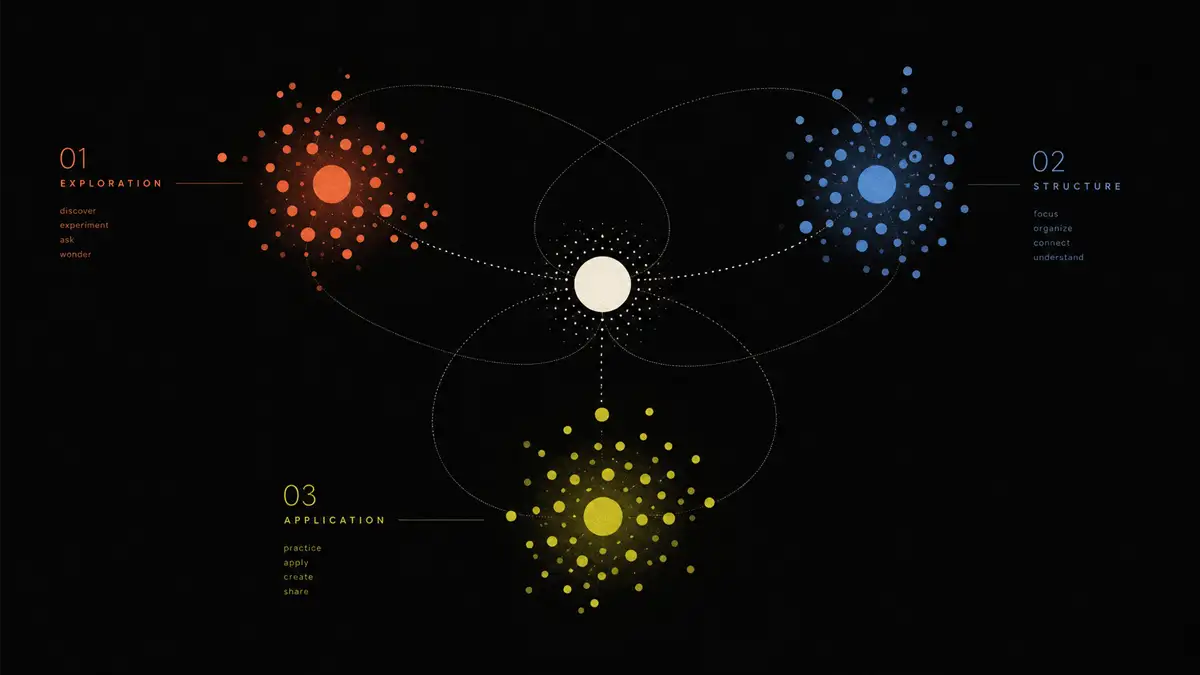

"Machine learning" gets used as if it's one thing, and it's really three fundamentally different teaching methods wearing the same name tag. One learns from an answer key, one learns without one, and one learns by getting punished and rewarded. Knowing which is which is the difference between understanding how an AI product actually works and just nodding along at the term.
What Machine Learning Actually Is
Machine learning is a subset of artificial intelligence that enables systems to learn from data, identify patterns, and make decisions with minimal explicit programming for each individual task. Instead of a person hand-coding a rule for every possible situation, an ML system is trained on examples and learns the underlying pattern connecting them.
| Term | What It Means |
|---|---|
| Machine Learning (ML) | Systems that learn patterns from data rather than following explicitly programmed rules |
| Supervised Learning | Learning from labeled data, where every example comes with a known correct answer |
| Unsupervised Learning | Finding patterns or groupings in unlabeled data, with no predefined right answer |
| Reinforcement Learning (RL) | Learning through trial and error via rewards and penalties from an environment |
Supervised Learning: Learning From An Answer Key
Supervised learning is the most widely used form of machine learning, and it works the way a flashcard does: every input comes paired with the correct output, so the model learns the mapping between them. Show it enough labeled examples, and it learns to predict the label for new, unseen data.
Classification: sorting input into distinct categories, like flagging an email as spam or not spam
Regression: predicting a continuous numerical value, like forecasting a stock price or a house's sale price
Common use cases: spam filtering, credit risk scoring, medical diagnosis support, demand forecasting
Unsupervised Learning: Sorting Without An Answer Key
Unsupervised learning trains on unlabeled data, with no predefined right answer, and the goal is to discover hidden structure the model wasn't told to look for. It's closer to being handed a pile of mixed objects and asked to sort them into groups using whatever logic emerges, rather than being told the categories in advance.
Clustering: grouping similar data points together, like segmenting customers into distinct market groups
Dimensionality reduction: simplifying complex data down to its most important features, often for visualization
Anomaly detection: flagging data points that don't fit the pattern, like unusual financial transactions
Reinforcement Learning: Learning By Trial And Error
Reinforcement learning has an agent learn by interacting directly with an environment, taking actions, and receiving rewards or penalties based on the outcome. There's no labeled dataset handed over in advance, the agent has to discover what works through repeated attempts, adjusting its behavior based on the feedback it gets.
Common use cases: game-playing AI, robotics, autonomous vehicles, and increasingly, the AI agents that plan and execute multi-step tasks
Reinforcement learning models are among the most autonomous approaches in machine learning, since they improve through direct interaction rather than a fixed dataset
Where This Gets More Complicated: Semi-Supervised And Generative
The three-way split covers most of the field, but two additional categories matter for understanding modern AI products.
Semi-supervised learning: combines a small amount of labeled data with a much larger pool of unlabeled data, since fully labeling a massive dataset is often too expensive or impractical. It typically outperforms unsupervised learning alone and shows up in demanding applications like speech recognition
Generative AI: learns patterns from existing data well enough to create new content, text, images, or music, that follows those same patterns, rather than just classifying or predicting from fixed categories
How One Chatbot Uses All Three At Once
The chatbot on your phone isn't built with just one of these approaches, it's a layered combination of several. A large language model typically starts with self-supervised pretraining on massive amounts of text, essentially a variant of supervised learning where the "labels" are generated automatically from the text itself, predicting a masked or next word.
From there, supervised fine-tuning on curated, human-written examples shapes how the model responds to instructions. Then reinforcement learning from human feedback further refines those responses, rewarding outputs that people rate as more helpful or appropriate and discouraging ones they don't. Three different types of machine learning, stacked into a single product.
How ML Fits Next To AI And Deep Learning
Machine learning, artificial intelligence, and deep learning are nested categories, not three names for the same thing. Artificial intelligence is the broadest field, any system performing tasks associated with human intelligence. Machine learning is the subset of AI focused specifically on learning from data. Deep learning is a further subset of machine learning that uses multi-layered neural networks, and it's the specific approach behind most recent breakthroughs, including the large language models covered elsewhere on this site.
Machine Learning: FAQ
Machine learning is a subset of artificial intelligence that enables systems to learn from data, identify patterns, and make decisions or predictions with minimal explicit programming for each specific task. Instead of a human writing out every rule a system should follow, the system is trained on examples and learns the underlying pattern itself.
Supervised learning trains on labeled data, where every example comes with a known correct answer, useful for prediction tasks like spam filtering. Unsupervised learning works on unlabeled data to find patterns, groupings, or anomalies nobody defined in advance, useful for tasks like customer segmentation. Reinforcement learning has an agent learn through trial and error by interacting with an environment and receiving rewards or penalties, useful for tasks like game-playing AI and robotics.
Often, yes. A modern chatbot, for instance, is commonly built using self-supervised pretraining on massive text data, further shaped by supervised fine-tuning on curated examples, and then refined using reinforcement learning from human feedback to make its responses more helpful and appropriate. The three types aren't competing approaches so much as different tools applied at different stages of building one system.
No, they're nested categories, not synonyms. Artificial intelligence is the broadest field, covering any system that performs tasks associated with human intelligence. Machine learning is a subset of AI focused specifically on learning from data. Deep learning is a further subset of machine learning that uses multi-layered neural networks, and it's the approach behind most recent breakthroughs, including large language models.
Semi-supervised learning combines a small amount of labeled data with a much larger amount of unlabeled data, since fully labeling a large dataset is often expensive or impractical. It typically outperforms unsupervised learning alone and is commonly used in demanding applications like speech recognition, where getting some labeled examples is feasible but labeling everything is not.
Jans Bock-Schroeder
Publisher & Founder of AI Angst
Coming from the world of art, photography, and the luxury market, Jans launched AI Angst in 2025 to explore the cultural, ethical, and psychological impacts of artificial intelligence. His work bridges creative vision with critical technology analysis, offering clarity in an era of rapid technological change.
Sources and Citations
This article is based on the following sources:
-
Google for Developers: "What is Machine Learning?"
Source for the core definition and the categorization of ML into supervised, unsupervised, reinforcement, and generative approaches.
https://developers.google.com/machine-learning/intro-to-ml/what-is-ml -
GeeksforGeeks: "Supervised vs Unsupervised vs Reinforcement Learning"
Source for the three primary types of ML and their characteristic use cases.
https://www.geeksforgeeks.org/machine-learning/supervised-vs-reinforcement-vs-unsupervised/ -
Pecan AI: "Types of Machine Learning: Supervised, Unsupervised and Reinforcement"
Source for how a single AI product combines multiple ML types, and the "three teachers" framing.
https://www.pecan.ai/blog/3-types-of-machine-learning/ -
TechTarget: "4 Types of Machine Learning Models Explained"
Source for semi-supervised learning and its comparative advantages over unsupervised learning alone.
https://www.techtarget.com/searchenterpriseai/tip/Types-of-learning-in-machine-learning-explained -
Medium (Sohaib Malik): "Types of Machine Learning: Supervised, Unsupervised, and Reinforcement Explained"
Source for classification versus regression within supervised learning, and clustering, dimensionality reduction, and anomaly detection within unsupervised learning.
https://medium.com/@sohaibmalikdev/types-of-machine-learning-supervised-unsupervised-and-reinforcement-explained-9b609ee67c17
Published: September 17, 2026. Sources verified at time of publication. All external links open in a new tab.