
Every answer ChatGPT, Claude, or Gemini has ever given you came from the same basic trick, repeated an enormous number of times: guess the next word. That description sounds almost insultingly simple for something that can write code, draft contracts, and hold a conversation. The gap between that simple description and what these systems can actually do is exactly what's worth understanding.
What An LLM Actually Is
A large language model is a deep learning system, trained on immense amounts of text, that learns to predict the next piece of language in a sequence and gets good enough at it to understand and generate coherent content. "Large" refers to both the size of the training data and the number of internal parameters, the adjustable values the model learns during training, which now commonly run into the hundreds of billions.
| Term | What It Means |
|---|---|
| LLM | The underlying model: a neural network trained on text to predict and generate language |
| ChatGPT / Claude / Gemini | Products built around an LLM, with a conversational interface, safety layers, and additional tooling wrapped around it |
| Token | A chunk of text, often a word or part of a word, that the model actually processes as a unit |
| Parameter | An internal, adjustable numerical value the model learns during training; more parameters generally mean more capacity to capture patterns |
How The Transformer Actually Works
Nearly every modern LLM is built on the transformer, a neural network architecture introduced in a 2017 Google paper titled "Attention Is All You Need." Before transformers, language models processed text one word at a time in order, which was slow and struggled to connect words that were far apart in a passage. Transformers changed both problems at once.
Tokenization: text is first broken into tokens, then each token is mapped to an embedding, a vector of numbers representing its meaning in a high-dimensional space
Self-attention: the model's key innovation, a mechanism that calculates how relevant every other token in the passage is to the one currently being processed, including tokens far apart in the text
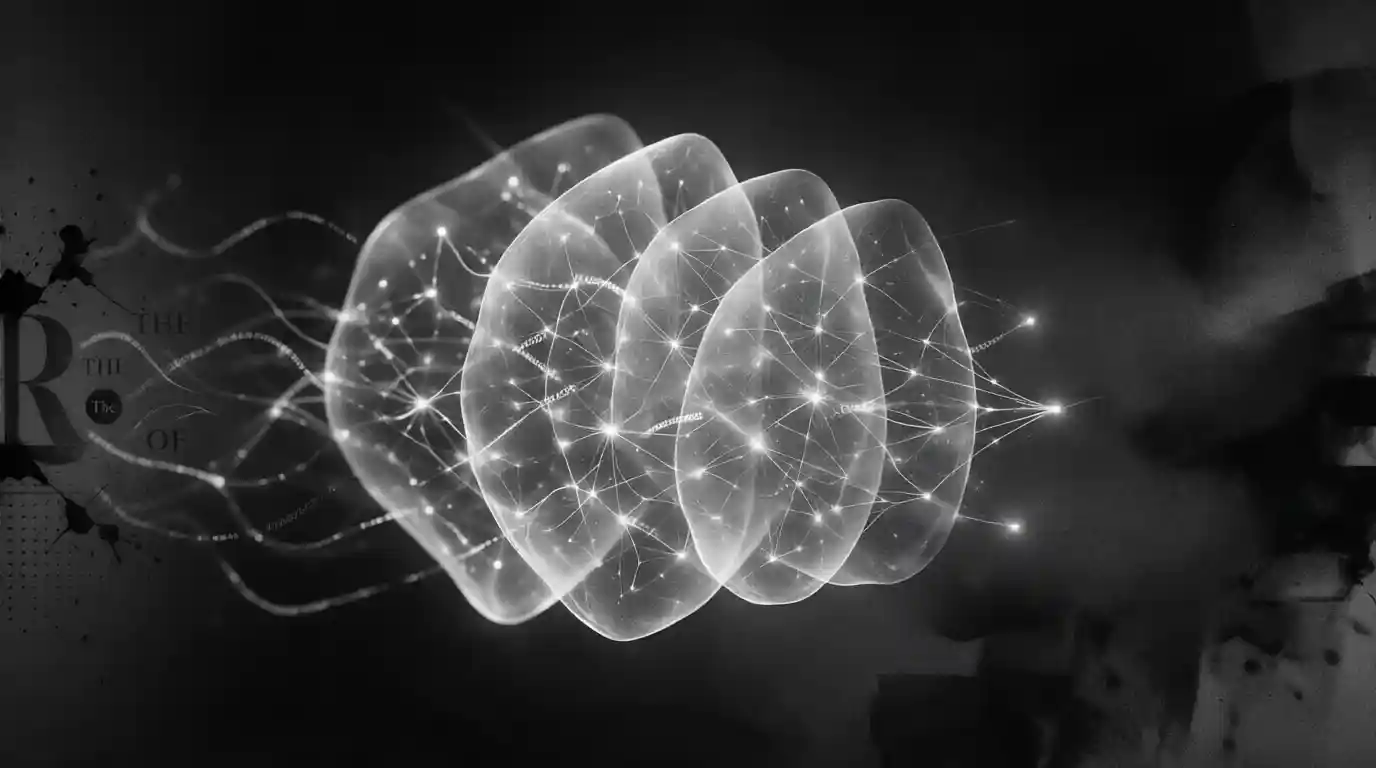
Layers: transformers stack many of these attention layers on top of each other, and at each layer the embeddings get refined into richer, more contextual representations
Parallelization: unlike older architectures, transformers process entire sequences at once rather than word by word, which is what made training on today's scale of data computationally realistic in the first place
How A Model Actually Gets Trained
Building an LLM happens in two broad phases, pre-training and fine-tuning, and most of the heavy lifting happens in the first one.
Pre-training: the model is trained on enormous text corpora using self-supervised learning, tasks like predicting a masked word or the next word in a sequence, that don't require humans to manually label the data. This is where a model implicitly picks up grammar, factual knowledge, and reasoning patterns, just from exposure to huge amounts of text
Fine-tuning: the pre-trained model is then further trained on a narrower, often human-curated dataset to shape its behavior for a specific use, like following instructions helpfully and safely in a chat interface, rather than just continuing text in whatever direction is statistically likely
That two-step process is why a raw pre-trained model and a shipped consumer chatbot can behave so differently, even when the underlying network is the same one.
Where LLMs Fit Next To NLP And Generative AI
An LLM is not a synonym for NLP, and it's not a synonym for generative AI either, it sits inside both as a specific category. NLP is the broad field of computers working with human language; an LLM is a particular, large-scale way of doing that. Generative AI is broader still, covering any AI system that creates new content, images, audio, video, or text.
All LLMs are generative AI, but not all generative AI is an LLM
Image generators like Midjourney and DALL-E are generative AI that don't produce text and aren't LLMs
An LLM is, more precisely, a text-focused generative AI system built on the transformer architecture
What LLMs Still Get Wrong
The same mechanism that makes LLMs fluent is also what makes them unreliable in a specific, predictable way. A model optimized to produce statistically plausible language will sometimes produce fluent, confident text that simply isn't true, a failure mode widely known as hallucination.
Hallucination: confident, well-formed output that's factually wrong, since the model is optimized for plausible language, not verified accuracy
Computational cost: training and running large models at scale requires specialized hardware, significant power, and ongoing infrastructure investment
Deployment complexity: putting an LLM into production requires deep learning expertise and distributed systems most teams don't have in-house by default
Inherited bias: patterns in the training data, including unfair or skewed ones, can show up in a model's output
Large Language Models: FAQ
A large language model, or LLM, is a deep learning system trained on massive amounts of text that learns to predict the next piece of text in a sequence, and gets good enough at that prediction to understand and generate coherent, relevant language. Tools like ChatGPT, Claude, and Gemini are products built around LLMs, not synonyms for the term itself.
Mechanically, yes, an LLM generates text by repeatedly predicting the most likely next token given everything before it, which is the same basic idea behind autocomplete. What separates it from your phone's keyboard is scale and context: billions of parameters trained on enormous datasets, combined with a self-attention mechanism that weighs relationships between distant words in a passage, produce predictions coherent and contextual enough to hold a conversation, write code, or summarize a document, not just guess the next likely word.
The transformer is the neural network architecture nearly all modern LLMs are built on, introduced in a 2017 Google paper titled "Attention Is All You Need." Its key innovation is self-attention, a mechanism that lets the model weigh how relevant every other word in a passage is to the word it's currently processing, including words far apart in the text. Transformers also process entire sequences in parallel rather than one word at a time, which is what made training on today's enormous datasets computationally practical.
NLP is the broader field concerned with computers understanding and generating human language; an LLM is one large-scale implementation within that field, not the field itself. LLMs are also a subset of generative AI specifically focused on language: all LLMs are generative AI, but not all generative AI is an LLM, image generators like Midjourney and DALL-E are generative AI that don't generate text and aren't LLMs.
LLMs can hallucinate, generating fluent, confident text that is factually wrong, because they're optimized to produce statistically plausible language, not verified truth. They're also expensive to train and run at scale, require specialized hardware and deep learning expertise to deploy, and can reproduce biases present in their training data. None of these are solved problems, they're active areas of ongoing research.

Jans Bock-Schroeder
Publisher & Founder of AI Angst
Coming from the world of art, photography, and the luxury market, Jans launched AI Angst in 2025 to explore the cultural, ethical, and psychological impacts of artificial intelligence. His work bridges creative vision with critical technology analysis, offering clarity in an era of rapid technological change.
Sources and Citations
This article is based on the following sources:
-
IBM: "What Are Large Language Models (LLMs)?"
Source for the core definition, tokenization, embeddings, and the layered structure of transformer models.
https://www.ibm.com/think/topics/large-language-models -
Google for Developers: "LLMs: What's a large language model?"
Source for the transformer's encoder-decoder structure and the self-attention mechanism.
https://developers.google.com/machine-learning/crash-course/llm/transformers -
Elastic: "Understanding large language models: A comprehensive guide"
Source for the distinction between LLMs and other generative AI, and pretraining/fine-tuning scaling challenges.
https://www.elastic.co/what-is/large-language-models -
Parallel: "What is an LLM? 2026 Guide to Large Language Model Training"
Source for the pre-training and fine-tuning process and parameter-count context.
https://www.parallelhq.com/blog/what-llm -
NVIDIA Glossary: "What are Large Language Models?"
Source for the general transformer-network framing and common LLM capabilities.
https://www.nvidia.com/en-us/glossary/large-language-models/
Published: September 16, 2026. Sources verified at time of publication. All external links open in a new tab.