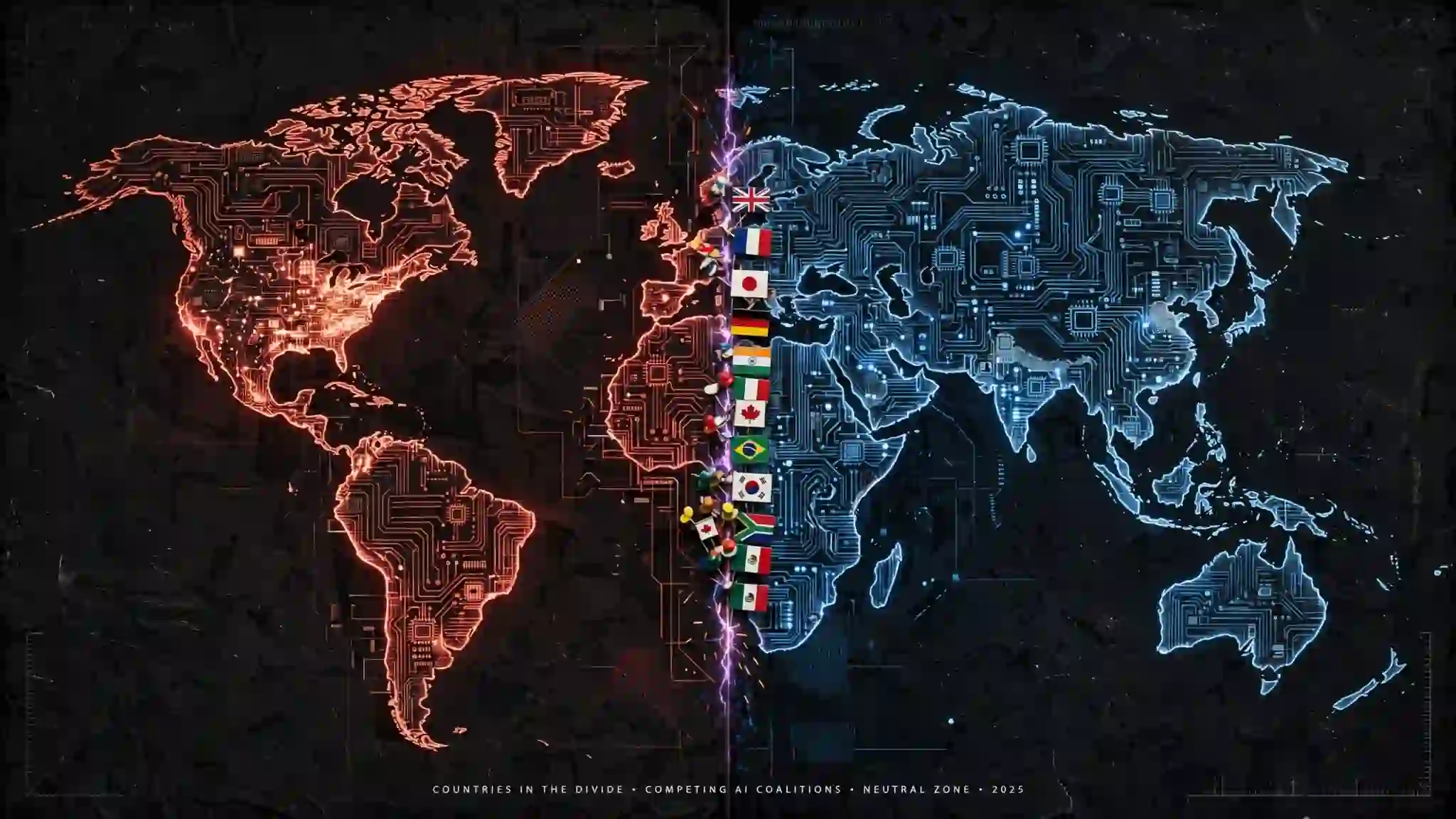
For the better part of a year, a couple dozen countries have been trying to have it both ways: cooperating with Washington on AI supply chains while keeping the door open to Beijing too.
A letter reportedly being drafted in the State Department is about to close that door.
What's Actually in the Draft Letter
Reuters reported on August 14, 2026 that the United States is preparing to tell dozens of countries they must pick a side in the AI race with China, according to a U.S. official and an internal draft the outlet reviewed.
The draft letter, prepared by the State Department, is addressed to the 35 signatories of a U.S. "AI Opportunity Statement," signed in June 2026
It warns countries they will be excluded from the U.S.-led coalition if they also sign onto Beijing's competing framework
The signatories include members of the non-binding Pax Silica framework, launched by Washington in 2025, plus other countries that have expressed interest in aligning AI cooperation with the U.S.
Pax Silica itself is aimed at securing supply chains for AI models, semiconductors, and critical minerals among partner nations
About two dozen countries have joined Pax Silica so far, including close U.S. allies Japan, Australia, and South Korea
"By pressing countries to choose sides, the U.S. hopes to starve China of resources in a race to make the most sophisticated AI, which could be used for military or economic dominance," Reuters reported.
The Country Already Caught in the Middle
One member of the US framework has already made the exact dual commitment Washington is now trying to prevent: Kazakhstan.
The U.S. touted Kazakhstan in June 2026 as the first country in Central Asia to join Pax Silica, citing the country's significant critical mineral reserves, resources central to both AI chip manufacturing and the broader supply chain Washington is trying to secure.
That same month, Kazakhstan also appeared among the 29 founding members of China's World Artificial Intelligence Cooperation Organization (WAICO), the rival coalition Chinese President Xi Jinping launched the following month in Shanghai. Kazakhstan isn't a minor or accidental case, it's the clearest illustration of exactly the overlap this new US letter is designed to eliminate.
| Coalition | Led By | Launched | Focus |
|---|---|---|---|
| Pax Silica | United States | 2025 | AI models, semiconductor, and critical mineral supply chains |
| AI Opportunity Statement | United States (State Dept.) | June 2026 | Broader alignment on AI cooperation, 35 signatories |
| WAICO | China | July 2026 | Global AI governance, headquartered in Shanghai, 29 founding members |
Why This Is Coming to a Head Now
The timing tracks a broader shift already visible across the AI industry this year. Reuters noted that "the race between the U.S. and China for technological leadership has reached a pivotal moment, as Chinese open-weight AI models have made rapid gains against proprietary systems from U.S. companies such as OpenAI and Anthropic."
The report also connected the pressure campaign to AI's fast-growing capabilities more broadly, including "the ability to hack autonomously," which it said has "forced a global reckoning over its power." On the other side of the ledger, Beijing is reportedly weighing its own restrictions on overseas access to some of China's leading AI models, a sign the split isn't purely a US-driven pressure campaign; both governments appear to be moving toward more closed, bloc-based approaches to AI cooperation rather than a shared global framework.
US-China AI Coalition Pressure: FAQ
According to Reuters, the U.S. State Department has drafted a letter to the 35 signatories of a U.S. "AI Opportunity Statement," signed in June 2026, warning that countries will be excluded from the U.S.-led Pax Silica coalition if they also join China's competing World Artificial Intelligence Cooperation Organization (WAICO), launched in July 2026.
Pax Silica is a U.S.-launched initiative, started in 2025, aimed at securing supply chains for AI models, semiconductors, and critical minerals among partner countries. About two dozen countries have joined so far, including close U.S. allies like Japan, Australia, and South Korea.
Kazakhstan has joined both. It was touted by the U.S. in June 2026 as the first Central Asian country to join Pax Silica, citing its significant critical mineral reserves, but it also appears among the founding members of China's WAICO, signed the same month Beijing launched that rival coalition.
Reuters reported that by pressing countries to choose, the U.S. hopes to starve China of resources, including critical minerals, chip access, and diplomatic cooperation, in the race to build the most sophisticated AI systems, which Washington views as having significant military and economic stakes.
The timing follows China's launch of WAICO in July 2026, an intergovernmental body promoting Chinese open-weight AI technology as an alternative to U.S.-led governance. It also comes as Chinese open-weight models have made rapid gains against proprietary U.S. systems from companies like OpenAI and Anthropic, intensifying competitive pressure on Washington to lock in partner countries before China's coalition grows further.
Reporting indicates Beijing is separately weighing restrictions on overseas access to some of its own leading AI models, reflecting China's stringent national security priorities. This suggests the emerging split isn't only being driven by U.S. pressure; both governments appear to be moving toward more controlled, bloc-based approaches to AI cooperation.

Jans Bock-Schroeder
Publisher & Founder of AI Angst
Coming from the world of art, photography, and the luxury market, Jans launched AI Angst in 2025 to explore the cultural, ethical, and psychological impacts of artificial intelligence. His work bridges creative vision with critical technology analysis, offering clarity in an era of rapid technological change.
Sources and Citations
This article is based on the following sources, published August 14-16, 2026:
-
Reuters (via CNBC): "U.S. to tell allies they must pick sides in AI race with China" (August 15, 2026)
Primary source for the core reporting by Michael Martina, based on a U.S. official and internal draft letter.
https://www.cnbc.com/2026/08/15/us-to-tell-allies-they-must-pick-sides-in-ai-race-with-china-reuters.html -
AOL (Reuters wire): "Exclusive-US to tell partners they must pick sides in AI race with China" (August 14, 2026)
Source for the Pax Silica background and the 35-signatory AI Opportunity Statement detail.
https://www.aol.com/articles/exclusive-us-tell-partners-must-210941000.html -
The Spokesman-Review (Reuters wire): "U.S. to tell partners they must pick sides in AI race with China" (August 15, 2026)
Source for the Kazakhstan case study and the Chinese open-weight model competitive context.
https://www.spokesman.com/stories/2026/aug/14/us-to-tell-partners-they-must-pick-sides-in-ai-rac/ -
Free Malaysia Today (Reuters wire): "US to tell partners they must pick sides in AI race with China" (August 16, 2026)
Source confirming the WAICO framing and Xi Jinping's July 2026 coalition launch.
https://www.freemalaysiatoday.com/category/business/2026/08/16/us-to-tell-partners-they-must-pick-sides-in-ai-race-with-china -
AI Angst: "29 Countries Just Signed Up for a Brand New AI Organization" (July 18, 2026)
Internal reference for WAICO's founding member list, including Kazakhstan.
/discover/world-ai-cooperation-organization
Published: August 17, 2026. Sources verified at time of publication. All external links open in a new tab. The draft State Department letter described here was reported as not yet finalized or sent at the time of publication; details may change.