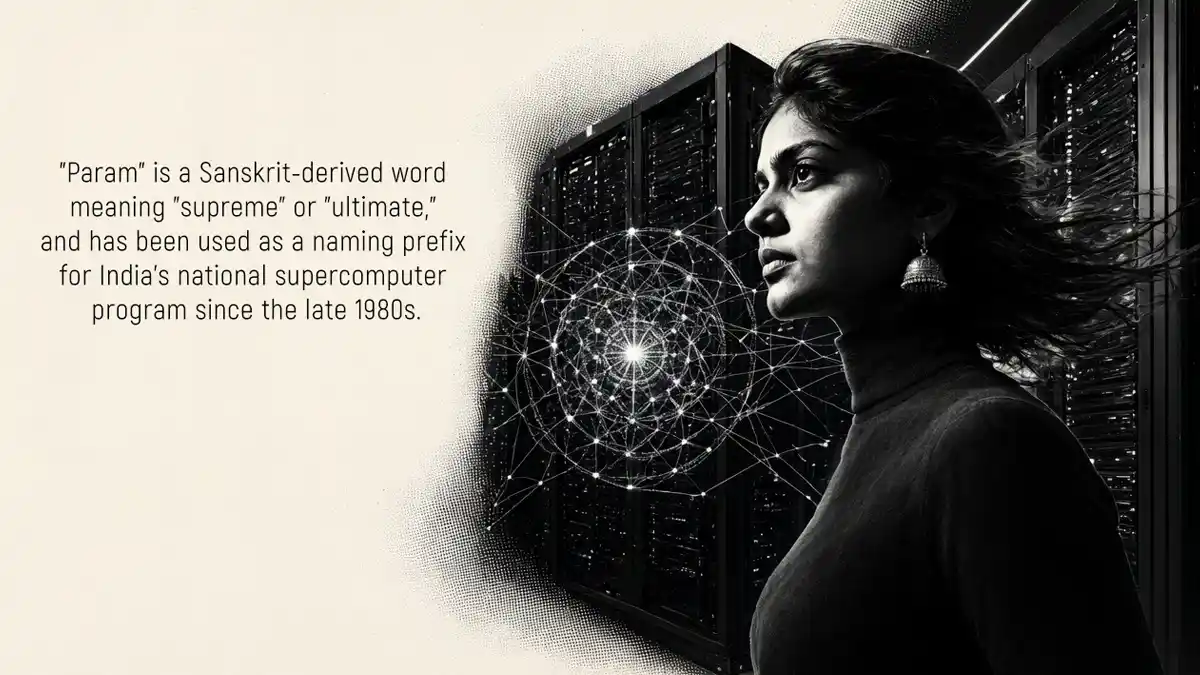
India has a habit of naming its national supercomputers after words that sound less like hardware and more like a philosophy lecture: Shakti, meaning power. Siddhi, meaning achievement. The newest one, switched on this weekend, is called Pragya. Supreme wisdom.
It's a fitting name for a machine that arrived alongside more than 3,000 new graduates.
What Actually Got Switched On
On August 8, 2026, Indian Prime Minister Narendra Modi inaugurated Param Pragya, an AI-powered high-performance supercomputing facility at IIT Delhi's Sonipat campus, during the institute's 57th convocation ceremony.
The ceremony celebrated the graduation of more than 3,000 students, including 587 doctoral scholars
Modi attended as chief guest, remotely inaugurating the facility, presenting the institute's top academic honors including the President's Gold Medal
Param Pragya is intended to strengthen IIT Delhi's capabilities in AI, data science, advanced computing, and interdisciplinary research
Some reporting indicated startups incubated at IIT Delhi may gain access to the system's GPU computing resources at subsidized rates
Exact technical specifications, peak petaflop or exaflop performance, chip architecture, weren't disclosed in coverage of the launch itself, which focused more on the facility's intended research role than its raw benchmark numbers.
One Node in a Much Bigger Network
Param Pragya isn't a one-off. It's the latest addition to a fast-growing set of facilities under India's National Supercomputing Mission and the newer India AI Mission, a coordinated push to build domestic AI compute capacity across the country's top research institutions.
Param Shakti: a 3.1-petaflop, fully indigenous system inaugurated at IIT Madras in January 2026, built by India's Centre for Development of Advanced Computing (C-DAC), supporting research in aerospace, climate science, materials, and drug discovery
AIRAWAT: India's existing flagship AI supercomputer, hosted at C-DAC in Pune, ranked 188th globally with roughly 200 AI petaflops of peak capacity
Param Siddhi-AI: also at C-DAC, adding a further 210 AI petaflops, bringing India's combined flagship AI compute to around 410 AI petaflops
| System | Location | Capacity | Status |
|---|---|---|---|
| AIRAWAT | C-DAC, Pune | ~200 AI petaflops | Operational |
| Param Siddhi-AI | C-DAC | ~210 AI petaflops | Operational |
| Param Shakti | IIT Madras | 3.1 petaflops | Operational since January 2026 |
| Param Pragya | IIT Delhi, Sonipat | Not disclosed | Inaugurated August 8, 2026 |
| G42/Cerebras national system | India (host TBD) | 8,000 AI petaflops (8 exaflops) | Announced February 2026, in development |
The Number That Puts It All in Perspective
The most striking figure in India's AI infrastructure story so far isn't Param Pragya itself, it's the system announced six months earlier that dwarfs everything else on this list.
In February 2026, Abu Dhabi's G42 and AI chipmaker Cerebras announced plans to build a national-scale AI supercomputer in India with a peak capacity of 8 exaflops, developed jointly with the Mohamed Bin Zayed University of Artificial Intelligence and C-DAC. Reports at the time described the planned system as roughly 19 times more powerful than India's entire existing national AI computing capacity combined. It's designed to operate entirely within Indian jurisdiction, under Indian data governance, as a foundational asset of the India AI Mission.
Against that backdrop, Param Pragya reads less like a single landmark and more like what it probably is: one more node going live in a rapidly expanding national compute network, timed, this particular weekend, to coincide with a graduation ceremony and a prime ministerial visit.
Param Pragya: FAQ
Param Pragya is an AI-powered high-performance supercomputing facility established at IIT Delhi's Sonipat campus, inaugurated by Indian Prime Minister Narendra Modi on August 8, 2026, during the institute's 57th convocation ceremony. It's intended to strengthen IIT Delhi's research capabilities in AI, data science, advanced computing, and interdisciplinary research.
"Param" is a Sanskrit-derived word meaning "supreme" or "ultimate," and has been used as a naming prefix for India's national supercomputer program since the late 1980s. "Pragya" translates roughly to "wisdom" or "insight," so the name loosely renders as "supreme wisdom."
It's the latest facility under India's National Supercomputing Mission and the India AI Mission, following systems such as Param Shakti (a 3.1-petaflop system inaugurated at IIT Madras in January 2026) and the existing AIRAWAT and Param Siddhi-AI systems hosted at India's Centre for Development of Advanced Computing (C-DAC).
Exact technical specifications for Param Pragya, such as its peak petaflop or exaflop performance, were not disclosed in the facility's inauguration coverage. For comparison, India's existing flagship AI systems, AIRAWAT and Param Siddhi-AI, together deliver a combined 410 AI petaflops, while a planned new system announced in February 2026 is expected to reach 8,000 AI petaflops, or 8 exaflops.
In February 2026, Abu Dhabi's G42 and AI chipmaker Cerebras announced plans to build a national-scale AI supercomputer in India with 8 exaflops of peak compute capacity, developed with the Mohamed Bin Zayed University of Artificial Intelligence and India's C-DAC. Reports described it as roughly 19 times more powerful than India's entire existing national AI computing capacity combined, and it's intended to operate entirely under Indian data governance and jurisdiction.
Coverage of the launch indicated the facility is intended primarily for IIT Delhi's own students and researchers working in AI, machine learning, and data-intensive fields, including doctoral scholars, with some reporting suggesting startups incubated at the institute may also gain access to computing resources at subsidized rates.

Jans Bock-Schroeder
Publisher & Founder of AI Angst
Coming from the world of art, photography, and the luxury market, Jans launched AI Angst in 2025 to explore the cultural, ethical, and psychological impacts of artificial intelligence. His work bridges creative vision with critical technology analysis, offering clarity in an era of rapid technological change.
Sources and Citations
This article is based on the following sources, published February 2026-August 2026:
-
Swarajya — "PM Modi To Inaugurate AI-Powered 'Param Pragya' High-Performance Supercomputing Facility at IIT Delhi's Sonipat Campus" (August 7, 2026)
Primary source for the inauguration announcement and convocation details.
https://swarajyamag.com/amp/story/tech/pm-modi-to-inaugurate-ai-powered-param-pragya-high-performance-supercomputing-facility-at-iit-delhis-sonipat-campus -
Free Press Journal (via ANI) — "PM Narendra Modi Unveils 'Param Pragya' AI Supercomputer At IIT Delhi" (August 8, 2026)
Source for confirmation of the inauguration and ceremony proceedings.
https://www.freepressjournal.in/education/pm-narendra-modi-unveils-param-pragya-ai-supercomputer-at-iit-delhi-giving-major-boost-to-advanced-computing-research-video -
Careers360 — "IIT Madras gets built-in-India 'Param Shakti' supercomputer with aim to boost scientific research" (January 8, 2026)
Source for the Param Shakti comparison figures.
https://news.careers360.com/iit-madras-param-shakti-supercomputer-govt-meity-c-dac-national-supercomputing-mission-2026-scientific-research-drug-discovery -
All India Radio News (newsonair.gov.in) — "Abu Dhabi to deploy exaflop-scale AI infrastructure to India" (February 20, 2026)
Source for the AIRAWAT, Param Siddhi-AI, and G42/Cerebras 8-exaflop system figures.
https://www.newsonair.gov.in/abu-dhabi-to-deploy-exaflop-scale-ai-infrastructure-to-india
Published: August 9, 2026. Sources verified at time of publication. All external links open in a new tab. Technical specifications for Param Pragya were not disclosed in available coverage as of publication.