Read enough AI headlines and you'll notice the phrase "open source" gets attached to almost every downloadable model that comes out, Llama, DeepSeek, Qwen, Kimi, Inkling, Gemma, all of it.
Almost none of them qualify for that label under the definition the open-source software world actually uses. There's a real term for what most of them are, and it's not a technicality.
Three Tiers, Not Two
AI models generally fall into one of three categories of availability, and the differences matter more than they sound:
Proprietary/closed models: like Claude, GPT-5.6 Sol, and Gemini. You access these through an API. You send data, get a response, and have no visibility into the architecture, training data, or internals. The provider controls pricing, availability, and updates.
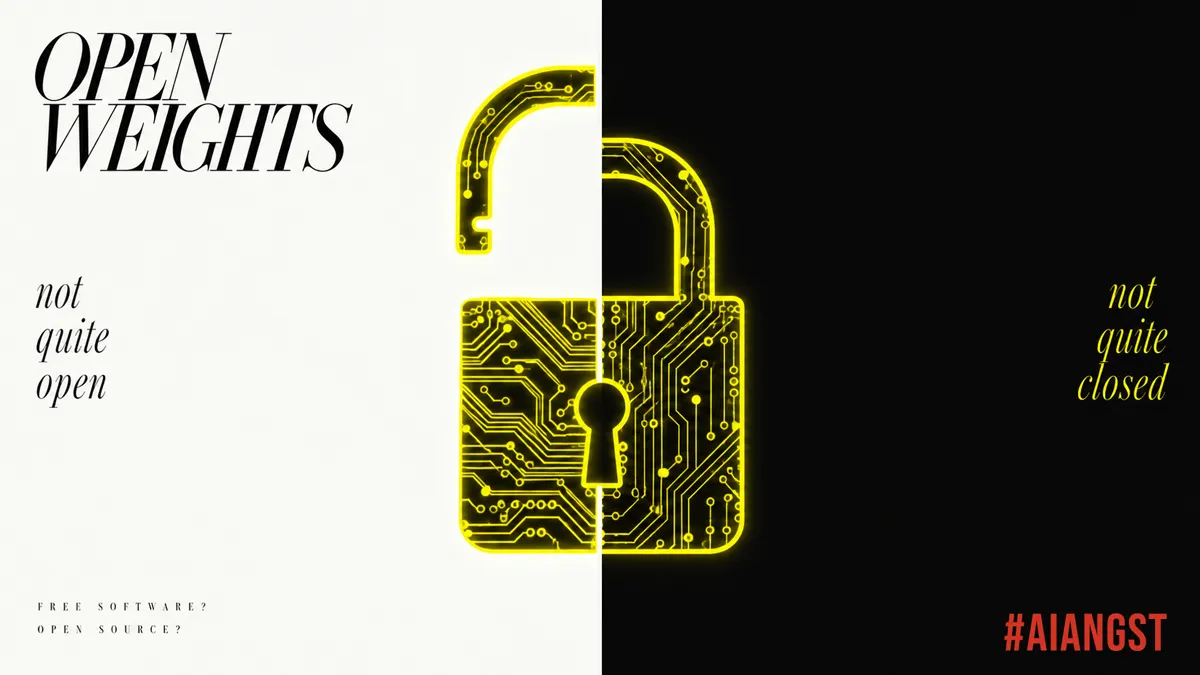
Open-weight models: the trained parameters, the "weights," are published for anyone to download and run on their own hardware. That's it. The training code and training data usually stay private.
Open-source models: release the weights and the training code and a detailed description of the training data, enough for a skilled team to substantially reproduce the model from scratch.
The simplest test for where any given model sits: can you download it and run it yourself? If yes, it's at least open-weight. Can you also see and reuse the code and data used to train it? Only then does it earn the fuller label.
Who Actually Set This Definition
This isn't a marketing distinction someone invented recently. The Open Source Initiative, the nonprofit that has defined "open source" for regular software since the 1990s, published its formal Open Source AI Definition in 2024.
Its standard rests on four freedoms: the right to use, study, modify, and share a system. In practice, that means genuine open-source AI requires access to the training code and enough detail about the data to rebuild and audit the model, not just a finished, runnable file.
Measured against that bar, the honest answer is that nearly every model marketed as "open source" today, Llama, DeepSeek, Qwen, Gemma, and yes, Inkling and Kimi K3, is technically open-weight, not open-source. Companies release the finished model. They don't typically release the recipe.
| Model | Maker | License |
|---|---|---|
| DeepSeek (recent models) | DeepSeek | MIT |
| Qwen (current models) | Alibaba | Apache 2.0 |
| gpt-oss | OpenAI | Apache 2.0 |
| Kimi K3 / K2.6 | Moonshot AI | Modified MIT (attribution required at scale) |
| GLM-5.2 | Z.ai (Zhipu) | MIT |
| Gemma 4 | Apache 2.0 (switched from custom terms, April 2026) |
The pattern across nearly the whole field: permissive licenses for downloading and running the model are common. Actual open-source status, in the strict sense, is rare. The license is also the detail people most often skip when evaluating a model, and the one most likely to cause problems later, since a download page and a terms-of-use document can tell very different stories.
Why the Distinction Actually Matters
It's tempting to treat this as pedantry. For a lot of everyday use, it basically is: if you can download a model, run it on your own infrastructure, and fine-tune it, you have most of the practical freedom that matters.
But the gap matters more in specific situations. Regulated industries, healthcare, finance, government, increasingly favor open-weight models paired with on-premise deployment specifically because it meets transparency, auditability, and data-sovereignty requirements. That auditability is only ever partial without the training data and code, since nobody outside the company can fully verify how the model was actually built or what it learned from.
It also matters for how the debate over AI safety gets framed. Hugging Face CEO Clem Delangue has argued against restricting open models on safety grounds, saying doing so "wouldn't make AI safer," and would instead concentrate power and make it harder for researchers, academics, and smaller organizations to participate in building safer AI. Whether you find that persuasive or not, it's an argument that depends on real, ongoing public access to model weights, not on the deeper, rarer transparency that full open-source status would require.
Open Weights: FAQ
Open weights means a company has published the trained numerical parameters of a model, so anyone can download it, run it on their own hardware, and fine-tune it. It doesn't require sharing the training code, the training data, or enough documentation for someone to rebuild an equivalent model from scratch.
The Open Source Initiative's Open Source AI Definition requires the freedom to use, study, modify, and share a system, which in practice means access to the training code and enough detail about the training data to substantially reproduce the model, not just the finished weights. Open weight only guarantees the finished, downloadable model itself.
By the Open Source Initiative's strict definition, no. All of them release trained weights under permissive licenses, but none publish the full training code and data needed to rebuild the model from scratch, which makes them open-weight rather than open-source under that standard, even though they're commonly marketed and described as open source.
No. Licenses vary and often carry different conditions. DeepSeek's recent models ship under the MIT license, Qwen uses Apache 2.0, OpenAI's gpt-oss models are Apache 2.0, Moonshot's Kimi models use a Modified MIT license with an attribution requirement at scale, and Google moved Gemma 4 to Apache 2.0 in April 2026 after using custom terms for earlier versions.
It affects what you can actually inspect, reproduce, or audit. A model you can download and fine-tune isn't necessarily one you or independent researchers can fully verify or rebuild, which matters most for regulated industries needing auditability, and for anyone relying on safety or bias claims about a model they can't fully examine.
Reasons vary by company, from building developer ecosystems and undercutting rivals on price, to genuine arguments that broader access to AI capability distributes power more evenly. Hugging Face CEO Clem Delangue has argued that restricting open models would concentrate power rather than making AI safer.
Jans Bock-Schroeder
Publisher & Founder of AI Angst
Coming from the world of art, photography, and the luxury market, Jans launched AI Angst in 2025 to explore the cultural, ethical, and psychological impacts of artificial intelligence. His work bridges creative vision with critical technology analysis, offering clarity in an era of rapid technological change.
Sources and Citations
This explainer draws on the following sources:
-
PBS News (via The Conversation) — "What's the difference between closed, open-source and open-weight AI? A researcher explains" (July 2026)
Primary source for the three-tier framing and the Open Source Initiative's definition.
https://www.pbs.org/newshour/science/whats-the-difference-between-closed-open%E2%80%91source-and-open-weight-ai-a-researcher-explains -
GEO Toolbox — "Open Weights vs Open Source: The Real Difference (2026)" (July 22, 2026)
Source for the current licensing table across DeepSeek, Qwen, Kimi, GLM-5.2, and Gemma 4.
https://geotoolbox.ai/blog/open-weights-vs-open-source -
TechRound — "What's The Difference Between Open Weight And Open Source AI?" (July 21, 2026)
Source for the Clem Delangue quote and industry context on OpenAI's open-weight releases.
https://techround.co.uk/artificial-intelligence/difference-open-weight-source-ai/ -
Digiwit — "Open-weight AI models explained: what businesses need to know" (June 2026)
Source for the regulated-industry auditability and data-sovereignty considerations.
https://digiwit.ai/blog/open-weight-ai-models-explained -
AI Angst — "Mira Murati's AI Startup Just Released Its First Model" and "China's Moonshot Just Built a Model That Claims to Rival Anthropic's Best" (July 2026)
Internal reference for the Inkling and Kimi K3 open-weight release details.
/discover/inkling-thinking-machines-open-weight-model
Published: July 27, 2026. Sources verified at time of publication. All external links open in a new tab. Model licenses change frequently; verify current terms directly with the model provider before building on any of the models named here.