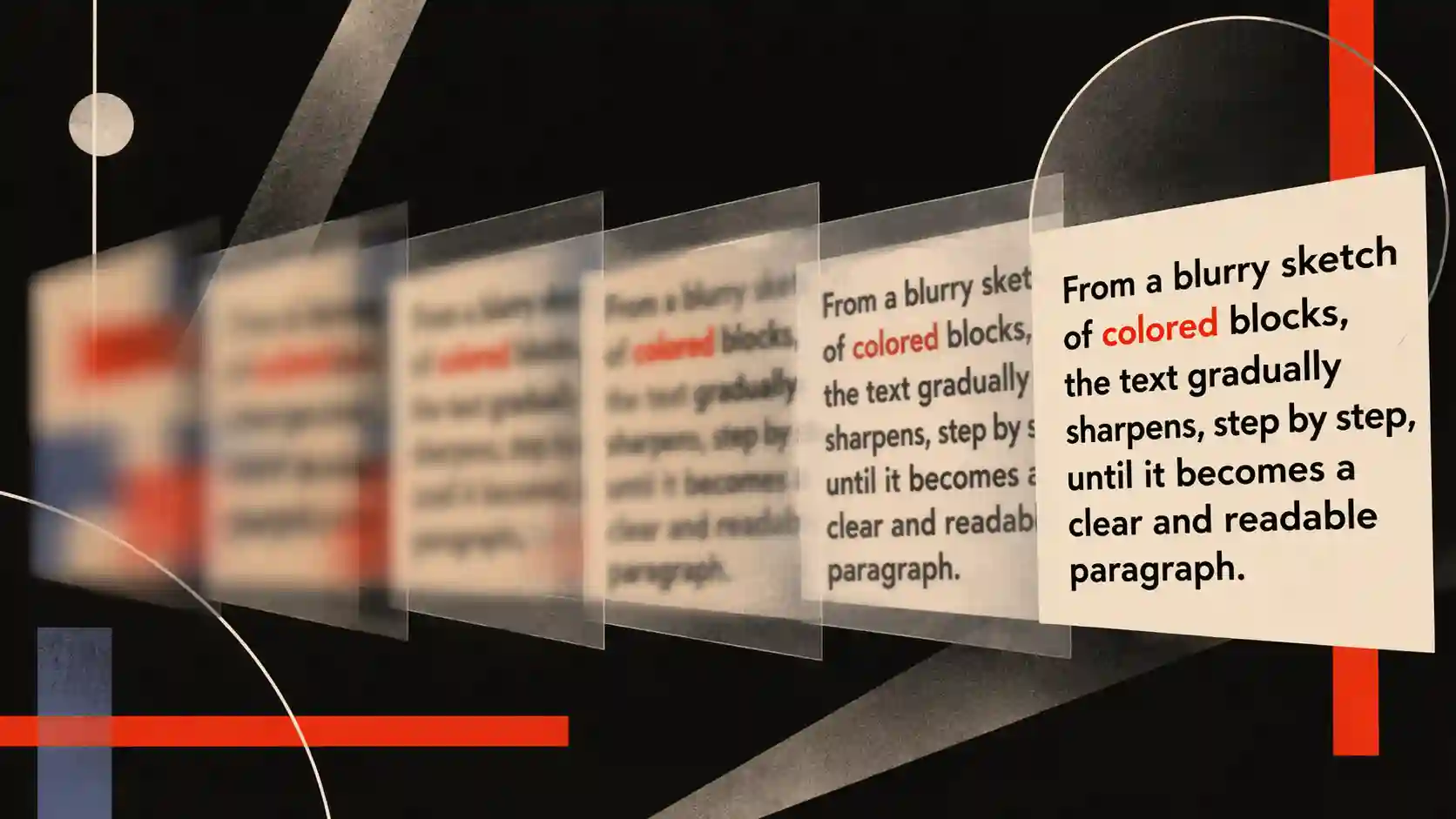

Nearly every chatbot you've used writes the way a typist does: one word, then the next, never skipping ahead. A new Stanford paper asks a different question, what if a model sketched the whole answer first, blurry and rough, and filled in the detail afterward, the way people actually work through an idea?
That's the pitch behind Next-Concept Modeling, or NCM. It's real, it's fast, and within days of publication it was being called "the end of LLMs" online. The paper itself says nothing of the kind.
What NCM Actually Is
Next-Concept Modeling is a text-generation framework from Stanford's Hazy Research lab and Together AI, published on arXiv on October 9, 2026, that builds text from a coarse outline down to fine detail instead of one token at a time. The paper's authors include Hermann Kumbong and Ishan S. Khare, with Simran Arora, Azalia Mirhoseini, and Christopher Ré among the co-authors.
| Detail | Fact |
|---|---|
| Paper | "Next-Concept Modeling: Fast, Parallel Coarse-to-Fine Text Generation," arXiv 2610.14162 |
| Published | October 9, 2026 |
| Institutions | Stanford University (Hazy Research) and Together AI |
| Headline claim | 10 to 31 times faster than strong diffusion language models at comparable quality, using roughly 4 to 5 times fewer training tokens |
| Model scale tested | Mostly around 100 million parameters; preliminary runs up to 725 million |
| Availability | Research code on GitHub and task-specific checkpoints on Hugging Face; no hosted inference provider |
Three Ways To Generate Text
The clearest way to understand NCM is to compare it with the two approaches it's competing against.
Autoregressive LLMs (the GPT, Claude, and Gemini family): predict one token, append it, repeat. Each new token depends on the ones before it, so output generation is inherently sequential
Diffusion language models: start from a corrupted or masked sequence and refine many positions in parallel across repeated passes. That cuts down sequential steps, but each pass typically processes the entire sequence, and quality tends to fall when the number of passes is cut
NCM: represents text as a hierarchy and generates it level by level, sequential across a small number of levels but parallel within each level
How It Works, In Two Stages
NCM borrows an idea from image generation called next-scale prediction, where a model generates a low-resolution version of an image first and adds detail afterward, and adapts it to text. That's harder than it sounds, because a sentence has no natural way to be "downsampled" the way an image can be shrunk, so the coarse versions have to be learned.
Stage 1, learn a hierarchy: a multiscale residual vector-quantized variational autoencoder (VQ-VAE) converts text into discrete codes across several levels. Early levels hold just a few codes capturing broad structure; later, longer levels encode whatever the earlier ones left out. Once trained, this tokenizer is frozen
Stage 2, generate the hierarchy: a transformer predicts each level from the levels before it, producing all the codes within a level at once. A decoder then turns the finished hierarchy back into readable text
The authors illustrate this with a German-to-English translation. The first decoded level is barely readable, each later level adds and corrects detail, and by the eleventh and final level the output closely matches the reference translation. Quality doesn't rise perfectly steadily, it rises and dips between intermediate levels, but the overall arc runs from rough draft to finished sentence.
Why It's Faster
NCM's speed comes from two sources working together: fewer sequential steps, and cheaper steps. Where a diffusion baseline in the paper makes 128 full-length generator calls on one benchmark, NCM makes about a dozen, and its early calls process only a handful of codes rather than the whole sequence.
What The Benchmarks Actually Show
The headline numbers come from three separate experiments, and combining them into one universal claim is the first mistake worth avoiding. All comparisons are against diffusion language models at matched parameter scale, measured on a single NVIDIA H100 GPU.
| Task | Reported Result |
|---|---|
| LM1B (unconditional generation) | 21 times faster than the strongest diffusion baseline, with better generative perplexity |
| OpenWebText (unconditional generation) | 10 times faster, with competitive quality |
| XSum (summarization) | 31 times faster, matching the strongest baseline's ROUGE-L score |
| Training efficiency | Roughly 4 to 5 times fewer training tokens, including tokenizer training (counts token exposures, not total compute) |
| Sudoku | 86.1% of hard boards solved versus 81.3% for the strongest baseline, using 12 generator calls instead of 16 |
The Sudoku result is the most interesting one conceptually: every cell has to satisfy row, column, and box constraints simultaneously, and the authors suggest coarse-to-fine generation helps because later levels can revise the whole board at once. That hints at structured, constraint-heavy tasks as a promising direction, without proving NCM is a better general reasoner.
Why "The End Of LLMs" Is The Wrong Headline
The viral framing compares NCM to frontier chatbots, and the paper never makes that comparison. Its speed results come from small research models measured against other non-autoregressive systems, not against GPT-, Claude-, or Gemini-class models.
Scale: most experiments use roughly 100 million parameters, and the scaling runs up to 725 million are described as preliminary, orders of magnitude below frontier systems
Replication: all results are reported by the authors and haven't yet been independently reproduced
Task-specific checkpoints: each released model is trained for a single job, whether summarization, translation, Sudoku, or one language-modeling dataset
No production path yet: there's no hosted API or inference provider, so it remains a research release rather than a drop-in replacement for anything
The design also carries known constraints the authors flag themselves: it depends on a separately trained and frozen tokenizer, it uses a fixed hierarchy depth so even a short continuation passes through every level, and the researchers observed occasional artifacts at the transitions between coarse levels.
Don't Confuse It With Meta's Large Concept Models
The word "concept" in NCM means something different from its use in Meta's similarly named Large Concept Models, published in December 2024. Meta's approach treats each sentence as a concept and predicts the next sentence autoregressively inside SONAR, an existing sentence-embedding space.
NCM instead learns its own hierarchy of discrete codes and generates it level by level, in parallel within each level. And "concept" here shouldn't be read as a claim that the model reasons like a person or works with human-readable ideas. It just refers to the information held in the coarse levels of a learned code hierarchy, an interesting architectural property, but not a statement about intelligence.
Why It's Still Worth Paying Attention To
NCM's lasting contribution is more likely to be the question it raises than the numbers it reports: does efficient text generation have to follow next-token prediction at all? It joins a growing cluster of non-autoregressive approaches, a direction also visible in TypeSafe AI's Jev model covered elsewhere on this site, that bet inference efficiency, not just raw model size, is where much of the next round of progress will come from.
The authors' own next steps point at the right open questions: scaling up, training the tokenizer and generator together instead of separately, and adaptive computation that would let the model spend less effort on easier outputs. Whether the efficiency gains survive at a scale and breadth that matter commercially is the part nobody knows yet.
Next-Concept Modeling: FAQ
NCM is a language generation framework from Stanford's Hazy Research lab and Together AI, published on arXiv on October 9, 2026. Instead of generating text one token at a time, it first encodes text into a hierarchy of discrete codes, then generates that hierarchy from coarse to fine, producing a rough outline of the whole output first and adding detail level by level, with every code inside a level predicted in parallel.
Standard autoregressive LLMs predict one token at a time, with each token depending on those before it. Diffusion language models start from a corrupted sequence and refine many positions in parallel over repeated passes, each usually processing the full sequence. NCM is sequential across a small number of hierarchy levels but parallel within each level, and its early levels contain only a few codes, so those early steps are cheap.
The authors report NCM generating text 21 times faster than the strongest diffusion language model baseline on LM1B with better generative perplexity, 10 times faster on OpenWebText with competitive quality, and 31 times faster on XSum summarization while matching its ROUGE-L score, using roughly 4 to 5 times fewer training tokens. Crucially, these comparisons are against diffusion language models of similar size on a single NVIDIA H100, not against frontier systems like GPT or Claude.
No, that framing comes from social media, not from the paper. NCM's experiments mostly use models of roughly 100 million parameters, with preliminary scaling runs up to 725 million, far smaller than frontier LLMs. The results are author-reported and not yet independently replicated, and the released checkpoints are each trained for a single task. It is a promising research result for fast text generation, not evidence of a general advantage over deployed frontier models.
Despite the similar names, they're different architectures. Meta's Large Concept Models, published in December 2024, treat each sentence as a concept and predict the next sentence autoregressively in an existing sentence-embedding space called SONAR. NCM instead learns its own hierarchy of discrete codes and generates it level by level in parallel. In NCM, "concept" refers only to information held in the coarse levels of that learned hierarchy, not to human-readable ideas or human-like reasoning.

Jans Bock-Schroeder
Publisher & Founder of AI Angst
Coming from the world of art, photography, and the luxury market, Jans launched AI Angst in 2025 to explore the cultural, ethical, and psychological impacts of artificial intelligence. His work bridges creative vision with critical technology analysis, offering clarity in an era of rapid technological change.
Sources and Citations
This article is based on the following sources:
-
Kumbong, Khare, et al.: "Next-Concept Modeling: Fast, Parallel Coarse-to-Fine Text Generation" (arXiv 2610.14162)
Primary source, the original paper, its two-stage framework, and benchmark results.
https://arxiv.org/abs/2610.14162 -
Stanford Scaling Intelligence Lab: "Next-Concept Modeling: Fast, Parallel Coarse-to-Fine Text Generation"
Source for the paper's abstract, author list, and the 10 to 31 times speedup and 4 to 5 times training-token claims.
https://scalingintelligence.stanford.edu/pubs/ncm/ -
Hugging Face Papers: "Next-Concept Modeling: Fast, Parallel Coarse-to-Fine Text Generation"
Source for the specific LM1B, OpenWebText, and XSum speedup figures.
https://huggingface.co/papers/2610.14162 -
Eden AI: "NCM vs LLM: What Next-Concept Modeling Really Changes" (October 21, 2026)
Source for the comparison of generation approaches, model-scale caveats, known design limitations, and the distinction from Meta's Large Concept Models.
https://www.edenai.co/post/ncm-vs-llm-next-concept-modeling -
DEV Community: "Next-Concept Modeling (NCM): A New Approach to AI Language Generation"
Source for the architecture comparison across autoregressive, diffusion, and NCM approaches.
https://dev.to/fulviojorge/next-concept-modeling-ncm-a-new-approach-to-ai-language-generation-44gg
Published: October 22, 2026. Sources verified at time of publication. All external links open in a new tab.