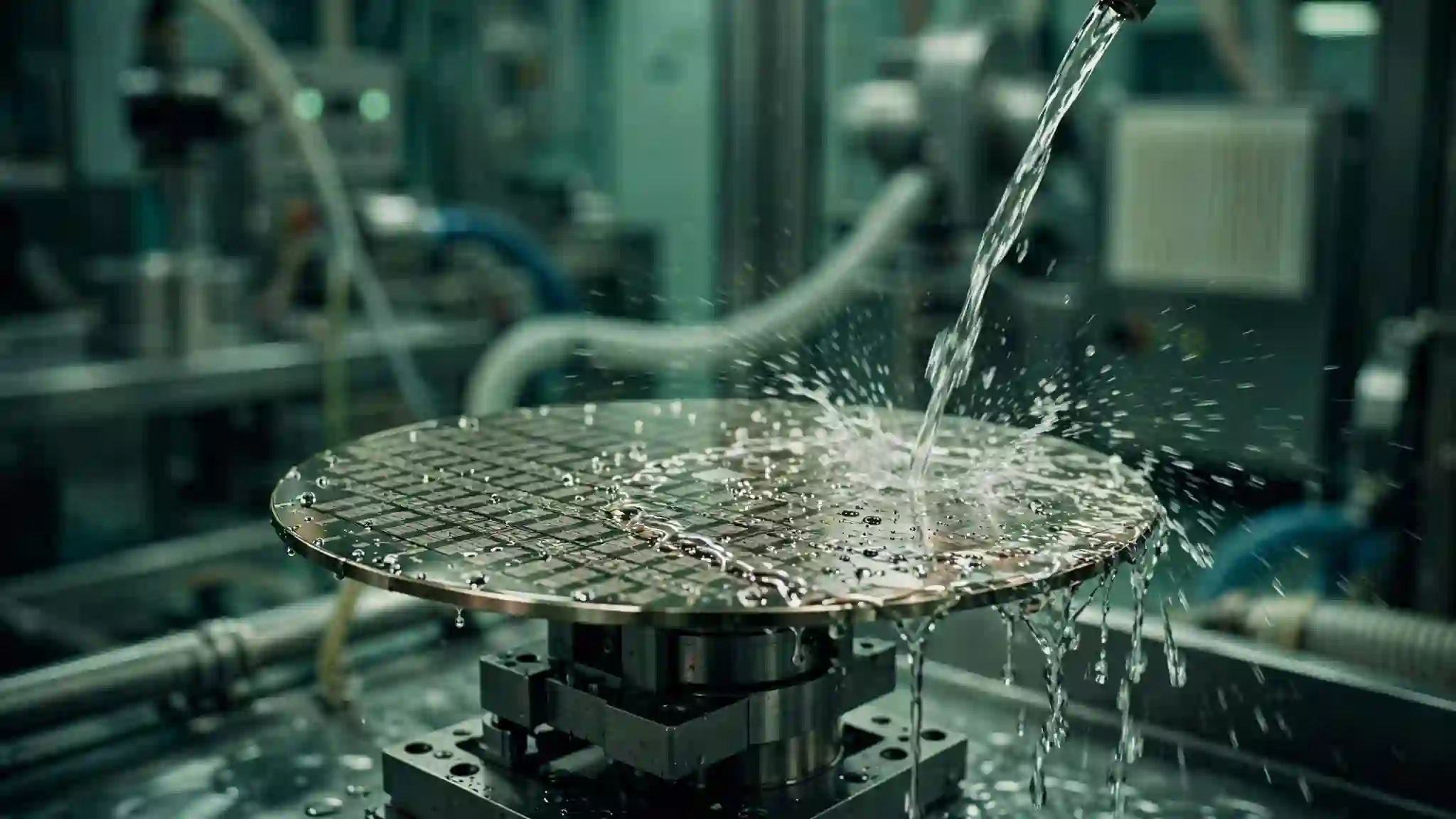

Somewhere in a factory in southern Japan, a company best known for camera film and office copiers just tripled its output of a chemical whose entire job is to rinse microscopic debris off a silicon wafer.
It's not a random bet. It's arguably the clearest sign yet of how deep the AI chip boom's supply-chain squeeze actually runs, and who's quietly become essential to relieving it.
What Fujifilm Actually Just Did
Fujifilm Holdings this month opened a new fabrication building at its factory in Oita, in southern Japan, that will triple production of post-CMP cleaners, chemicals essential for removing particles and residue from silicon wafers after chemical-mechanical polishing (CMP), a core step in advanced chip manufacturing.
The expansion cost roughly ¥7 billion (about $44 million)
Fujifilm made the investment after forecasting the market for these materials would "grow rapidly going forward"
Semiconductors now mark, in Fujifilm's own framing, the most promising growth segment in its business
Revenue from this business grew 25% year-over-year in the April-June 2026 quarter alone
The bottleneck this addresses is a real one. As Bloomberg's reporting put it: "The global expansion of data centers for artificial intelligence has created bottlenecks and shortages across the supply chain," and that pressure has, in turn, "boosted the company better known for its cameras and office copier machines."
How a Film Company Ended Up Here
Fujifilm isn't new to semiconductor materials, but the pace of its buildout has accelerated sharply. The company already produces CMP slurries for copper interconnect polishing, photoresists and photolithography-related materials, thin-film chemicals, and polyimides used in advanced semiconductor packaging.
The underlying logic is one shared by several Japanese chemicals companies right now: adapting decades of precision chemical-engineering expertise, originally built for an entirely different industry, photographic film, toward the extremely exacting demands of chip fabrication. Fujifilm has also said it's developed AI-driven internal tools that help its own engineers identify new chemical formulas in a matter of months, rather than the years that kind of research traditionally required.
| Metric | Figure |
|---|---|
| Oita expansion cost | ¥7 billion (~$44 million) |
| Post-CMP cleaner capacity increase | 3x (tripled) |
| Electronics segment revenue growth (Q1 FY2027, YoY) | +25% |
| Electronics segment sales (FY ended March 2026) | ¥456.2 billion (+11.9% YoY) |
| Electronics segment operating profit (FY ended March 2026) | ¥100.9 billion (+34.4% YoY, 22.1% margin) |
| Legacy business share of group revenue | ~35% |
The Rough Patch Behind the Timing
This buildout isn't happening from a position of comfort. Fujifilm's stock "suffered its worst decline on record last month after earnings disappointed," per Bloomberg, with the company's struggling legacy office-equipment business acting as a persistent drag even as semiconductor materials and imaging (Instax, digital cameras) carried the results.
Fujifilm's response has been to lean harder into the businesses that are actually working, rather than pull back. The company is reportedly considering spinning off its legacy office-equipment unit, which still accounts for roughly 35% of group revenue, into a separately listed company. Fujifilm's stated rationale: separating it out would let that business make its own investment decisions more quickly, while freeing the parent company to commit capital more aggressively to semiconductor materials and its biopharmaceutical contract manufacturing (CDMO) business, the two segments it's positioning as its actual future.
Fujifilm's own long-range plan, VISION2030, targets ¥4 trillion in group sales and a 15%+ operating margin, a goal that explicitly assumes the CDMO business exits its current investment phase and starts generating real profit, while semiconductor materials, already profitable and already growing fast, does more of the heavy lifting in the meantime.
Fujifilm and Semiconductors: FAQ
Fujifilm opened a new fabrication building at its factory in Oita, Japan this month, tripling its production capacity for post-CMP cleaners, chemicals essential for removing particles and residue from silicon wafers after chemical-mechanical polishing. The expansion cost approximately 7 billion yen, or about $44 million.
Chemical-mechanical polishing (CMP) is a step in chipmaking that smooths and flattens layers on a silicon wafer, but it leaves behind particles, minute metal fragments, and organic residue. Post-CMP cleaners are the specialized chemicals used to remove that residue while protecting the metal surface underneath, a step that becomes more critical as chip designs get smaller and more complex, exactly the kind of advanced chips AI data centers depend on.
Revenue from Fujifilm's Electronics segment, centered on semiconductor materials, grew 25% year-over-year in the April-June 2026 quarter. For the fiscal year ending March 2026, the segment posted 456.2 billion yen in sales and 100.9 billion yen in operating profit, a 22.1% operating margin, with sales up 11.9% and operating profit up 34.4% from the prior year.
Fujifilm's legacy office equipment business has stagnated, and the company's stock suffered its worst monthly decline on record after a disappointing earnings report. Semiconductor materials and biopharmaceutical contract manufacturing (CDMO) have become the two pillars Fujifilm is betting its future growth on instead, leveraging chemical engineering expertise originally developed for photographic film.
Yes. Fujifilm is reportedly considering spinning off its legacy office-equipment business, which still accounts for roughly 35% of the group's overall revenue, into a separately listed company. Fujifilm has said doing so would let that unit make its own investment decisions more quickly, while freeing the parent company to focus capital on semiconductor materials and biopharmaceuticals.
Beyond post-CMP cleaners, Fujifilm produces CMP slurries used in copper interconnect polishing, photoresists and photolithography-related materials, thin-film chemicals, and polyimides used in advanced semiconductor packaging. The company has said it's aiming to position itself as a supplier across more of the chipmaking process, including materials for lithography and advanced packaging, and has developed AI-driven tools that it says help engineers identify new chemical formulas in months rather than years.

Jans Bock-Schroeder
Publisher & Founder of AI Angst
Coming from the world of art, photography, and the luxury market, Jans launched AI Angst in 2025 to explore the cultural, ethical, and psychological impacts of artificial intelligence. His work bridges creative vision with critical technology analysis, offering clarity in an era of rapid technological change.
Sources and Citations
This article is based on the following sources:
-
Bloomberg (via Business Standard): "Fujifilm expands key chip material output to capture AI demand" (August 21, 2026)
Primary source for the Oita expansion, investment figure, stock decline, and spin-off consideration.
https://www.business-standard.com/companies/news/fujifilm-expands-key-chip-material-output-to-capture-ai-demand-126082101488_1.html -
FUJIFILM Holdings Corporation: "Fujifilm Announces Financial Results for the First Quarter Ended June 30, 2026" (official filing)
Source for the Electronics segment's quarterly revenue growth and product-line performance.
https://holdings.fujifilm.com/en/news/list/2166 -
Investing.com (Reuters/Nikkei Veritas): "Fujifilm CFO says semiconductor materials demand extremely strong" (July 16, 2026)
Source for CFO Higuchi's comments on demand strength and fiscal 2027 guidance.
https://www.investing.com/news/company-news/fujifilm-cfo-says-semiconductor-materials-demand-extremely-strong-93CH-4795083 -
Seeking Alpha: "Fujifilm: Semiconductor Materials Might Change Its Outlook" (July 14, 2026)
Source for FY2026 Electronics segment sales/profit figures and Fujifilm's revenue-doubling target for the segment by FY2030.
https://seekingalpha.com/article/4921945-fujifilm-semiconductor-materials-might-change-its-outlook
Published: August 21, 2026. Sources verified at time of publication. All external links open in a new tab. This is not financial advice; consult a qualified financial advisor before making investment decisions.