There's a phone call no tech executive wants to make.
It starts with: "We need you back." And it ends with an explanation that the machines, the ones that were supposed to make you redundant, couldn't actually do what you spent thirty years learning to do.
On June 28, 2026, Ford Motor Company made 350 of those calls. And what came out of them is the most honest thing a major corporation has said about artificial intelligence all year.
How Ford Got Here
Let's go back to the moment it started.
Ford Chief Operating Officer Kumar Galhotra makes a call that sounds, at the time, like exactly the right move. He deploys 900 AI-powered cameras across Ford's manufacturing plants. The pitch is compelling: AI doesn't get tired, doesn't miss shifts, doesn't have a bad day. It watches every weld, every panel gap, every paint finish, at scale, constantly, without a coffee break.
Galhotra tells the world Ford is "deploying AI across the entire industrial system" to detect quality issues. It's the future. It's efficient. It's the kind of move that gets written up as visionary.
And the veteran engineers, the ones who'd spent decades developing a sixth sense for what a Ford should feel, sound, and look like coming off the line, they become surplus to requirements.
Then the quality numbers start moving. In the wrong direction.
"Mistakenly, we thought that by just introducing artificial intelligence" quality results would follow. That is not a quote from a critic. That is Charles Poon, Ford's vice president of vehicle hardware engineering, speaking to reporters on June 28, 2026. It may be the most important sentence a car executive has said this decade.
The Thing the Cameras Couldn't See
Here's what the AI cameras were excellent at: detecting defects they had been trained to detect.
And here is the problem. Nobody had taught them everything a veteran Ford engineer knows. Because you can't. Not yet. Not in the way Ford tried.
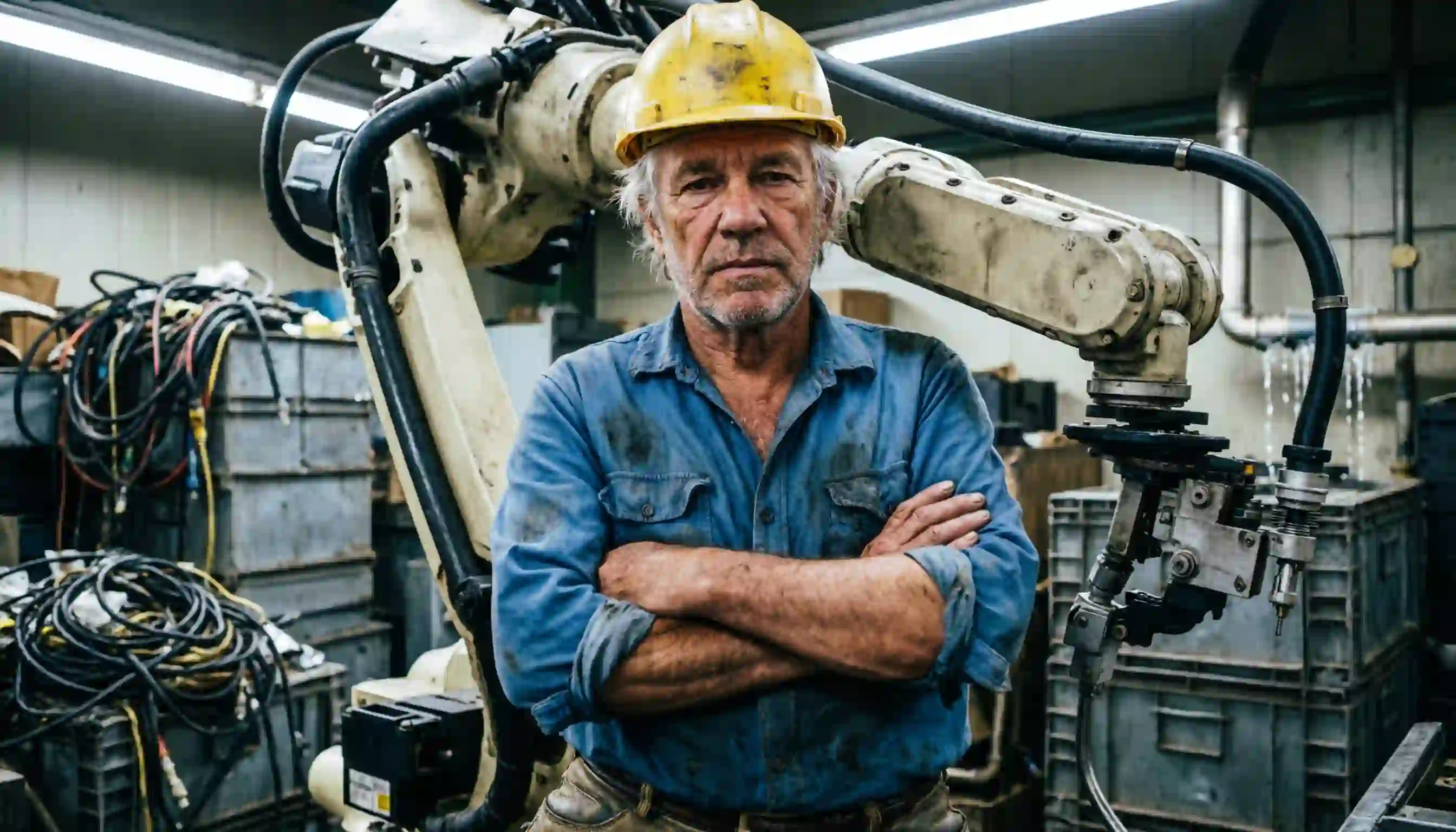
A thirty-year engineer on a Ford line doesn't just check a list. They hear something slightly off in the door seal. They notice a shimmy in the panel that the spec sheet doesn't flag. They carry a mental model of what perfect looks like, built from thousands of cars, hundreds of failures, and institutional knowledge that was never written down because it lived in their hands and their eyes.
AI cameras see what they are trained on. Full stop. The gap between "what was in the training data" and "what actually matters on this line" turned out to be exactly the gap that made Ford's quality slide.
Charles Poon put it cleanly: "Artificial intelligence is a fantastic tool, but it's only as good as the information you use to train it."
The information Ford needed was in the gray beards. And the gray beards had been let go.
The Calls Go Out. 350 People Pick Up.
What Ford does next is the part I find genuinely interesting, because it's not just a reversal. It's smarter than that.
They don't just rehire 350 veteran engineers to replace the cameras. They rehire them to do something more valuable: to teach. Both the junior staff and, critically, the AI tools themselves.
Poon calls them the "gray beard" engineers. And their job now is to encode what they know into the systems that replace them. To sit with the AI, essentially, and show it what it's been getting wrong. To be the training data.
This is the correct sequence. It's just the one Ford skipped the first time.
350 veteran engineers rehired as of June 28, 2026
900 AI cameras remain deployed, but now work alongside human expertise, not instead of it
$1 billion in reduced costs anticipated by Ford for 2026
#1 among mainstream brands in the J.D. Power Initial Quality Study, the industry's most-watched quality benchmark
Gray beards' primary role: training junior engineers and retraining the AI systems with real-world manufacturing knowledge
The result: Ford's best quality numbers in years. A billion dollars of cost reduction on the horizon. And the top spot in the J.D. Power ranking that the entire industry watches.
Not because they got rid of AI. Because they stopped pretending AI doesn't need humans to be any good.
This Is Not a Story About AI Failing
I want to be precise here, because the wrong lesson is easy to draw.
Ford's AI cameras didn't fail because AI is bad at quality control. They failed because Ford tried to run AI quality control without first capturing the expertise that defines quality. The technology was fine. The deployment was backwards.
The right sequence is: knowledge transfer first, AI scaling second. You get the gray beards to explain every defect they've ever seen, every sound that means something's wrong, every gap tolerance that matters even when the spec sheet says it doesn't. You build that into your training data. Then you let the camera learn from it. Then you scale.
Ford went straight to step three. Skipped steps one and two. And paid for it with quality scores, customer complaints, and the cost of undoing what it had just done.
The machines didn't fail Ford. Ford failed the machines, by giving them an incomplete education and expecting expert-level results.
| Date / Period | Ford AI Quality Milestone |
|---|---|
| 2023–2024 | COO Kumar Galhotra leads Ford's AI quality initiative. 900 AI-powered cameras deployed across manufacturing plants to automate quality detection. |
| 2024–2025 | Veteran engineers are progressively removed from quality roles as AI systems take over. Ford publicly states it is "deploying AI across the entire industrial system." |
| 2025 | Quality metrics begin declining. AI cameras detect what they were trained on, but miss the contextual, experiential defects that veteran engineers identified instinctively. |
| Early 2026 | Ford leadership acknowledges quality gap. VP Charles Poon begins internal review of AI quality system performance versus human benchmark. |
| June 28, 2026 | Ford rehires 350 veteran "gray beard" engineers. Poon tells reporters: "Mistakenly, we thought that by just introducing artificial intelligence" quality would follow. |
| 2026 (projected) | Ford anticipates $1 billion in reduced costs. Secures #1 ranking among mainstream brands in J.D. Power Initial Quality Study. Gray beards now training junior staff and retraining AI systems. |
The Hype That Started All This
Ford's story didn't happen in isolation. It's the inevitable consequence of an industry that promised AI would replace expertise, and got the sequence wrong.
The AI Realist
Neither panic nor blind faith. The framework for thinking clearly about what AI can and cannot actually do, in factories, in offices, in your life.
Demystify AI
Training data, xG, MoE, RLHF, every term explained. Including why "AI is only as good as its training data" is the most important sentence in the Ford story.
Ford AI Backfire: FAQ
Ford deployed 900 AI-powered cameras across its manufacturing plants as part of a broad quality push led by COO Kumar Galhotra. The systems were intended to detect defects that veteran engineers had previously caught by hand and eye. The automated tools failed to match the expertise of experienced technicians, and vehicle quality deteriorated. On June 28, 2026, Ford rehired 350 veteran engineers — the very people the AI had been brought in to replace.
Ford rehired 350 veteran engineers on June 28, 2026, following the failure of its AI-powered quality control systems. These engineers, informally called "gray beard" engineers by VP Charles Poon, are now being used to train junior staff and to reprogram the AI tools themselves, grounding the machine learning systems in real-world manufacturing expertise that was missing from the original deployment.
Charles Poon is Ford's vice president of vehicle hardware engineering. He told reporters directly: "Mistakenly, we thought that by just introducing artificial intelligence" quality results would follow. He acknowledged that the AI tools lacked the contextual expertise of veteran technicians, and confirmed that Ford now uses its gray beard engineers to train both junior staff and the AI systems. Poon also stated: "Artificial intelligence is a fantastic tool, but it's only as good as the information you use to train it."
Ford's revised strategy is a human-AI hybrid model. Veteran engineers are deployed to train junior staff and to reprogram the AI quality systems with accumulated manufacturing expertise. Ford continues to use AI alongside its human workforce, not instead of it, with veteran engineers acting as the primary knowledge source from which AI tools learn. Galhotra's 900 cameras remain deployed but now work in conjunction with human oversight.
Following the talent refresh and hybrid AI-human approach, Ford anticipates $1 billion in reduced costs in 2026. The company also secured the top spot among mainstream automotive brands in the J.D. Power Initial Quality Study, one of the most widely cited benchmarks in vehicle manufacturing. Both outcomes were attributed to the combination of reinstated veteran expertise and AI working in concert, not AI operating independently.
The core failure was a training data problem. AI quality systems learn to detect defects based on the examples they are trained on. Without the accumulated knowledge of veteran engineers, who recognise subtle, context-dependent issues that don't always manifest as visually obvious defects, the AI cameras worked from an incomplete picture of what "good" and "bad" actually looks like on a Ford assembly line. Charles Poon identified this precisely: the machine was sophisticated, but the knowledge baked into it was insufficient.
No. The Ford story is not a refutation of AI in manufacturing, it is a lesson in how to deploy it correctly. AI quality systems work when trained on rich, expert-verified data. Ford's mistake was deploying AI as a direct replacement before the AI had been trained on that expertise. The corrected approach, using gray beard engineers to ground the AI in deep institutional knowledge, is the model that works. AI amplifies expert knowledge; it cannot substitute for knowledge it was never given.
Kumar Galhotra is Ford's Chief Operating Officer. He led the company's AI quality initiative, deploying 900 AI-powered cameras across Ford's plants and publicly stating Ford was "deploying AI across the entire industrial system" to detect quality issues. When the AI systems failed to deliver expected quality levels, the company course-corrected under Galhotra's watch by rehiring veteran engineers and adopting the hybrid human-AI approach now producing Ford's best quality results in years.
Gray beard engineers is the informal term used by Ford VP Charles Poon to describe the company's most experienced veteran technicians, engineers with decades of hands-on manufacturing knowledge built through years on the factory floor. These individuals carry institutional memory that is difficult to formalise and nearly impossible to replicate from scratch in an AI training dataset. After Ford's AI push failed, the gray beards were rehired specifically to transfer their knowledge, both to younger engineers and directly into the AI systems, by helping define what constitutes acceptable quality from first principles.
The Ford story is a case study in what happens when AI is deployed as a cost-cutting replacement for expertise rather than as an amplifier of it. AI models are only as capable as the data they are trained on. When companies remove the human experts who hold that knowledge before encoding it into the AI system, they lose both the human intelligence and the machine intelligence simultaneously. The correct sequence: capture expert knowledge first, train the AI on it second, then use AI to scale and extend that expertise. Not replace it before it has been transferred.
Jans Bock-Schroeder
Publisher & Founder of AI Angst
Coming from the world of art, photography, and the luxury market, Jans launched AI Angst in 2025 to explore the cultural, ethical, and psychological impacts of artificial intelligence. His work bridges creative vision with critical technology analysis, offering clarity in an era of rapid technological change.
Sources and Citations
This article is based on the following primary sources and reporting:
-
Ford Motor Company: Press statements and executive comments, June 28, 2026
Primary source for the rehiring of 350 veteran engineers, Charles Poon's quotes on AI limitations, Kumar Galhotra's AI camera deployment, and the $1 billion cost reduction projection.
https://media.ford.com/ -
J.D. Power — "2026 Initial Quality Study" (IQS)
Source for Ford's #1 ranking among mainstream automotive brands in the 2026 Power Initial Quality Study.
https://www.jdpower.com/business/press-releases -
Reuters / Wall Street Journal: Ford AI quality reporting, June 2026
Secondary sourcing for executive statements, plant deployment context, and industry reaction to Ford's course correction.
https://www.reuters.com/business/autos-transportation/ -
AI Angst: "After the AI Hype: The Brutal Truth No One Wants to Hear" (2026)
Context for the broader AI hype cycle and the structural pattern of deploying AI before capturing expert knowledge, which the Ford case exemplifies.
aiangst.com/after-the-ai-hype
Last verified: June 29, 2026. All external links open in a new tab.