This Sunday, a new rule quietly kicks in across all 27 EU member states: if content was made or altered by AI, in a lot of cases, it now has to say so, out loud, where you can actually see it.
The fines for getting this wrong are large enough to get any general counsel's attention. The strange part is that the European Commission's own guidance admits the technology to do this properly isn't fully ready.
What Actually Changes on August 2
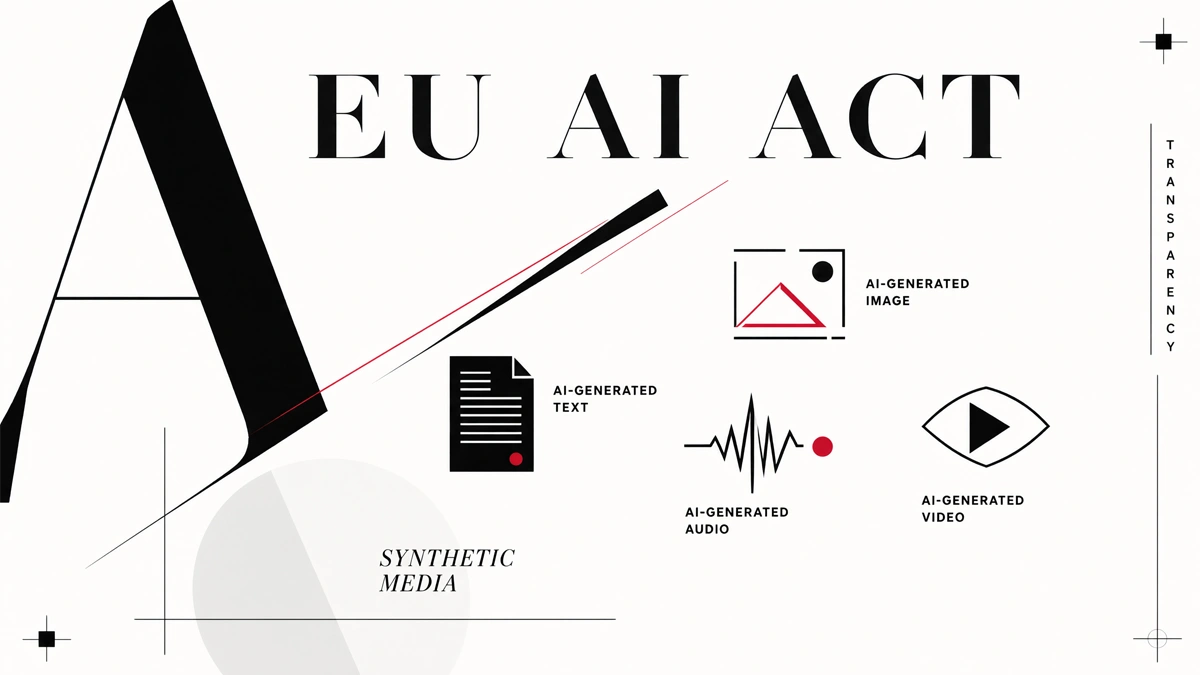
Article 50 of the EU AI Act is the section behind this. It targets what the law calls "transparency risk," AI systems capable of deceiving people about whether they're dealing with a machine, or whether content in front of them was made by one.
Deepfakes: AI-generated or manipulated image, audio, or video that resembles real people, places, or events must be disclosed as artificial
Public-interest text: AI-generated or AI-manipulated text published to inform the public on matters of public interest must be labeled
Chatbots and interactive systems: users must be told when they're talking to an AI rather than a person
A vague label doesn't count. Regulators have specifically ruled out things like a tiny disclosure buried in a footer, a faint watermark on an image, or a label that flashes for a single frame of video
The obligation only applies going forward: content already published before August 2 doesn't need retroactive labeling, but anything published after that date does, even if it was actually created earlier.
Who's Actually Exempt
Not everything AI touches needs a label. Two carve-outs matter most:
Genuine editorial review: if a person or team has actually reviewed AI-generated content and taken clear responsibility for the final version, it doesn't need a label. A superficial "skim" doesn't qualify; regulators are explicit that this exemption requires real review with clear accountability assigned.
Artistic and satirical content: clearly fictional, creative, or satirical AI-generated work gets lighter-touch disclosure treatment than content meant to inform the public.
| Date | What Happens |
|---|---|
| August 2024 | The EU AI Act formally enters into force, with Article 50 already written into it |
| July 22, 2026, 6pm CEST | Deadline for companies to sign the voluntary Code of Practice and appear on the initial signatory list |
| August 2, 2026 | Visual labeling obligation takes effect: deepfakes, public-interest AI text, and chatbot disclosures |
| December 2, 2026 | Machine-readable marking mandate takes effect, plus a grace period for systems already on the market before August 2 |
Why Even Brussels Admits the Tech Isn't All the Way There
Here's the part that's caught outside attention. The Commission's own Code of Practice on marking and labelling AI-generated content, the voluntary framework companies can sign to demonstrate compliance, openly states that no single watermarking technology currently meets all four statutory requirements at once.
Its answer is a layered approach: combining metadata embedding, imperceptible watermarking, and activity logging together, specifically because each method has failure modes the others don't cover. As one legal analysis of the Code put it, the framework "sets out how to meet the transparency obligations before common evaluation standards have fully emerged," meaning companies are being asked to demonstrate compliance ahead of the technical benchmarks that would let anyone measure that compliance consistently.
Signing the Code isn't mandatory, but it isn't nothing either: it shifts the burden of proof toward regulators rather than the company, giving signatories a presumption of conformity. Companies that skip it face more frequent information requests and have to demonstrate their own compliance measures are adequate, unassisted, to market surveillance authorities.
EU AI Labels: FAQ
Article 50 of the EU AI Act requires that AI-generated deepfakes and AI-generated or manipulated text published on matters of public interest be clearly and visibly labeled, and that people be informed when they're interacting with an interactive AI system such as a chatbot. The visual labeling obligation takes effect August 2, 2026.
Deepfakes, meaning AI-generated or manipulated image, audio, or video content that resembles real people, places, or events, must be disclosed as artificially generated. AI-generated or AI-manipulated text published to inform the public on matters of public interest must also be labeled, unless it has gone through genuine human editorial review with clear accountability.
Non-compliance can carry fines of up to 15 million euros, or up to 3% of a company's total worldwide annual turnover for the prior financial year, whichever is higher. Smaller companies benefit from the lower of the two figures rather than automatically facing the percentage-based calculation.
Yes. Content that has undergone genuine human editorial review, with a clear individual or team taking responsibility for the final version, doesn't need an AI label, though a superficial or nominal review isn't enough to qualify. There are also separate, lighter-touch disclosure rules for clearly artistic, creative, satirical, or fictional AI content.
A standardized visual label, currently proposed as an "AI" mark localized per language, such as "KI" in German or "IA" in French, has been proposed as part of the European Commission's voluntary Code of Practice, alongside a taxonomy separating "fully AI-generated" from "AI-assisted" content. It is not yet a single finalized, mandatory design across all member states.
The Commission's own Code of Practice acknowledges that no single watermarking or metadata technology currently satisfies all of the law's technical requirements at once, so it recommends a layered approach combining metadata embedding, imperceptible watermarking, and logging, each covering gaps the others can't. A separate machine-readable marking mandate doesn't take effect until December 2, 2026, later than the August visual-labeling deadline.

Jans Bock-Schroeder
Publisher & Founder of AI Angst
Coming from the world of art, photography, and the luxury market, Jans launched AI Angst in 2025 to explore the cultural, ethical, and psychological impacts of artificial intelligence. His work bridges creative vision with critical technology analysis, offering clarity in an era of rapid technological change.
Sources and Citations
This article is based on the following sources:
-
European Commission — "Commission publishes Code of Practice on marking and labelling AI-generated content" (Shaping Europe's Digital Future, June 10, 2026)
Primary official source for the Code of Practice and the August 2, 2026 effective date.
https://digital-strategy.ec.europa.eu/en/news/commission-publishes-code-practice-marking-and-labelling-ai-generated-content -
Tech Times — "EU Finalizes AI Disclosure Rules as Watermarking Mandate Outpaces Technology" (July 21, 2026)
Source for the Code of Practice signatory deadline and the watermarking-technology gap.
https://www.techtimes.com/articles/321174/20260721/eu-finalizes-ai-disclosure-rules-watermarking-mandate-outpaces-technology.htm -
Addleshaw Goddard LLP — "EU AI Act: Code of Practice on marking and labelling AI-generated content" (2026)
Source for the December 2026 grace period and the Code's Commitment structure.
https://www.addleshawgoddard.com/en/insights/insights-briefings/2026/technology/eu-ai-act-code-practice-marking-labelling-ai-generated-content/ -
artificialintelligenceact.eu — "The EU AI Act's Transparency Rules: A Practical Guide to Article 50" (May 14, 2026)
Source for the "clear and distinguishable" labeling standard and the proposed EU visual label.
https://artificialintelligenceact.eu/transparency-rules-article-50/ -
Lausen Rechtsanwälte — "Section 50 of the AI Act: Labeling requirement effective August 2026" (May 18, 2026)
Source for fine amounts and the editorial-review exemption criteria.
https://lausen.com/en/section-504-of-the-ai-act-what-organisations-must-label-as-ai-content-from-august-2026/
Published: July 30, 2026. Sources verified at time of publication. All external links open in a new tab. Final Article 50 guidelines were still subject to consultation as of this writing; details may be updated before or shortly after the August 2, 2026 effective date.