The five companies building most of the world's AI infrastructure are set to spend more than a trillion dollars doing it, in two years. That figure alone would be striking. What makes it newsworthy is who just flagged it as a risk: not a short-seller, not a rival, but the Bank for International Settlements, the institution that exists to watch central banks watch everyone else.
In its Annual Economic Report 2026, released this June, the BIS didn't just note the size of the AI buildout. It lined it up against four historical investment manias, and none of the comparisons were flattering.
The Trillion-Dollar Bet
The report's starting point is simple: AI's productivity case is real but still unproven at scale. Task-level studies point to large efficiency gains, commonly in the 20 to 50% range for time saved on specific tasks like coding or customer support. But aggregate productivity growth estimates across the whole economy are far more modest, under 1% over a long horizon, reflecting how hard it is to adopt a new technology broadly and fold it into existing ways of working.
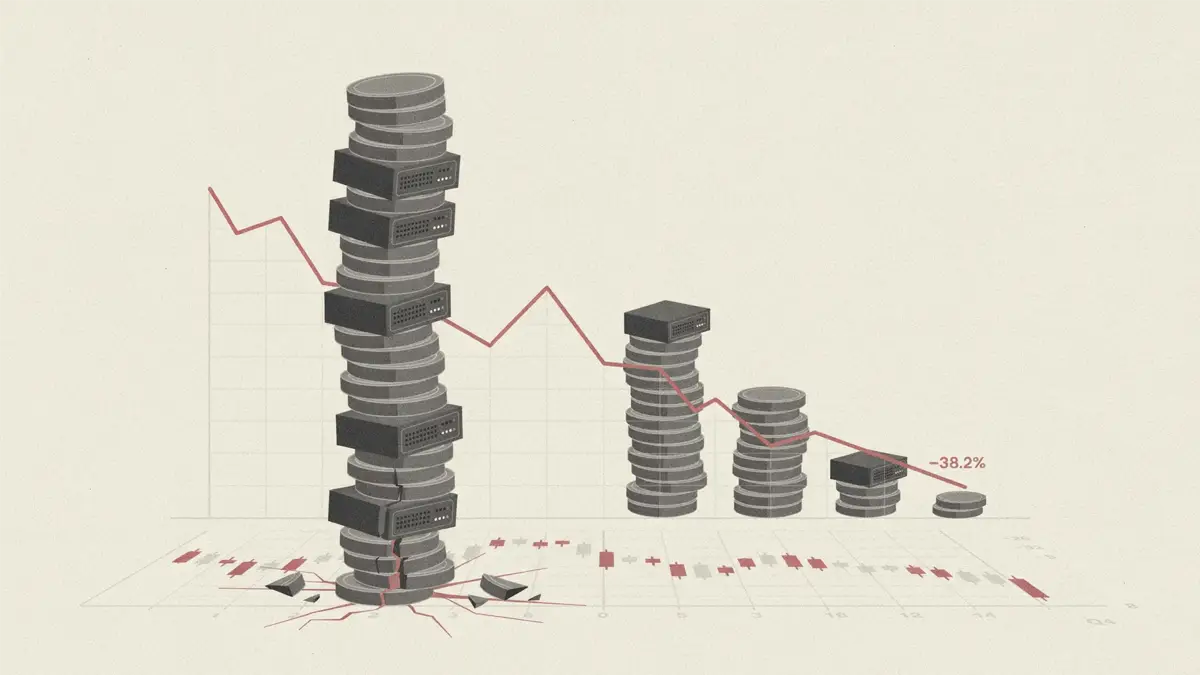
That gap between task-level promise and economy-wide delivery hasn't slowed the spending. The BIS puts a number on it: the five largest hyperscalers are on pace to spend over a trillion dollars on AI-related capital expenditure across 2025 and 2026 combined. Crucially, the report notes those commitments are outpacing the firms' own earnings and free cash flow, pushing some of them to issue debt just to keep the buildout going.
The five largest hyperscalers are set to spend over $1 trillion on AI capex from 2025 through 2026
That spending is outpacing earnings and free cash flow, driving some firms toward new debt issuance
One cited industry projection puts cumulative AI capex commitments at $3 to 4 trillion through 2030
Growing bottlenecks in electricity, advanced semiconductors, and grid equipment are already pushing up power prices and input costs
US stocks, heavily weighted toward AI-linked names, now make up roughly 64% of the MSCI Global index
Why would firms with uncertain returns keep raising the stakes? The BIS points to a winner-take-most contest dynamic: with a widespread belief that only a handful of players with superior technology will end up dominating the market, competitors may be over-committing to projects with genuinely uncertain payoffs just to avoid being shut out. Modelling that contest structure, the report finds that as competitive capex rises, the net economic surplus for the AI sector as a whole, total payoff minus investment cost, actually declines, and could turn negative in adverse scenarios.
The Financing Is Getting Harder to See Through
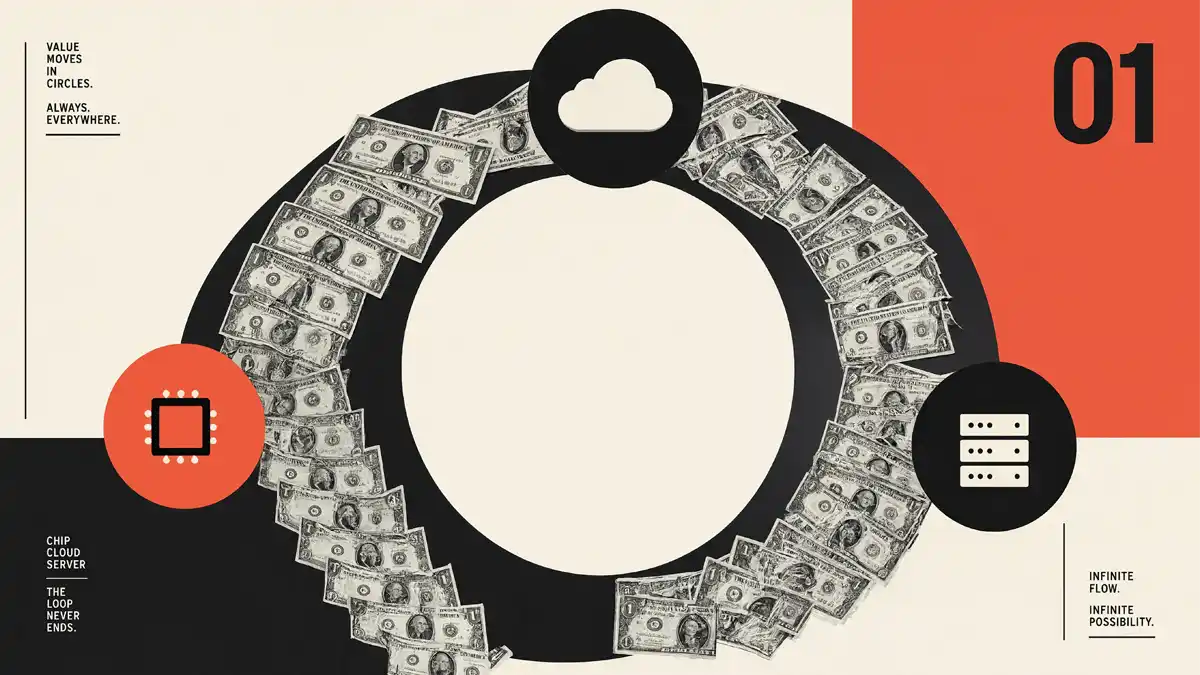
Part of what worries the BIS isn't just the size of the spending, it's how opaque the financing behind it has become. Hyperscalers, chip makers, and AI labs are increasingly linked through private arrangements the report calls circular financing: chip makers and hyperscalers take equity stakes in AI labs or "neocloud" providers, who in turn commit to multi-year purchases of chips or computing power, sending the capital right back around as reported revenue.
Layer onto that a wave of data-centre construction that's increasingly outsourced to third parties and leased back to hyperscalers on long-dated contracts, sometimes with the same underlying assets pledged more than once, and the report says these arrangements now account for a sizeable share of sector-wide financing and forward revenue. Credit spreads on some AI-linked issuers have already started to widen, even as equity markets keep pricing in significant further upside.
The BIS also flags a second, less obvious channel: engineering, procurement, and construction contractors that build out the physical data-centre footprint. Their balance sheets are comparatively weak, and the report notes they would be among the first exposed if hyperscalers ever slowed or paused their capex pace.
| Metric | Figure | Source |
|---|---|---|
| Hyperscaler AI capex, 2025–2026 combined | Over $1 trillion | BIS Annual Economic Report 2026 |
| Projected cumulative AI capex commitments through 2030 | $3–4 trillion | BIS Annual Economic Report 2026, citing industry projection |
| Task-level AI productivity gains (time saved) | 20–50% | BIS Annual Economic Report 2026 |
| Aggregate long-run productivity growth estimate from AI | Under 1% | BIS Annual Economic Report 2026 |
| US share of the MSCI Global equity index | ~64% | BIS Annual Economic Report 2026 |
Four Futures, and One the BIS Invented a Name For
Beyond the near-term financing risk, the report's Box C takes a longer view, asking whether AI could break the historical link between human idea-generation and long-run economic growth. It sketches four scenarios rather than a single forecast.
Under "business as usual," labour remains the binding constraint and growth stays near its historical trend of around 2% a year. Under a "bounded productivity boost," trend growth shifts up by a constant margin, something the report notes hasn't happened since the Industrial Revolution. Under "transformative AI," the technology becomes a self-improving, self-reinforcing growth engine, output expands exponentially, and labour's share of income falls toward zero.
The fourth scenario is the report's own contribution to the debate: a "demand bottleneck." As automation shifts income away from displaced workers and into further AI investment, the consumer base that would justify continued capacity expansion can erode. Forward-looking firms, seeing a shrinking future market for AI-produced goods and services, may find it unprofitable to automate the next task, not because the technology hits a wall, but because the demand to justify further investment simply isn't there. In this scenario, growth rises initially, then falls below its historical trend as the bottleneck takes hold.
The scenarios matter beyond growth forecasting; they shape the report's read on interest rates. The natural rate of interest, or r-star, rises under the productivity-boost and transformative scenarios, but under the demand-bottleneck scenario it rises at first and then falls below its pre-AI baseline. Which path plays out, the report says, depends on things nobody currently has firm numbers for: how reliant AI profits are on consumer demand, how fast competition erodes margins, and how quickly AI infrastructure becomes obsolete.
Why This Time Might Hit Harder
The BIS argues a correction today could travel further than in past tech cycles, for reasons that have little to do with AI itself. Household equity exposure has grown substantially as a share of both wealth and income over recent decades, meaning a sharp valuation reset would likely produce a more pronounced wealth effect and consumption pullback than in previous downturns. And with US equities, heavily concentrated in AI-linked names, making up roughly 64% of the MSCI Global index, a US-led repricing has more room to travel internationally than it once did.
There's also a credit channel. The report notes that broad indices of credit spreads tend to move against stock returns, more so in high-yield than investment-grade debt, and that large, synchronised corrections in both markets are rare but not unprecedented, pointing to the Great Financial Crisis and the March 2020 "dash for cash" as examples. A repricing of AI-linked risk, the BIS warns, has the potential to trigger a broader corporate credit freeze, one that could spill into the less transparent private credit market that has expanded rapidly among mid-sized and small firms. That segment, the report notes, already shows early stress signs, including rising redemption requests at direct lending funds.
AI Investment Sustainability: FAQ
According to the BIS Annual Economic Report 2026, the five largest hyperscalers are on track to spend over a trillion US dollars on AI-related capital expenditure across 2025 and 2026 combined, a pace that is outrunning their earnings and free cash flow and pushing some of them toward debt issuance to keep funding it.
The BIS describes a pattern where chip makers and hyperscalers take equity stakes in AI labs or "neocloud" providers, who then commit to multi-year purchases of chips or computing power, effectively recycling capital back to investors as reported revenue. Combined with data-centre leaseback deals whose terms are often poorly disclosed, the report says these arrangements account for a sizeable share of sector-wide AI financing and forward revenue, which makes the sector's real financial health harder to assess from the outside.
It's genuinely uncertain. The report models four scenarios: growth stays near its historical trend; growth gets a one-off permanent boost; AI becomes a self-reinforcing "transformative" growth engine; or a "demand bottleneck" emerges where automation shifts income away from workers faster than new demand can replace it, causing growth to eventually fall below its historical trend. Which scenario plays out depends on factors that are still unknown, including how much AI profits depend on consumer spending and how fast AI infrastructure becomes obsolete.
The report places the AI capex surge alongside the canal mania of the 1830s, the British railway mania of the 1840s, the electrification-driven exuberance of the "Roaring Twenties," and the dotcom boom of the late 1990s. It notes all four episodes involved a genuine technological breakthrough that attracted capital beyond what commercial returns could ultimately justify, and all four ended in an investment reversal with broader economic fallout.
The BIS points to several channels: stretched equity valuations concentrated in a small number of AI-linked stocks, rising household equity exposure that would amplify any wealth-effect hit to consumer spending, growing hyperscaler and AI-lab debt issuance, and spillover risk into the less transparent private credit market that has expanded among mid-sized and small firms, a segment already showing early stress signs such as rising redemption requests at direct lending funds.

Jans Bock-Schroeder
Publisher & Founder of AI Angst
Coming from the world of art, photography, and the luxury market, Jans launched AI Angst in 2025 to explore the cultural, ethical, and psychological impacts of artificial intelligence. His work bridges creative vision with critical technology analysis, offering clarity in an era of rapid technological change.
Sources and Citations
This article is based on the following source:
-
Bank for International Settlements: "Annual Economic Report 2026" (June 2026)
Primary source for all figures and analysis in this article, drawn from Chapter I, "Progress and peril," including the section "AI progress and investment boom under pressure" and Box C, "Transformative AI, long-term growth and r-star." Published by the BIS Monetary and Economic Department; views expressed in the original report do not necessarily reflect those of BIS member central banks.
https://www.bis.org/publ/arpdf/ar2026e.htm
Published: August 20, 2026. All external links open in a new tab.