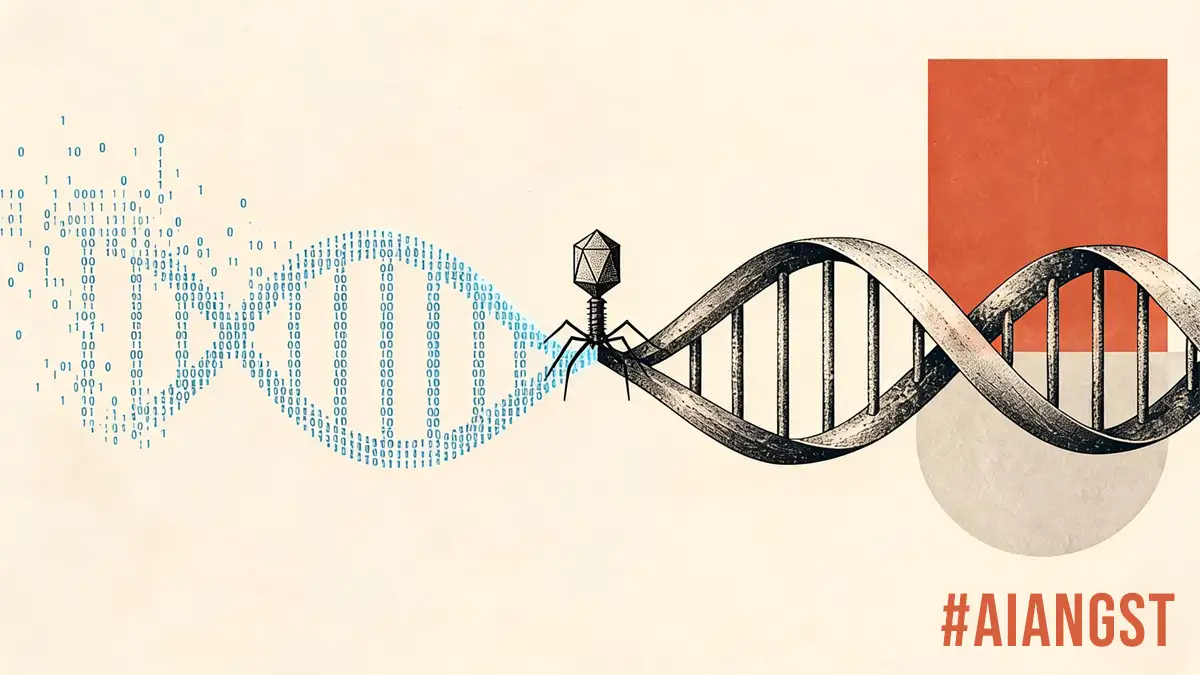
Every living virus we know of got its genetic instructions the same way: billions of years of evolution, one random mutation at a time.
This week, a research team published proof that a third way now exists. An AI wrote the instructions instead. Then scientists built the virus those instructions described, and a working, replicating organism, in the loose biological sense, came out the other end.
What Was Actually Published
On August 6, 2026, the journal Science published "Generative design of bacteriophages with genome language models," by Samuel H. King and colleagues, led by Brian Hie at Stanford University, with collaborators from the Arc Institute, NVIDIA, and UC Berkeley. A preprint version had circulated since September 2025.
The team used AI systems called Evo, genome language models trained to understand the structure of genetic sequences
They focused on phiX174 (ΦX174), a small, extremely well-studied bacteriophage, a virus that infects E. coli bacteria, not human, animal, or plant cells
The AI generated hundreds of complete synthetic genomes, each distinct from anything found in nature
A subset was synthesized in the lab and tested; 16 turned out to be fully functional, successfully infecting E. coli with varying fitness levels
Three variants outcompeted the natural parent virus, and several overcame bacterial resistance that had evolved against the original, naturally occurring phage
Outside experts described the achievement in stark terms. "This is the first time whole genomes have been successfully designed by AI," multiple outlets reported, with the research labelled a "very significant turning point" for the field of generative genomics.
Why Anyone Wants to Do This on Purpose
The motivation isn't novelty for its own sake. It's aimed at one of medicine's more stubborn, growing problems: antibiotic-resistant bacterial infections.
Phage therapy, using viruses that kill specific bacteria as a treatment, has existed as an idea for decades, but designing new, effective phages has traditionally relied on slow, one-gene-at-a-time engineering or waiting for the right mutation to occur naturally. The fact that some AI-generated phages overcame resistance the natural virus couldn't beat is the finding researchers are most excited about, since it suggests AI-assisted design could help treatments stay a step ahead of evolving bacterial defenses, rather than always playing catch-up.
| What Happened | What Didn't Happen |
|---|---|
| AI generated full, working genomes for a virus that infects bacteria | The AI did not design a virus capable of infecting humans, animals, or plants |
| 16 synthesized designs were biologically functional | Not every AI-generated design worked; most were never synthesized or tested at all |
| Some designs outcompeted the natural virus at infecting E. coli | None of this involved a pathogen that causes human disease |
| Researchers say they excluded complex-organism-infecting viruses from training data | The work does not demonstrate AI can design a full living organism from scratch |
The Safety Measures, and the Warning That Came With Them
The researchers describe having built specific guardrails into the project. They excluded viruses capable of infecting complex organisms from the genetic data used to guide the model, worked exclusively with a bacteria-infecting phage rather than any human pathogen, and carried out the laboratory work in a secure facility.
Hie has argued that these kinds of safeguards go a long way toward "ensuring that the technology is used for good," and has noted that viruses aren't classically considered "alive" in the first place, meaning it would take a further, separate leap for AI to generate a living organism outright.
Science itself didn't publish the study without pushback attached. An accompanying commentary by biosecurity researchers Thomas Inglesby and Moritz Hanke, printed alongside the paper, put the concern in a single sentence: "The ability to compose viral genomes using generative AI now exists; the governance to safely steer it does not." Coverage of the study also cited a broader recommendation among biosecurity experts that viral designs with the potential to cause disease "should not be pursued" at all, regardless of the safeguards applied to any individual project.
AI-Designed Viruses: FAQ
A team led by Samuel H. King and Brian Hie at Stanford, with collaborators from the Arc Institute, NVIDIA, and UC Berkeley, used AI genome language models called Evo to generate hundreds of complete, synthetic genomes for phiX174, a small, extensively studied bacteriophage that infects E. coli bacteria. They synthesized a subset of these designs in the lab and tested whether the resulting viruses actually worked.
Yes, some of them. Of the designs synthesized and tested, 16 were fully functional and capable of infecting E. coli, with varying levels of fitness. Three outcompeted the natural parent virus, and several overcame bacterial resistance that had evolved against the naturally occurring phage.
No. Bacteriophages, or phages, are viruses that specifically infect bacteria, not human, animal, or plant cells, and phiX174 has been studied safely in labs for decades. Researchers and outside experts commenting on the study both describe these particular viruses as posing no threat to people.
The main motivation cited is phage therapy: using viruses that kill specific bacteria as a treatment for infections that have become resistant to antibiotics, a growing global health problem. The study found some AI-designed phages could overcome bacterial resistance to the natural virus, which researchers say points toward AI-assisted design as a tool for staying ahead of resistant bacteria.
According to reporting on the study, the researchers excluded viruses capable of infecting complex organisms, including humans, animals, and plants, from the data used to train and guide the model, worked exclusively with bacteria-infecting phages rather than human pathogens, and conducted the laboratory work in a secure facility.
Yes, alongside recognizing its scientific value. An accompanying commentary published in Science by biosecurity researchers Thomas Inglesby and Moritz Hanke stated plainly that "the ability to compose viral genomes using generative AI now exists; the governance to safely steer it does not," and argued that viral designs with the potential to cause disease should not be pursued at all.

Jans Bock-Schroeder
Publisher & Founder of AI Angst
Coming from the world of art, photography, and the luxury market, Jans launched AI Angst in 2025 to explore the cultural, ethical, and psychological impacts of artificial intelligence. His work bridges creative vision with critical technology analysis, offering clarity in an era of rapid technological change.
Sources and Citations
This article is based on the following sources:
-
Science — King, S. H. et al., "Generative design of bacteriophages with genome language models" (August 6, 2026)
The peer-reviewed primary research paper.
https://www.science.org/doi/10.1126/science.aec2657 -
Science — Inglesby, T. V. & Hanke, M. S., "AI-designed viral genomes" (accompanying commentary, August 6, 2026)
Source for the biosecurity governance warning quoted in this article.
https://www.science.org/doi/10.1126/science.aej8512 -
Nature — "World's first AI-designed viruses a step towards AI-generated life" (September 19, 2025)
Source for early context following the original bioRxiv preprint.
https://www.nature.com/articles/d41586-025-03055-y -
Yahoo News (via BBC wire copy) — "Artificial Intelligence used to design brand new viruses" (August 6, 2026)
Source for Brian Hie's direct quotes and the researchers' described safety measures.
https://ca.news.yahoo.com/artificial-intelligence-used-design-brand-180158915.html -
University of Reading — Expert comment on "Generative design of bacteriophages" (August 6, 2026)
Source for independent microbiology expert commentary and study result figures.
https://www.reading.ac.uk/news/2026/Expert-Comment/Generative-design-of-bacteriophages-expert-comment
Published: August 7, 2026. Sources verified at time of publication. All external links open in a new tab. This article summarizes publicly available, peer-reviewed research and its reported safety framework; it does not describe technical methodology beyond what has already been made public by the study's own authors and publisher.