We're Thinking About AI All Wrong
In a world captivated by the rapid advancements of Large Language Models (LLMs), one of the founding fathers of artificial intelligence offers a starkly different perspective.
September 30, 2025 JBS
In a world captivated by the rapid advancements of Large Language Models (LLMs), one of the founding fathers of artificial intelligence offers a starkly different perspective.
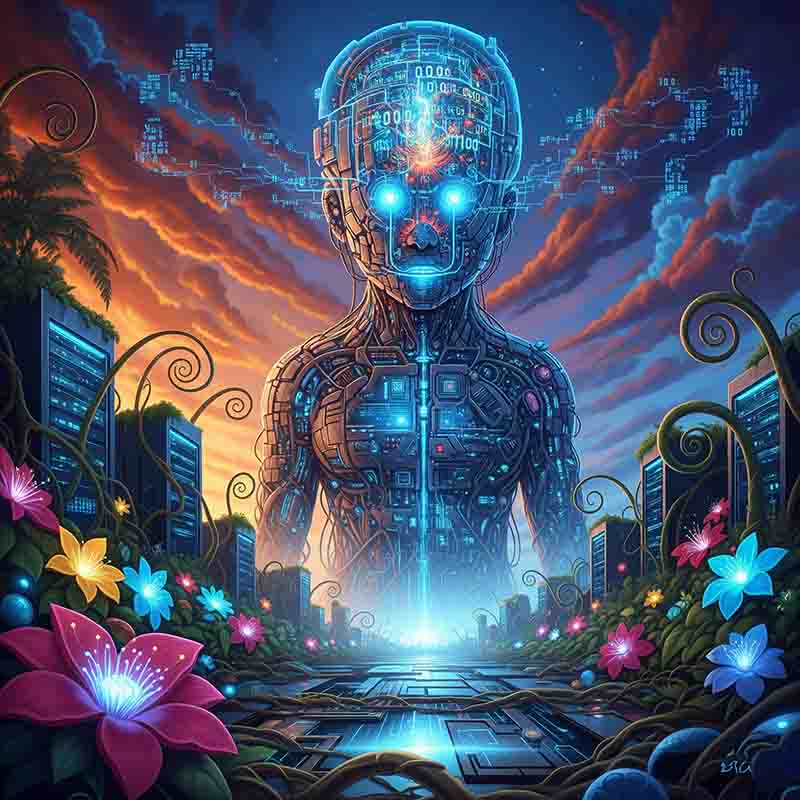
In the quest to build artificial intelligence, two paradigms now stand in stark opposition. The first, embodied by Large Language Models (LLMs), sees intelligence as a masterful mimicry of vast human knowledge.
In the current AI landscape, Large Language Models (LLMs) are undisputed titans. Their stunning capabilities have captured the public imagination and dominate the field's discourse. But what if this entire approach, for all its power, is a fundamental detour from the path to true intelligence?
Richard Sutton, a Turing Award winner and a founding father of reinforcement learning, believes it is. He presents a powerful critique of the modern AI paradigm. Sutton argues not as a mere contrarian, but as a “classicist” calling the field back to its first principles.
He believes we’ve lost track of what “basic AI” is. For Sutton, the path forward isn’t found in better mimicry of human text, but in building agents that learn from the raw data of life itself.
His argument unfolds across five surprising claims that challenge the very foundations of the LLM revolution.
At the heart of Sutton's critique is a philosophical chasm. He argues that LLMs, trained on the internet's vast library of human text, are not learning about the world itself. They are learning to predict what a person would say about the world. They are mimicking entities, people, who possess world models, but they are not building those models themselves.
This distinction is not merely academic; it strikes at the core of what it means to learn. Citing Alan Turing, Sutton defines learning as coming from “experience, where experience is the things that actually happen in your life. You do things, you see what happens, and that's what you learn from.”
This is an active, embodied process of cause and effect. LLMs, by contrast, are passive absorbers of static data. For Sutton, a true world model enables a system to predict what will happen next in the world, not just what a person would say will happen next.
To mimic what people say is not really to build a model of the world at all. You're mimicking things that have a model of the world: people... A world model would enable you to predict what would happen. They have the ability to predict what a person would say. They don't have the ability to predict what will happen.
Sutton’s claim that LLMs lack a world model is a direct consequence of his next point: they lack a meaningful goal. Citing computer science pioneer John McCarthy, he defines intelligence as “the computational part of the ability to achieve goals.” Without a goal, a system isn't intelligent; it's just a behaving system.
He dismisses an LLM's objective of "next token prediction" as a substantive goal because it doesn’t involve influencing the external world.
An LLM is a passive observer predicting a stream it cannot change. The crucial consequence is that the system can't truly learn from interaction. Because its predictions have no real-world stakes, it “will not be surprised by what happens next.
They'll not make any changes if something happens, based on what happens.” Without surprise, without the need to make an adjustment when reality deviates from prediction, there is no ground truth, no right or wrong, and therefore no genuine learning.
Sutton's argument about goals is rooted in an even more fundamental disagreement with the AI mainstream: a rejection of the very way we think about learning itself. The common view is that imitation, which is analogous to LLM training, provides a solid foundation for intelligence. After all, children imitate their parents.
Sutton finds this view baffling, expressing genuine surprise at such a "different point of view." He forcefully argues that this gets animal and human learning completely backwards. The most basic form of learning is rooted in trial-and-error and active experimentation.
A baby waving its hands around isn’t imitating a correct action; it’s exploring its own abilities and learning the consequences. For Sutton, it is “obvious” from the entirety of psychology that supervised learning, being given examples of desired behavior, is not a natural process.
As he memorably puts it, “Squirrels don't go to school,” yet they learn everything they need to know through direct, unguided experience.
This is a profound challenge to the LLM paradigm, which is essentially supervised learning on a planetary scale.
It's obvious, if you look at animals and how they learn, and you look at psychology and our theories of them, that supervised learning is not part of the way animals learn. We don't have examples of desired behavior.
This flawed model of learning, Sutton argues, makes LLMs the next logical victim of his most famous idea: "The Bitter Lesson." This is his observation that, throughout AI history, general methods that leverage massive computation (like search and learning) have always ultimately outperformed methods that rely on curated human knowledge.
At first glance, LLMs, which consume “ungodly amounts of compute”, seem to be the lesson's ultimate vindication.
Sutton sees a paradox. While they use immense computation, LLMs are still fundamentally dependent on a massive corpus of human knowledge: the internet. This sets the stage for a new instance of the bitter lesson.
He predicts that systems learning purely from direct experience will eventually have access to far more data than can ever be captured in human text.
Relying on human knowledge feels good and produces impressive short-term results, but it is a psychological trap that history suggests will not win in the end.
In every case of the bitter lesson you could start with human knowledge and then do the scalable things... But in fact, and in practice, it has always turned out to be bad. People get locked into the human knowledge approach.
Sutton's technical critique culminates in a unique and surprisingly optimistic philosophy. He sees the "succession" to digital intelligence as inevitable, but frames it not as our replacement, but as our legacy, a monumental success for science
He elevates this view from a mere opinion to a grand, cosmological perspective. "I mark this as one of the four great stages of the universe," he states. "First there's dust... Stars make planets. The planets can give rise to life. Now we're giving rise to designed entities."
He draws a line between "replicated" intelligences like us, which we reproduce without fully understanding, and the dawn of "designed" intelligences we can build and improve intentionally.
For Sutton, this transition is one of the most significant events in cosmic history. Whether we greet this future with pride or horror is not a matter of fate, but a choice in our own perspective.
I think we should be proud that we are giving rise to this great transition in the universe. It's an interesting thing. Should we consider them part of humanity or different from humanity? It's our choice. It's our choice whether we should say, "Oh, they are our offspring and we should be proud of them and we should celebrate their achievements." Or we could say, "Oh no, they're not us and we should be horrified."
The thread connecting all of Sutton's arguments is a powerful and coherent alternative to the prevailing view of AI.
This "experiential paradigm," grounded in goals, interaction, and learning from the unvarnished data of reality, isn’t a new idea.
It is a foundational concept that, in the excitement over the impressive feats of LLMs, the field may have forgotten.
Accelerating the Future
Open Standard for Internet-Native Payments
AI Angst vs. AI Realism
Access Your Essential Glossary!
